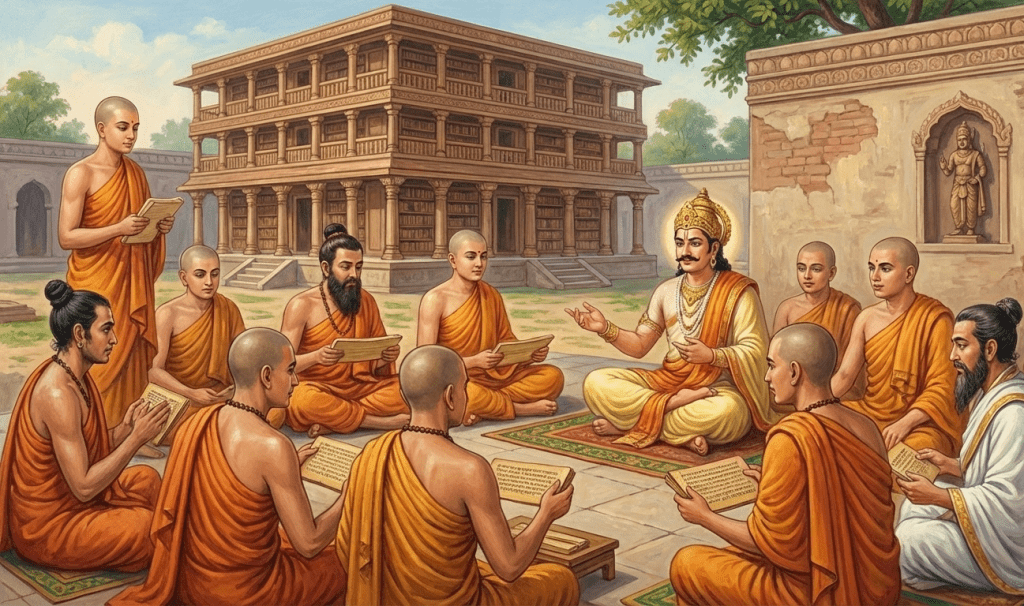
Harshavardhana’s reign (c. 606-647 CE) marked the last great empire of ancient North India. Noted for his patronage of Buddhism (Nalanda), he was defeated by Pulakeshin II. His era is detailed by Banabhatta and Hsuan Tsang.
Reign of Harshavardhana
Reign of Emperor Harshavardhana (c. 590 – c. 647 CE) marks a pivotal, albeit brief, golden age in the history of ancient India. Rising from the ashes of the fragmented Gupta Empire, Harsha, the king of Thanesar (Sthaneshvara) and Kannauj (Kanyakubja), consolidated power over a vast dominion in Northern India. His period, often simply referred to as the Harsha Period, is chronicled extensively through indigenous texts like the Harshacharita by his court poet Banabhatta and the detailed travelogue of the famous Chinese Buddhist pilgrim, Hsuan Tsang (Xuanzang). Harsha’s rule is remembered for its effective administration, patronage of art and culture, religious tolerance, and most significantly, the flourishing of Buddhism. This article explores the key facets of the Harshavardhana era, providing a comprehensive overview for students and history enthusiasts alike.
Also Read: Mauryan Empire
Harsha Military Conquests
Harsha’s ascent to power was rooted in necessity and ambition. After the murder of his elder brother, Rajyavardhana, by the Gauda king Shashanka, Harsha took the throne and swore vengeance.
- The Rise from Thanesar: Harsha first unified the kingdoms of Thanesar and Kannauj, the latter becoming his primary capital, allowing him to command the resources of the rich Gangetic plain.
- The Eastern Campaign: His first major military objective was to defeat the formidable Shashanka of Gauda (Bengal). Though the exact details are debated, the ultimate result was the collapse of the Gauda kingdom after Shashanka’s death. This victory secured Harsha’s control over Bengal and Bihar.
- Conquest of Valabhi: Harsha engaged in a prolonged conflict with the Maitraka king Dhruvabhatta of Valabhi (Gujarat). The conflict was ultimately resolved not by force, but through a diplomatic alliance cemented by the marriage of Harsha’s daughter to the Maitraka king.
- The Southern Stumbling Block: The most significant military setback for Harsha was his campaign against the Chalukya king Pulakeshin II of Badami. A major battle on the banks of the Narmada River (c. 618-619 CE) resulted in a decisive Chalukya victory. This defeat effectively set the Narmada River as the southern boundary of Harsha’s empire.
- Domain Extent: By the zenith of his power, Harsha’s empire stretched from the Himalayas in the north to the Narmada River in the south, and from Valabhi and Sind in the west to Assam (Kamarupa) in the east.
Also Read: Ashoka
Harsha and Buddhism
While Harsha was initially a devout follower of the sun god Surya (a Hindu deity), his religious outlook evolved significantly, largely influenced by the Buddhist scholar Hsuan Tsang and his own sister, Rajyashri.
- Patronage: Harsha became a profound patron of Buddhism, particularly the Mahayana school. He banned the slaughter of animals for food and established numerous viharas (monasteries) and stupas.
- Nalanda University: Harsha gave significant financial and administrative support to the world-renowned Nalanda University, which became the foremost center of Buddhist learning in the world . Hsuan Tsang himself spent many years studying there.
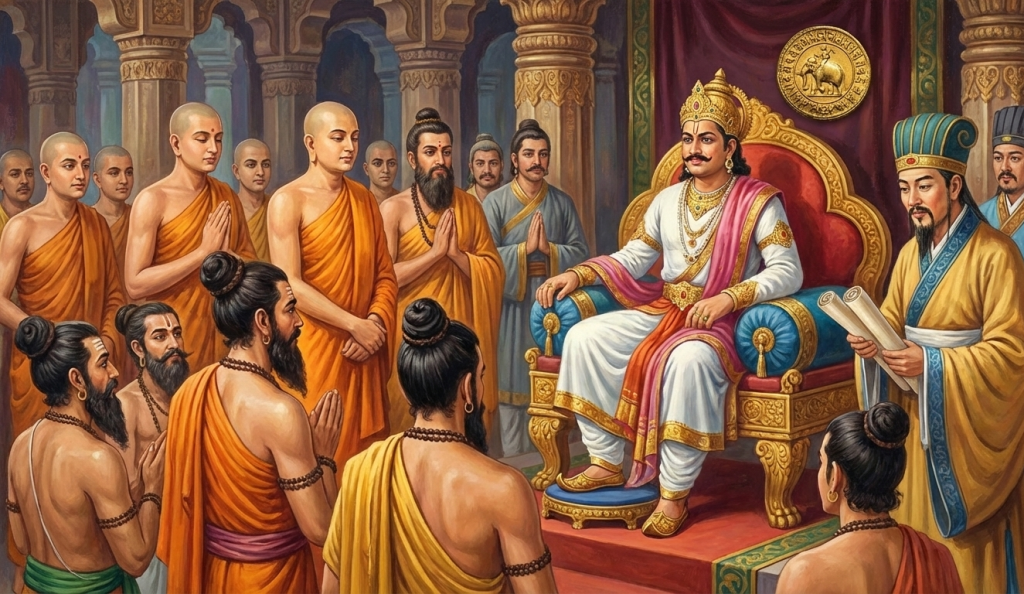
- The Kanauj Assembly (643 CE): Harsha convened a grand assembly at Kannauj to honor Hsuan Tsang and propagate the Mahayana doctrine. The assembly lasted for twenty-one days and was attended by twenty kings, thousands of scholars, and religious figures from various traditions.
- The Prayag Assembly (Moksha Parishad): Every five years, Harsha held a great quinquennial ceremony at Prayag (modern-day Allahabad) called the Moksha Parishad. During this event, he would distribute all the wealth accumulated in the royal treasury to the poor, the needy, and religious practitioners of all sects—Brahmanical, Buddhist, and Jain. Hsuan Tsang’s account vividly describes Harsha’s profound generosity, even giving away his own clothes and jewels.
Also Read: Sangam Period
Administration
Harsha’s administrative framework was largely a continuation of the Gupta system but displayed a tendency towards decentralization and feudalism.
- Central Administration: The king was the supreme authority, but he relied on a Council of Ministers (Mantriparishad). Harsha was known to be a tireless administrator, personally supervising his empire by constant travel and inspection.
- Provincial Administration: The empire was divided into provinces (Bhuktis), which were further subdivided into districts (Vishayas). The key administrative officials were the Mahasandhivigrahaka (Minister of Peace and War), the Mahabaladhikrita (Commander-in-Chief), and the Grāmākṣapaṭalika (Record keeper).
- Revenue System: The primary sources of revenue included the land tax, which was usually fixed at one-sixth of the produce (1/6 of the produce), and taxes on trade and ferries.
- Law and Justice: Hsuan Tsang noted that the penal code was relatively severe compared to the Gupta period, with common use of imprisonment, mutilation, and deportation for serious offenses. However, the overall administration of law was reported to be just and equitable.
- Military: Harsha maintained a large and powerful standing army consisting of infantry, cavalry, and war elephants. The strength of his army, estimated by Hsuan Tsang, reflects the stability and resources of his empire.
Also Read: Gupta Period
Society and Culture
The society under Harsha was characterized by a synthesis of traditions, with significant developments in art, literature, and education.
- Social Structure: The traditional four-fold varna system—Brahmanas, Kshatriyas, Vaishyas, and Shudras—was prevalent, but with a rise in the rigidity of caste rules. Hsuan Tsang’s observations reveal the respect accorded to the Brahmanas and the existence of untouchability.
- Culture and Literature: Harsha himself was an accomplished playwright and poet, credited with writing three Sanskrit plays: Priyadarshika, Ratnavali, and Nagananda. His court was graced by scholars like Banabhatta, whose works Harshacharita (biography of Harsha) and Kadambari are masterpieces of Sanskrit prose.
- Education: Learning flourished, with Nalanda, Valabhi, and Kanauj acting as major educational hubs. The emphasis was on Vedic, Buddhist, Puranic, and secular knowledge.
- Status of Women: The general condition of women was deteriorating, with the practice of sati (widow immolation) becoming more common, especially among the royal and Kshatriya families (as seen in the attempted sati of Harsha’s sister, Rajyashri).
Also Read: Cholas
Economy
The Harsha period was marked by relative prosperity, though a decline in foreign trade compared to the Gupta era suggests a slight shift towards a more localized, self-sufficient economy.
- Agriculture: Agriculture was the backbone of the economy, benefiting from the fertile Gangetic plain. The state took a share of the produce as land revenue.
- Trade and Commerce: Internal trade was vigorous, facilitated by good roads and an organized system of ferries. Key commodities included textiles, salt, and various foodstuffs.
- Urban Centers: Kannauj, Prayag, Nalanda, and Valabhi were significant economic and administrative centers.
- Currency: There is a scarcity of gold coins from Harsha’s reign, leading some historians to believe that the economy was moving towards a greater reliance on barter or silver currency. This contrasts with the abundant gold coinage of the Gupta period.
Also Read: Pandyas
| Feature | Description | Primary Sources |
| Capital | Kannauj (Kanyakubja) | Hsuan Tsang, Banabhatta |
| Key Event | Defeat by Pulakeshin II at the Narmada River | Aihole Inscription |
| Religious Policy | Initially Hindu (Sun worship), later patron of Mahayana Buddhism, and tolerant of all faiths | Hsuan Tsang’s accounts |
| Literature | Harsha (3 plays), Banabhatta (Harshacharita, Kadambari) | Sanskrit Literature |
| Administration | Semi-feudal, decentralized, land tax at 1/6th of produce | Hsuan Tsang, Copper Plates |
Also Read: Cheras
Reign of Harshavardhana, lasting over four decades, was instrumental in bringing a degree of unity and stability to North India after the disintegration of the classical era. His patronage of Buddhism and Nalanda University, his administrative efficiency, and his own literary contributions cemented his legacy as one of the most remarkable figures in ancient Indian history. Following his death in 647 CE, the empire rapidly dissolved, plunging North India into a period of political chaos once again, underscoring that the unity he achieved was largely a product of his exceptional personal charisma and military strength.