
Mauryan Empire (c. 322–185 BCE) was ancient India’s first great empire. Under Ashoka, it reached its peak, transforming its ideology from conquest to Dhamma (moral governance). Sources include the Ashokan Edicts and Kautilya’s Arthashastra, detailing its centralized administration.
Mauryan Empire: Unifying Ancient India
Mauryan Empire (c. 322–185 BCE) stands as a monumental period in ancient Indian history, renowned for being the first empire to unify a substantial part of the Indian subcontinent. Originating from the kingdom of Magadha in the eastern Gangetic plains, its rise marked the transition from smaller regional kingdoms (Mahajanapadas) to a vast, centralized imperial structure. The Mauryan dynasty, founded by Chandragupta Maurya, ushered in an era of political stability, administrative sophistication, extensive trade, and significant cultural developments, culminating in the reign of Emperor Ashoka, whose adoption of Dhamma profoundly influenced governance and propelled the spread of Buddhism across Asia. The study of the Mauryan Empire relies on a rich combination of indigenous texts, foreign accounts, and direct royal inscriptions, allowing for a detailed reconstruction of its political, social, and economic life.
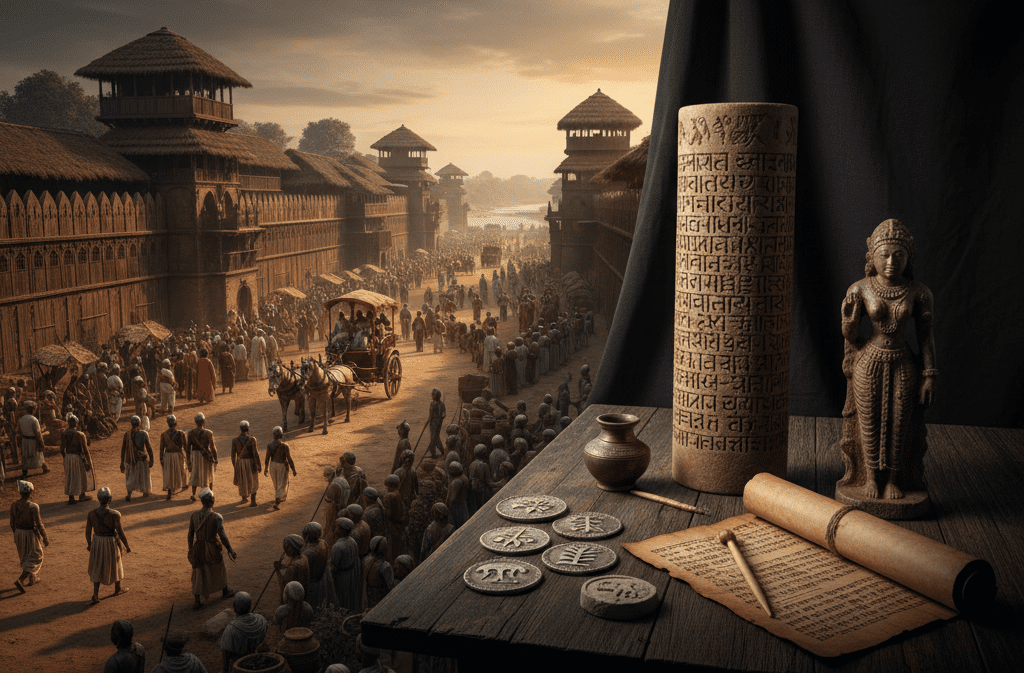
Sources: Inscriptions and Sites
Our detailed understanding of the Mauryan Empire is largely derived from a combination of direct royal pronouncements and archaeological evidence.
- Ashokan Inscriptions: These are the most crucial and primary sources, as they are contemporary royal records. Commissioned by Emperor Ashoka (c. 268–232 BCE), these edicts are engraved on rocks and polished stone pillars across the geographical breadth of the empire. They are usually written in Prakrit using the Brahmi script in the eastern and central regions, and the Kharoshthi script in the northwest, along with bilingual and Greek/Aramaic versions in Afghanistan.
- Content and Classification: The inscriptions are generally classified into Major Rock Edicts (covering Ashoka’s Dhamma policy, welfare measures, and his conversion), Minor Rock Edicts (detailing his personal journey and pilgrimages), and Pillar Edicts (later declarations reinforcing Dhamma and administrative rules).
- Sites: Key sites include the Major Rock Edicts at Kalsi (Uttarakhand), Girnar (Gujarat), and Dhauli and Jaugada (Odisha, providing the special Kalinga Edicts). The elaborate Pillar Edicts are famous for the Lion Capital of Ashoka found at Sarnath, which is now the national emblem of India.
- Archaeological Sites: Excavations have confirmed the material culture and urban life. The capital Pataliputra (modern Patna) reveals evidence of a massive wooden palisade and grand administrative structures mentioned by Megasthenes. The remains of stupas, viharas, and caves, such as those at Sanchi and the Barabar Caves, provide further insight into Mauryan art, architecture, and religious patronage.
Literary Sources (The Arthashastra)
Literary sources, both indigenous and foreign, complement the archaeological data by providing context on political theory, administration, and social life.
- The Arthashastra: This Sanskrit treatise, attributed to Kautilya (also known as Chanakya or Vishnugupta), the minister and mentor of Chandragupta Maurya, is the preeminent source on Mauryan statecraft.
- Content: It is a manual for the successful running of a kingdom, detailing everything from foreign policy, military strategy, espionage, law, and economics, to the minute duties of various government officials.
- Theory: The text lays out the Saptanga Theory (Seven Limbs of the State): Svamin (King), Amatya (Minister), Janapada(Territory/Population), Durga (Fort), Kosha (Treasury), Danda (Army), and Mitra(Ally). It emphasizes the importance of a strong, centralized monarchy and an efficient bureaucracy.
- The Indica: This account, written by Megasthenes, the Greek ambassador to Chandragupta’s court, survives only in fragments cited by later classical authors (e.g., Strabo, Arrian, and Pliny).
- Content: It provides an outsider’s view of Mauryan India, describing the enormous city of Pataliputra, the military organization, the division of society into seven groups (a possible misunderstanding of the Varna system), and the administration of the capital city.
- Puranas and Buddhist/Jain Texts: The Puranas provide genealogical lists of the Mauryan kings. Buddhist texts (like the Dīpavaṃsa and Mahāvaṃsa) and Jain texts (like the Parisistaparvan) offer detailed, though often hagiographical, accounts, particularly concerning the lives of Chandragupta (who is said to have adopted Jainism late in life) and Ashoka.
Rulers and Political History of the Mauryas
The dynasty was founded and sustained by three powerful rulers:
| Ruler | Reign (BCE) | Key Contributions and Events |
| Chandragupta Maurya | c. 322–298 | Founded the empire by overthrowing the Nanda dynasty. Consolidated power in North and Central India. Defeated the Seleucid Greek general Seleucus I Nicator (c. 305 BCE), resulting in a major peace treaty, matrimonial alliance, and the acquisition of large territories (including Aria, Arachosia, Gedrosia, and Paropamisadae). |
| Bindusara | c. 298–272 | Maintained the empire’s vast boundaries and is credited with extending Mauryan control into the Deccan region (peninsular India, excluding the southernmost tip). Known to the Greeks as Amitrochates (from Sanskrit Amitraghata, meaning “Slayer of enemies”). Maintained crucial diplomatic ties with the Hellenic kingdoms. |
| Ashoka | c. 268–232 | Considered the greatest Mauryan ruler. His conquest of Kalinga (modern Odisha) around 261 BCE resulted in immense bloodshed. This event became a turning point, leading to his conversion to Buddhism and the adoption of the policy of Dhamma. His reign saw the empire reach its territorial peak. |
Mauryan Administration
The Mauryan Empire employed sophisticated and highly centralized administrative machinery necessary to govern a territory spanning from the Hindu Kush to the southern Deccan.
- Central Government: The King was the supreme judicial, legislative, and military authority. He was assisted by the Mantriparishad (Council of Ministers). Key high officials, known as Mahamatras or Tirthas, headed various departments:
- Samaharta: Chief Revenue Collector.
- Sannidhata: Chief Custodian of the Treasury.
- Dharmamahamatras: Special officials appointed by Ashoka to propagate and supervise the implementation of Dhamma.
- Provincial Administration: The empire was divided into four main provinces, each governed by a Kumara (royal prince) or a trusted governor. The provinces were:
- Uttarapatha (North-West, Capital: Taxila)
- Avanthipatha (West, Capital: Ujjain)
- Dakshinapatha (South, Capital: Suvarnagiri)
- Prachi (East, Capital: Pataliputra)
The provinces were further subdivided into districts, overseen by officials like the Rajukas (responsible for land assessment and justice) and Yuktas (subordinate officials).
- City Administration: Megasthenes describes the administration of the capital, Pataliputra, as being managed by a body of 30 officials divided into six boards, each overseeing a specific function (e.g., industry, foreign residents, trade, census, manufactured articles).
- Espionage System: The Arthashastra details a highly organized intelligence system (Gudhapurushas), which was crucial for monitoring officials, rebels, and neighboring states.
Foreign Relations
Mauryan foreign policy transitioned from military-strategic under Chandragupta to cultural-diplomatic under Ashoka.
- Hellenic Engagement: Following the treaty with Seleucus I Nicator, diplomatic relations flourished. Greek ambassadors like Megasthenes and Deimachus were resident at the Mauryan court. This interaction facilitated the exchange of scholars, goods, and ideas.
- Ashoka’s Dhamma Vijaya (Conquest through Dhamma): Ashoka’s edicts document his outreach to neighboring and distant kingdoms as part of his policy of moral conquest. He sent goodwill missions, established hospitals, and introduced welfare measures in the domains of his contemporaries:
- Antiochus II Theos (Syria)
- Ptolemy II Philadelphus (Egypt)
- Antigonus Gonatas (Macedonia)
- Magas (Cyrene)
- Alexander (Epirus or Corinth)
- Buddhist Missions: The most enduring foreign policy impact was the propagation of Buddhism. Ashoka sent missions led by monks, including his son Mahinda and daughter Sanghamitra, to Sri Lanka, Burma (Myanmar), and Southeast Asia, successfully establishing Buddhism in those regions.
Decline of the Mauryas
The Mauryan Empire, despite its initial grandeur, began to decline rapidly after the death of Ashoka in 232 BCE.
- Weak Successors: Ashoka’s successors were incapable of maintaining control over such a vast and diverse empire. Internal rifts and short, disputed reigns destabilized the central authority.
- Financial Strain: The immense expenses of maintaining a vast bureaucracy, a standing army, and Ashoka’s widespread charitable and Dhamma works (including the construction of stupas and monasteries) likely exhausted the imperial treasury. The later Mauryan kings resorted to debasing coinage, a sign of economic distress.
- Over-Centralization and Administrative Burden: The administration was heavily reliant on the personal authority and strength of the ruling emperor. Once Ashoka was gone, the lack of effective control from Pataliputra allowed distant provinces like Taxila and Suvarnagiri to assert their autonomy.
- Brahmanical Reaction: Some historians suggest that the anti-sacrificial stance of Ashoka’s Dhamma and his immense patronage of Buddhism alienated the orthodox Brahmanical class, which might have contributed to the empire’s internal weakening.
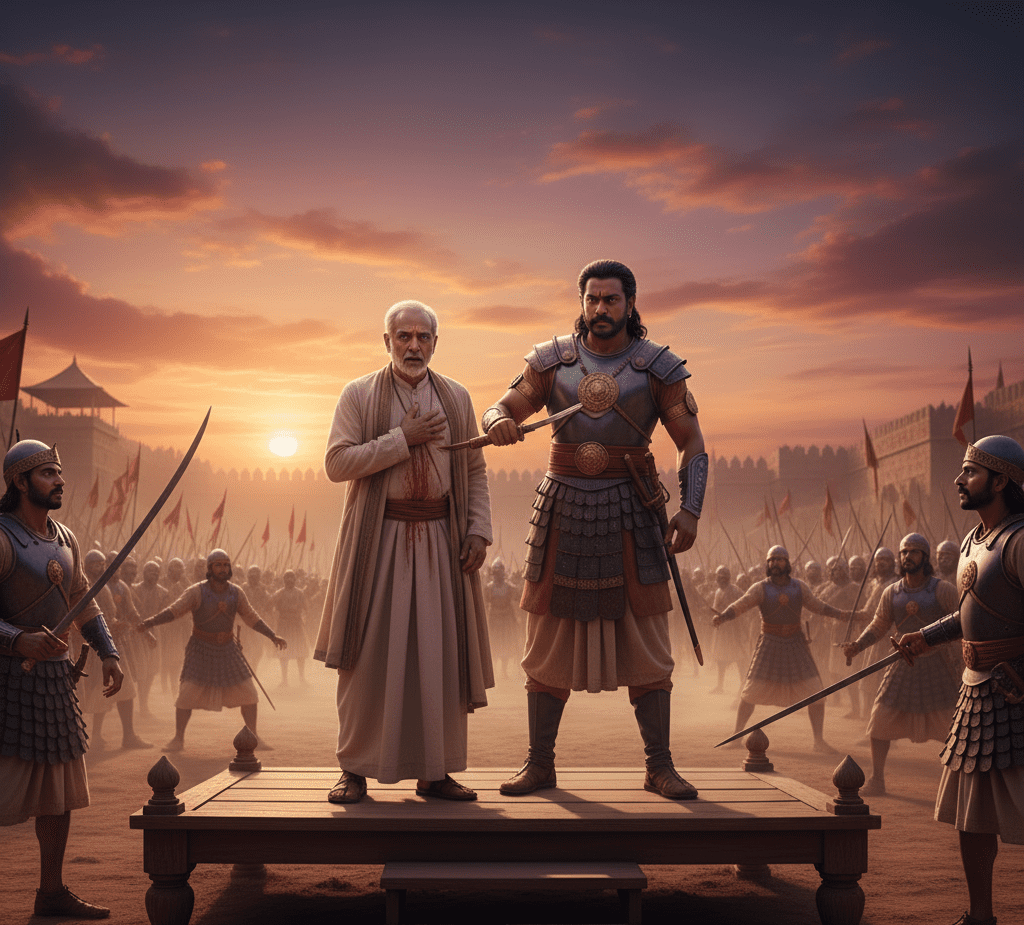
- The Final Blow: The disintegration culminated in the assassination of the last Mauryan ruler, Brihadratha, around 185 BCE by his own Senapati (commander-in-chief), Pushyamitra Shunga. Pushyamitra then founded the Shunga dynasty, reducing the empire to a smaller kingdom centered around Magadha.
Mauryan Empire remains a pivotal epoch in the history of the subcontinent. Its establishment under Chandragupta Maurya marked the birth of a unified political entity in India, underpinned by the sophisticated principles of statecraft detailed in the Arthashastra. The empire reached its zenith under Ashoka, who transformed the state’s ideology through his policy of Dhamma, shifting the emphasis from military conquest to moral and social welfare, simultaneously ensuring the global propagation of Buddhism. Despite its impressive administrative structure and cultural achievements, the empire’s over-reliance on a strong central ruler and resultant fiscal strain led to its rapid collapse after Ashoka. Nevertheless, the Mauryan legacy—manifested in its exemplary art, architecture, coinage, and the enduring ethical values of Ashoka’s Dhamma—continues to inspire and inform modern Indian identity, a testament to its profound historical significance.