
Discover the Gupta Golden Age (320-550 CE): India’s classical era of art, science (zero, rotation of Earth), and Sanskrit literature (Kālidāsa). Learn about key rulers like Chandragupta II and the advanced administration and culture.
Gupta Period (c. 320 – 550 CE)
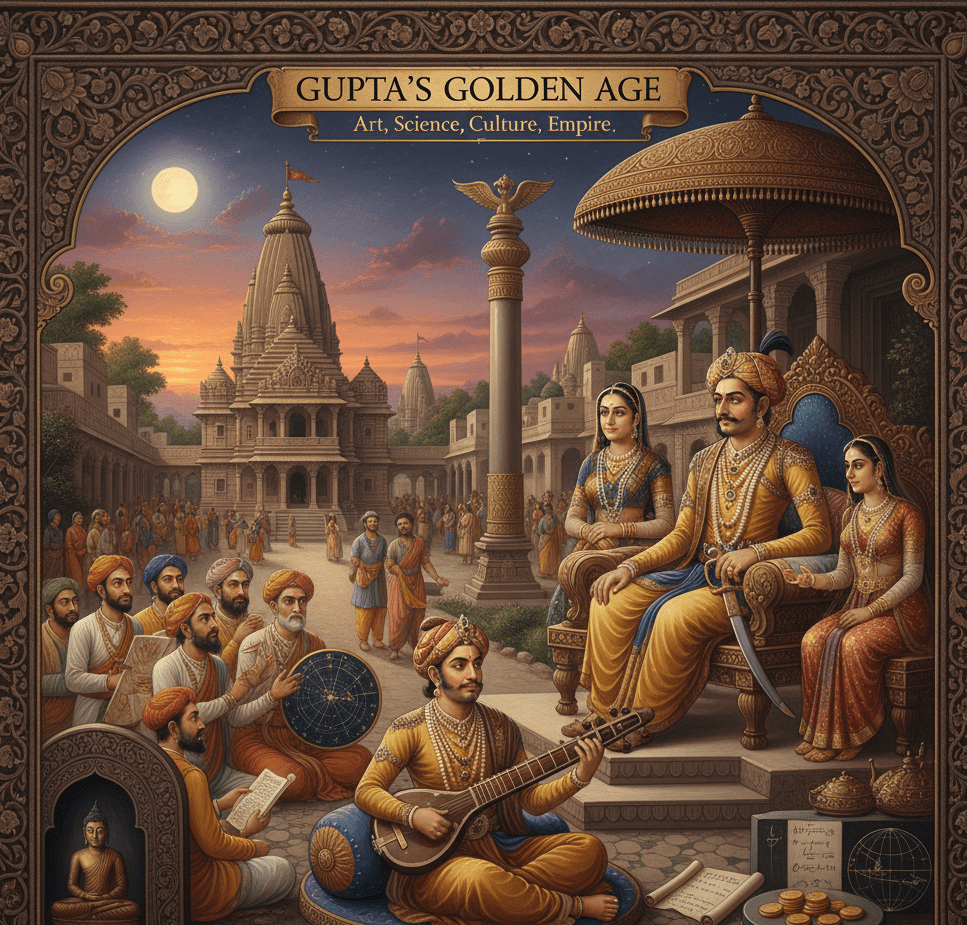
Gupta Empire, which dominated the Indian subcontinent from the early 4th to the mid-6th century CE, is widely celebrated as the “Golden Age of India.” This era witnessed unprecedented advancements in administration, law, science, technology, arts, and literature, establishing classical standards that profoundly influenced the subsequent trajectory of Indian culture. Emerging after the fragmentation that followed the collapse of the Mauryan Empire and the decline of the Kuṣāṇa power, the Guptas brought political unity and stability to a large part of North India, fostering an environment where prosperity and intellectual achievements flourished.
Also Read: Asoka
Sources of Gupta Rule
Our detailed understanding of the Gupta Empire is derived from a rich confluence of indigenous and foreign records, offering complementary views of its political, social, and cultural life.
- Literary Sources:
- Puranas: Texts like the Vayu, Vishnu, and Matsya Puranas contain valuable genealogies and geographical descriptions, helping scholars map the original territories and trace the lineage of the early Gupta kings.
- Classical Sanskrit Literature: The works of the court poet Kālidāsa, such as the epic poem Raghuvaṃśa (narrating the lineage of the Raghu dynasty) and the play Abhijnana Shakuntalam, offer sophisticated insights into court life, societal values, and the high level of cultural refinement achieved. Other significant plays like Devichandraguptam and Mudrarakshasa provide narrative, though sometimes contested, accounts of political events and rivalries.
- Inscriptions: These are the most reliable sources for political history.
- The Prayāga Praśasti (Allahabad Pillar Inscription), composed by Hariṣeṇa, is a panegyric detailing the extensive military conquests of Samudragupta across North and South India, classifying the conquered kingdoms into various categories based on their treatment by the emperor.
- The Mehrauli Iron Pillar Inscription records the conquests of a king named ‘Chandra’ (generally identified with Chandragupta II), showcasing the advanced level of Gupta metallurgy.
- Numismatic Evidence: The vast array of gold coins (dinars) issued by the Guptas is unparalleled in Indian history. These coins not only depict the rulers in various roles (e.g., Samudragupta playing the veena, Chandragupta II slaying a lion) but also bear important titles and religious symbols, providing insights into their military prowess, royal ceremonies, religious beliefs, and economic prosperity.
- Foreign Accounts: The detailed travelogue of the Chinese Buddhist pilgrim Fahien provides a crucial external perspective on the socio-economic and administrative condition of the empire during the reign of Chandragupta II.
Rulers and Political History of Guptas Chronology
The political history of the Guptas is marked by a steady territorial expansion and military consolidation until the mid-5th century CE.
- Sri Gupta (Founder): Started with a small kingdom, likely in parts of Magadha and Bengal.
- Chandragupta I (c. 319–335 CE): Recognized as the first truly sovereign and pivotal ruler. He adopted the imperial title Maharajadhiraja and secured a significant political and territorial advantage by marrying the Lichchhavi princess Kumāradevī. His ascension in 319 CE marks the beginning of the Gupta Era, a formal calendar system.
- Samudragupta (c. 335–375 CE): Known as the greatest military genius of the dynasty. The Prayāga Praśasti describes his policy of Digvijaya (conquest) followed by Dharma Vijaya (righteous conquest) where he defeated twelve rulers in the South and annexed most of the northern kingdoms. His patronage of the arts earned him the title Kavirāja.
- Chandragupta II (Vikramāditya) (c. 375–415 CE): His reign represents the zenith of the empire’s power and cultural achievements. He successfully crushed the Western Kshatrapas (Shakas) of Gujarat and Malwa, securing access to valuable sea trade routes and earning the title Śakāri (destroyer of Shakas). His court was famously adorned by the Navaratnas (Nine Gems), a circle of eminent scholars.
- Kumaragupta I (c. 415–455 CE): His rule was generally peaceful and prosperous. He is primarily credited with founding the famous Nālandā Mahāvihāra, which grew into one of the world’s first great residential universities.
- Skandagupta (c. 455–467 CE): The last major Gupta emperor. He successfully repelled the initial, devastating invasions of the Hunas (Hephthalites), preserving the integrity of the empire, though the military campaigns severely depleted the imperial treasury.
Also Read: Foreign Invasions
Foreign Travellers Visit – Fahien’s Visit
The Chinese Buddhist monk Fa-hien (Fāxiǎn) travelled across India between 399 and 414 CE, primarily seeking Buddhist scriptures and visiting pilgrimage sites. His observations are critical for understanding the Gupta heartland, especially Magadha, under Chandragupta II.
- Administration and Law: Fahien noted the remarkable mildness of the administration. The government did not resort to heavy taxation, forced labour was absent, and officials were adequately paid. Crimes were generally punished by fines, and the death penalty was rare, suggesting a relatively sophisticated and humane justice system.
- Social Life and Economy: He described the people as numerous, prosperous, and happy. The system of Chāṇḍālas (untouchables) living outside the main cities was noted, highlighting social stratification. He remarked that most people abstained from eating meat, onions, or garlic, reflecting a spread of non-violence (Ahimsa).
- Religious Landscape: Although the Gupta rulers were Hindus, Fahien observed the flourishing state of Buddhism in its major centres. He noted numerous monasteries and stupas, but he also highlighted the harmonious coexistence between Buddhists, Hindus, and Jains, underscoring the era’s religious tolerance.
Also Read: Mauryan Empire
Gupta Administration
The Gupta administration was characterized by a move towards decentralization compared to the highly centralized Mauryan model. While the king remained the supreme head, the administration relied on a strong hierarchy of provincial and local officers and the growing use of hereditary posts.
- The King: Assumed high-sounding titles like Maharajadhiraja, Parama-bhaṭṭāraka, and Chakravartin (Universal Ruler), often claiming divine sanction, symbolizing the imperial structure.
- Central Officials: Key administrative titles included:
- Mahābalādhikṛta: Commander-in-Chief of the armed forces.
- Mahāsandhivigrahika: Responsible for foreign affairs, including peace and war treaties.
- Kumārāmātya and Amātya: A class of civil servants and high officials who served as ministers, provincial governors, or district officers, indicating the fluidity of administrative roles.
- Provincial Structure: The empire was divided into:
- Desas/Bhuktis (Provinces), governed by Uparikas (Governors) or royal princes.
- Vishayas (Districts), under the authority of a Vishayapati.
- Local Governance: At the district and village level, local bodies gained importance. The Vishaya Adhikaranas (District Offices) included local representatives like the Nagaraśreṣṭhin (chief banker/merchant) and Sārthavāha (chief caravan trader), ensuring local interests were represented in administration. The village, led by the Grāmika or Grāmādhyaksha, remained the fundamental unit.
Other Important Dynasties
The Gupta period and its immediate aftermath saw the co-existence and rise of several other significant regional powers.
- Vākāṭakas: This powerful dynasty ruled the Deccan (modern Maharashtra and Madhya Pradesh) contemporaneously with the Guptas. The strategic marriage of Chandragupta II’s daughter, Prabhāvatīguptā, to the Vākāṭaka King Rudrasena II, secured a vital southern frontier and allowed the Guptas to focus on the Western Kshatrapas. The Vākāṭakas were great patrons of art, particularly evident in the cave temples of Ajanta.
- Maitrakas of Valabhi: They established an independent kingdom in the Saurashtra region (Gujarat) following the Gupta decline and ruled for several centuries, becoming a major centre for Buddhist learning.
- Maukhāris: Ruling in the region of Kanauj (UP) and parts of Magadha, they initially served as subordinates but rose to challenge the Later Guptas, establishing a powerful kingdom that played a crucial role in the post-Gupta political scene.
Society, Religion, and Culture
Society
The Gupta age solidified many features of classical Indian society.
- Caste and Stratification: The Varna system became more rigid, marked by the proliferation of numerous sub-castes (Jatis), often based on specialized professions. The Brahmins ascended to a position of paramount social and religious authority, often receiving tax-free land grants (Agrahāras) from the kings.
- Status of Women: Generally declined. They were increasingly excluded from education, and practices like early marriage and occasional evidence of Sati (widow immolation) among the upper classes began to appear, contrasting with the relative freedom women enjoyed in earlier periods.
- Family Structure: The joint family system was the prevailing social unit, with the father (Graṃha-pati) holding ultimate authority.
Religion
- Revival of Hinduism (Brahmanism): The Gupta rulers were staunch Bhāgavatas (devotees of Viṣṇu) but practiced exemplary religious tolerance. This period is often marked as the culmination of the evolution of the Purāṇic religion. Deities like Viṣṇu, Śiva, and various Goddess forms rose to immense prominence.
- Temple Worship: The shift from Vedic sacrificial rituals to temple-based idol worship was formalized. The Puranas, which narrate the myths and legends of the major deities, were compiled and edited in their final form during this time.
- Other Religions: Though Hinduism flourished, Buddhism and Jainism continued to thrive, evident from the patronage received at centres like Nālandā (Buddhist) and Valabhi (Jain).
Culture (Art and Architecture)
The art and architecture of the Gupta period represent a culmination of earlier Indian styles, characterized by a refined classicism.
- Architecture (Temple): This era saw the genesis of distinct Hindu temple architecture. The Daśāvatāra Temple at Deogarh (Lalitpur, UP) is a famous example, featuring a square sanctum (garbhagṛha) and an enclosed ambulatory path, marking the early stages of the North Indian Nagara style. Brick temples, such as the one at Bhitargaon, were also prominent.
- Sculpture: The Gupta style is known for its spiritual expression, serene beauty, and ideal naturalism. The standing and seated Buddha statues from Sarnath are quintessential examples, noted for their graceful drapery, subtle smiles, and absence of ornamentation.
- Painting: The frescoes of the Ajanta Caves (Caves XVI and XVII) reached their peak under the Vākāṭakas (who had Gupta connections). These paintings depict scenes from the Jātaka tales with unparalleled skill in form, colour, and emotional depth.
Urban Centres in Gupta Period
While some decline in urban intensity was noted compared to the peak of the Kuṣāṇa period, several cities remained vibrant hubs of commerce, culture, and administration.
- Pāṭaliputra: Remained the majestic imperial capital, strategically located near river routes.
- Ujjain: Served as a highly significant political and commercial hub, sometimes functioning as a secondary capital, especially under Chandragupta II, controlling the routes to the western coast.
- Vārāṇasī (Banaras): A major centre for textiles and religious learning.
- Mathura: Continued its role as a key religious and artistic centre, famous for its red sandstone sculpture school.
- Broach (Bharuch/Bharukaccha): The most important port on the western coast, handling crucial overseas trade, particularly with the Roman Empire and Southeast Asia.
Economy
The Gupta period is marked by great economic prosperity, supported by effective agricultural administration and extensive trade networks.
- Agriculture and Land Revenue: Agriculture remained the chief source of income. Land was meticulously surveyed and classified. The king was the theoretical owner of the land, and the primary source of state income was Bhāga (King’s share of the produce, typically 1/6th) and various other taxes like Bali (emergency tax) and Uparikara (tax on temporary tenants).
- Trade and Commerce: Internal trade was facilitated by well-maintained roads and efficient provincial governance. Trade with Southeast Asia and China continued to thrive via the eastern ports, although trade with the Roman Empire witnessed a decline towards the later part of the period.
- Coinage: The sheer volume and purity of the Gold Dinars (initial purity often over 90%) attest to the economic buoyancy and the vast wealth of the state, likely accumulated through land revenue and trade profits.
Science and Technology
The Gupta era is justly celebrated for its foundational contributions to mathematics, astronomy, and metallurgy, many of which were transmitted globally.
- Mathematics and Astronomy:
- Āryabhaṭa I (c. 476 CE): The most towering figure. His work, the Āryabhaṭīya, explains the concept of zero and the place-value decimal system, calculates the value of $\pi$ with high accuracy (as $3.1416$), and presents the first sophisticated theory that the Earth is spherical and rotates on its axis, causing day and night.
- Varāhamihira: A versatile polymath whose major work, the Pañcasiddhāntikā, is a treatise on five astronomical schools. His work, the Bṛhat Saṃhitā, is an encyclopaedia dealing with various subjects from astronomy to botany.
- Metallurgy: The Mehrauli Iron Pillar provides stunning proof of the Guptas’ technological mastery. This massive, rust-resistant pillar, forged with a high phosphorus content, demonstrates ancient Indian iron-making skill unmatched globally for centuries.
- Medicine: Suśruta and Caraka‘s earlier works were studied and systematized. Dhanvantari, revered as the god of medicine, was reputedly one of the Navaratnas, indicating royal patronage of medical science.
Literature
The Gupta period is the classical age of Sanskrit literature, characterized by a flowering of sophisticated poetry and drama.
- Kālidāsa: Often considered the greatest poet and dramatist in the Sanskrit language. His masterpieces include:
- Plays: Abhijnana Shakuntalam (regarded as one of the finest love stories in world literature), Vikramōrvaśīyam, and Mālavikāgnimitram.
- Epics/Poetry: Raghuvaṃśa and Kumārasambhava.
- Lyrical Poetry: Meghadūta (The Cloud Messenger).
- Puranas and Epics: The final redaction and standardization of the major Puranas (like the Vishnu, Vāyu, and Bhāgavata Puranas) and the great national epics, the Ramayana and the Mahabharata, took place during this era, defining the narrative core of Hinduism.
- Fables and Prose: The Pañcatantra, a collection of moral fables in prose and verse, was likely composed by Viṣṇuśarman during this time, becoming an internationally translated work.
- Grammar: Amarasiṃha composed the Amarakośa, an essential Sanskrit thesaurus and dictionary.
Later Guptas
The period following Skandagupta’s death was marked by a steady decline fueled by internal and external pressures.
- Huna Invasions: Although initially repelled, the relentless invasions of the Hunas (Alchon Huns) under Toramāṇa and Mihirakula from the late 5th century severely drained the empire’s financial and military resources, particularly in the western regions.
- Rise of Feudatories: The weakening central authority led powerful feudatories, such as the Maitrakas of Valabhi, the Maukhāris, and the Later Guptas of Magadha (a separate collateral branch), to assert their independence, leading to territorial fragmentation.
- Economic Strain: The continuous warfare and the gradual decrease in the purity of the later Gupta gold coinage (reflecting economic stress) indicate the empire’s decline. By the mid-6th century, the Gupta Empire as a centralized entity ceased to exist, giving way to the fragmented political structure that characterized the subsequent era.
Gupta period, often termed the “Golden Age,” was a transformative epoch in Indian history. It institutionalized the classical forms of Hindu temple architecture, refined Sanskrit literature to its greatest heights through the genius of Kālidāsa, and made fundamental contributions to world science, notably in mathematics and astronomy by Āryabhaṭa. While the empire eventually succumbed to external invasions and internal decentralization, its administrative structures, legal codes, and artistic achievements established a lasting legacy, serving as the blueprint for Indian civilization in the centuries that followed and profoundly influencing the cultural landscape of Southeast Asia.