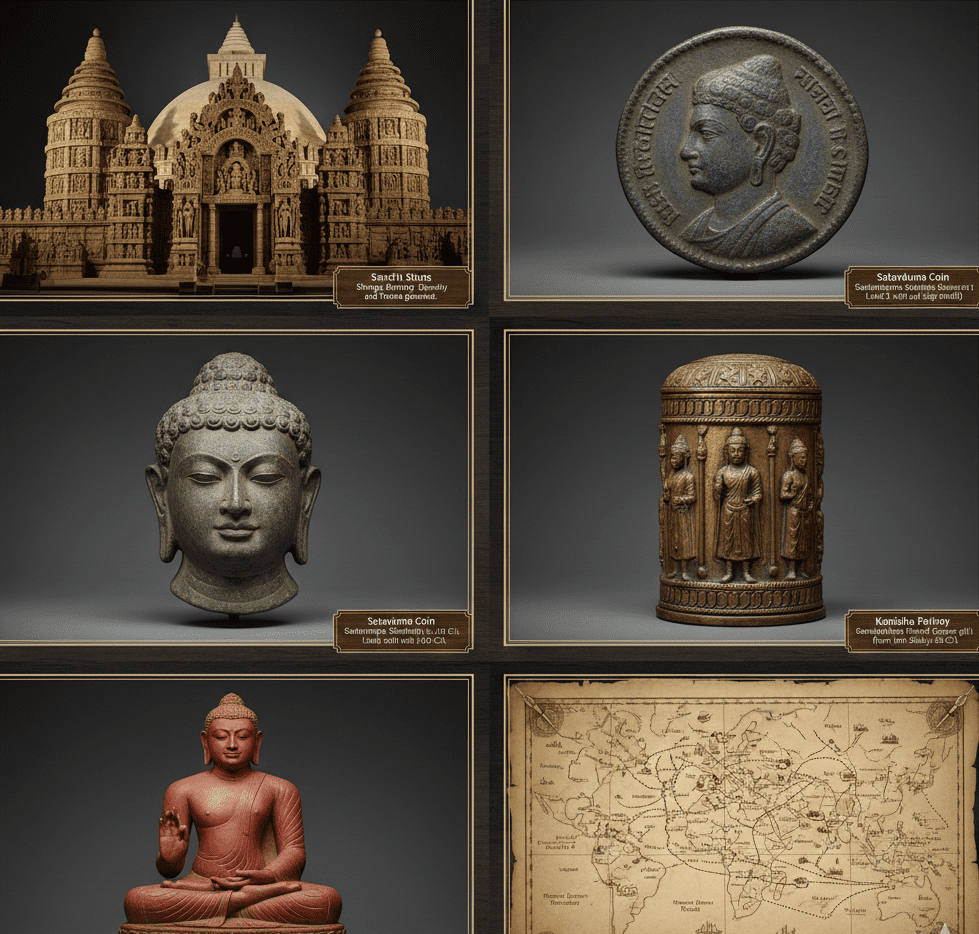
Discover Post-Mauryan India (185 BCE–320 CE): A period of transition featuring regional powers like the Satavahanas, Shungas, and Kanvas, and foreign empires like the Kushanas under Kanishka. Learn about the flourishing trade and the evolution of the Jati social system.
Post-Mauryan India (c. 185 BCE – 320 CE)
The period immediately following the dissolution of the Mauryan Empire around 185 BCE marks a critical phase in Indian history, often termed the Post-Mauryan Age. This era, extending up to the rise of the Gupta Empire in the 4th century CE, was characterized by political decentralization and the simultaneous emergence of several powerful regional kingdoms and foreign principalities across the subcontinent. Despite political fragmentation, this age witnessed remarkable continuity and growth in cultural, economic, and social spheres, including the evolution of the Jati system, the establishment of lucrative international trade routes, and the flourishing of distinctive artistic and religious traditions under diverse dynasties like the Shungas, Kanvas, Satavahanas, Sakas, and Kushanas.
Also Read: Mauryan Empire
Political Landscape: Indigenous Dynasties
The heartland of the Mauryan Empire in Magadha and Central India initially saw the rise of indigenous powers, which struggled to maintain the territorial integrity of the former empire.
Sungas and Kanvas (North/Central India)
- Shunga Dynasty (c. 185 – 73 BCE):
- Foundation and Rule: The dynasty was established by Pushyamitra Shunga, a Brahmin general who assassinated the last Mauryan king, Brihadratha. Their rule was centered around Pataliputra, but their territory was significantly smaller than the Mauryan Empire, controlling mainly Magadha and parts of Central India.
- Brahmanical Revival: This period is associated with a renewed emphasis on Brahmanical Hinduism. Pushyamitra Shunga is recorded to have performed two Ashvamedha sacrifices, symbolizing the resurgence of orthodox traditions.
- Culture and Literature: The Shunga court patronized Sanskrit literature. The grammarian Patanjali, author of the Mahabhashya (a commentary on Panini’s grammar), is often placed in this period.
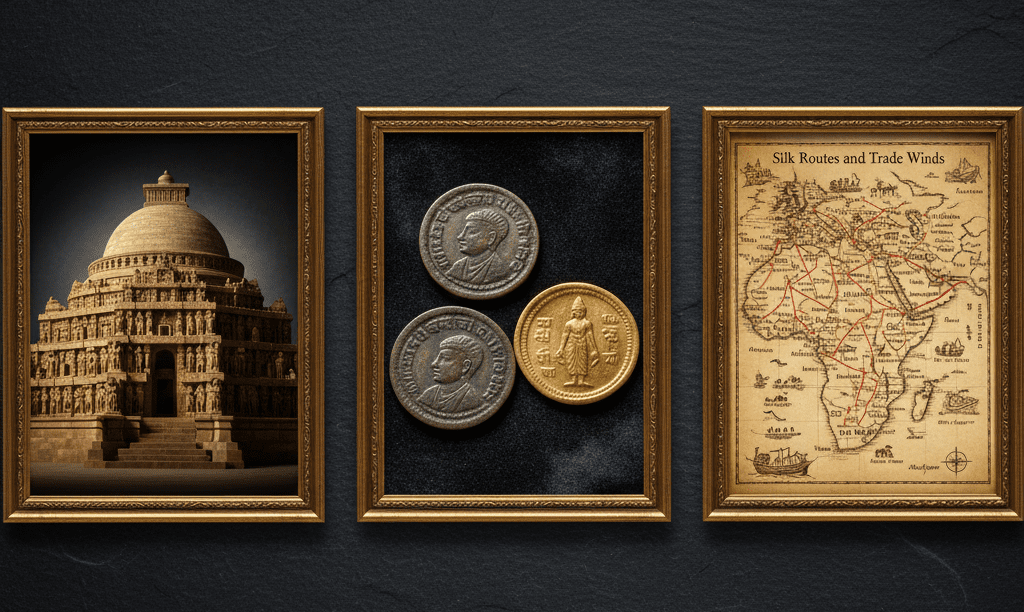
- Art and Architecture: They are credited with the expansion and enclosure of the Sanchi Stupa and the construction of the railings at the Bharhut Stupa, often utilizing stone to replace earlier wooden structures.
- Kanva Dynasty (c. 73 – 28 BCE):
- Decline of Magadha: The Kanvas succeeded the Shungas but were a very short-lived dynasty, marking the final, and geographically restricted, phase of Magadhan rule before the region was overshadowed by other, more powerful emerging polities.
Satavahanas (Deccan)
- Geographical Dominance: The Satavahanas (also known as the Andhras) established their authority in the Deccan, controlling vital trade routes between the north and the south, and linking the coastal ports. Their rule is generally placed from the 1st century BCE to the 3rd century CE.
- Key Rulers and Conflicts:
- Simuka is traditionally named as the founder. The dynasty faced prolonged and intense conflict with the Western Kshatrapas (Sakas).
- Gautamiputra Satakarni (c. 106–130 CE) is considered the most illustrious ruler. His achievements, including the destruction of the Sakas, Yavanas, and Pahlavas, are detailed in the Nasik Prasasti (inscription) by his mother, Gautami Balashri. He is famed for reviving the dynasty’s glory.
- Vashishtiputra Pulamavi and Yajna Sri Satakarni also maintained a large empire and engaged in overseas trade.
- Administration and Society: Their administration was decentralized, featuring feudatories like the Maharathis and Mahabhojas. Satavahana kings often used Matronymics (e.g., Gautamiputra, Vashishtiputra), suggesting a possible link to matrilineal social practices, although the succession remained patrilineal.
- Culture: They primarily used Prakrit as their official language. King Hala compiled the famous collection of Prakrit poems, the Gathasattasai (Saptasataka). They patronized both Brahmanism and Buddhism, evident in rock-cut architecture like the Karle Chaitya and the stupas at Amaravati and Nagarjunakonda.
Also Read: Foreign Invasions
Political Landscape: Foreign Influx
The political instability in the North-West allowed several successive waves of Central Asian tribes to enter and establish powerful kingdoms in the Indian subcontinent.
Sakas (Indo-Scythians)
- Entry and Divisions: The Sakas (Scythians) followed the Indo-Greeks into India. They established five main branches in different regions: Afghanistan, Punjab (capital at Taxila), Mathura, Western India, and the Upper Deccan.
- Western Kshatrapas: The most powerful and enduring branch was the Western Kshatrapas (ruling parts of Gujarat and Malwa).
- Rudradaman I: The most famous Saka ruler was Rudradaman I (c. 130–150 CE), whose achievements are recorded in the Junagarh/Girnar inscription (dated 150 CE). This inscription is significant as it is the first extensive record to be composed in highly refined Sanskrit prose. It details his successful repair of the Sudarsana Lake originally built during the Mauryan period.
Kushanas
- Origin and Expansion: The Kushanas were a branch of the Yuezhi tribe from Central Asia. They succeeded the Sakas and Pahlavas, eventually establishing an empire that stretched from Central Asia (Turan and Bactria) into North India.
- Founders: Kujula Kadphises established the first unified Kushana kingdom, and his son, Vima Kadphises, extended the empire into Northwestern India and was the first to issue a large number of gold coins in India.
Kanishka (c. 78 CE – 100 CE)
- The Greatest Ruler: Kanishka is the most celebrated ruler of the Kushana dynasty, marking the zenith of their power.
- Saka Era: His accession is traditionally associated with the beginning of the Saka Era in 78 CE, a calendar system still used in India.
- Capital and Extent: His empire included the Gandhara region (modern Pakistan/Afghanistan) and a large part of North India. His capital was Purushapura (modern Peshawar).
- Patronage of Mahayana Buddhism: Kanishka was a great patron of Buddhism. He convened the Fourth Buddhist Council in Kundalvana (Kashmir) to settle disputes within the faith, which led to the formal schism and the spread of Mahayana (Great Vehicle) Buddhism.
- Culture and Learning: His court was a hub of intellectual activity, hosting renowned scholars like the Buddhist philosopher Asvaghosha (author of the Buddhacharita), the physician Charaka (author of the Charaka Samhita), and the Buddhist scholar Nagarjuna.
- Economic Control: The Kushanas controlled a significant portion of the Silk Route, facilitating flourishing trade and leading to the minting of abundant gold and copper coinage, indicating great prosperity.
Society: Evolution of Jatis
The Post-Mauryan period witnessed profound changes in the social structure, primarily driven by economic expansion and the absorption of foreign ethnic groups.
- Absorption and Sanskritization: The influx of foreign ruling groups (Indo-Greeks, Sakas, Parthians, and Kushanas) necessitated their integration into the existing social framework. Brahmanical texts, like the Manusmriti, gradually accorded them a status within the Varna system, often classifying them as Vratya Kshatriyas (degraded warriors) to legitimize their rule while maintaining the purity of the four Varnas.
- Proliferation of Jatis (Sub-Castes): The increase in trade and craft specialization led to the emergence of numerous occupational groups, such as goldsmiths, weavers, and oil millers. Each of these endogamous professional guilds (or Shrenis) solidified into distinct Jatis (sub-castes). This process transformed the relatively simple four-fold Varna system into the highly complex, fragmented Jati-based hierarchy, marking a critical step in the development of the modern caste system.
- Influence of the Merchant Class: The booming international and internal trade led to the vast enrichment of the Vaisya (merchant) class, which wielded immense economic and social power. Their wealth was often channeled into religious endowments, especially to Buddhist and Jain monasteries, as evidenced by numerous donor inscriptions.
- Position of Women: Generally, the status of women saw a gradual decline, with greater restrictions on their mobility and rights. However, notable exceptions exist, such as the power held by royal mothers like Gautami Balashri of the Satavahanas.
Art, Culture, and Economy
- Religious Developments: The Kushana period saw the growth of Mahayana Buddhism, characterized by the worship of images of the Buddha and Bodhisattvas, marking a major change from early Hinayana practices. This development significantly influenced artistic production.
- Artistic Schools: Two major schools of art flourished:
- Gandhara School: Patronized heavily by the Kushanas, this school developed in the North-West (modern Peshawar region) and represents a fusion of Indian and Greco-Roman sculptural traditions, particularly in depicting the Buddha.
- Mathura School: This school was purely indigenous, centering around Mathura. It produced vibrant images of the Buddha, Jain Tirthankaras, and various Hindu deities, showing a transition towards the classical Indian sculptural style.
- Economy and Trade: The period was an economic peak. The control over the Silk Route and the use of the Monsoon Winds for maritime trade with the Roman Empire led to an unprecedented influx of wealth, particularly Roman gold coins (denarii). Craft specialization, supported by powerful merchant and craft guilds (Shrenis), thrived in urban centers like Taxila, Mathura, Ujjain, and Arikamedu.
Also Read: Asoka
Post-Mauryan period, though politically fragmented, was far from an age of decline. It was a time of immense synthesis and dynamic transition. The confluence of indigenous political shifts (Shungas and Satavahanas) and the assimilation of foreign groups (Sakas and Kushanas) fundamentally reshaped the social fabric, giving rise to a more complex Jati structure. Economically, the control of global trade routes brought prosperity, while religiously and culturally, the rise of Mahayana Buddhism and the distinct art forms of Gandhara and Mathura left an indelible mark. This era successfully bridged the vast, centralized Mauryan Empire with the classical age of the Guptas, establishing many of the core features that would define the subsequent history of the subcontinent.