
Persian and Macedonian invasions fundamentally reshaped ancient India. Darius I’s conquest established the wealthy Hindus satrapy, while Alexander’s brief campaign fractured the Northwest’s polities. These events introduced Hellenistic culture, boosted trade, refined administrative systems, and paved the way for the unified Mauryan Empire.
Foreign Invasions
The history of ancient India is punctuated by periods of profound transformation resulting from external contacts and foreign invasions. Among the earliest and most consequential incursions were the Persian Invasions of the 6th century BCE and Alexander’s Invasion in the 4th century BCE. These events, focused primarily on the northwestern frontiers of the subcontinent, did more than merely redraw political boundaries; they inaugurated significant changes in trade routes, monetary systems, administrative practices, and cultural exchange. This article systematically examines the nature of these invasions, their immediate and long-term consequences on Indian society, economy, and administration, and their role in setting the stage for the rise of the Mauryan Empire.
Persian Invasions
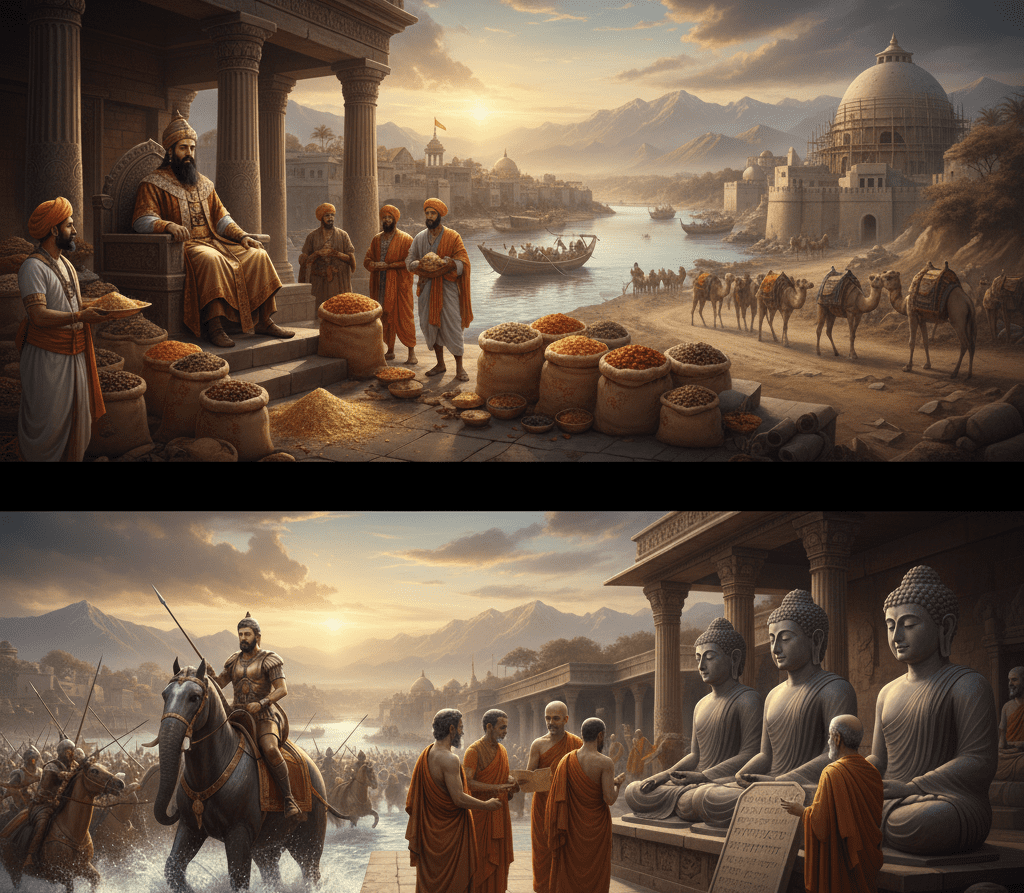
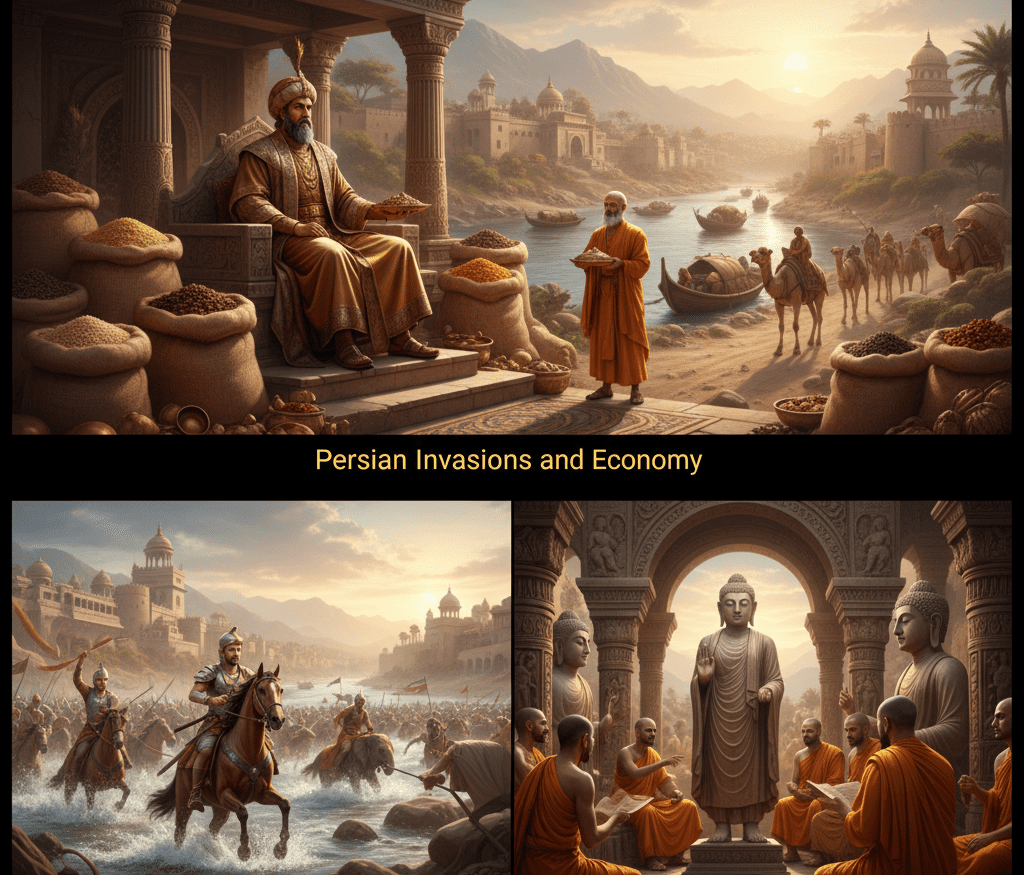
The Persian Empire, under the Achaemenid dynasty, became the first major foreign power to penetrate the Indian subcontinent in the late 6th century BCE, driven by territorial expansion and the desire to control prosperous trade routes.
The Achaemenid Conquests
- Cyrus the Great (c. 550 BCE): Cyrus, the founder of the Achaemenid Empire, is traditionally credited with conquering the Indian tribe of the Kambojas and extending his dominion up to the region of Gandhara (modern-day eastern Afghanistan and northwestern Pakistan).
- Darius I (c. 518 BCE): The most significant Achaemenid conquest was completed by Darius I. Inscriptions, such as the Behistun and Persepolis inscriptions, confirm the incorporation of the region of Sindh and parts of the Punjab into the vast Persian Empire. This new Indian province was designated as Hindus (derived from the river Indus) and was the 20th Satrapy (province) of the Achaemenid Empire.
- Xerxes I: Darius’s successor, Xerxes, employed Indian infantry and cavalry units in his campaigns against the Greeks, notably at the Battle of Plataea.
Economic and Cultural Exchange
The inclusion of the Northwest in the Achaemenid Empire had several key impacts:
- Tribute: The Hindus satrapy was the most populous and reportedly paid the largest tribute to the Persian Empire, estimated at 360 talents of gold dust annually.
- Trade Routes: Persian control facilitated the development and security of overland trade routes, which would later prove vital for commerce between India and Western Asia.
- Script: The Kharosthi script, written from right to left, which later became prominent in northwestern India, is believed to have been introduced through Achaemenid influence, likely derived from the Aramaic script used by the Persian administration.
- Art and Architecture: Elements of Persian art and architecture, particularly in monumental construction, are discernible in later Indian styles, notably the bell-shaped capitals of the Mauryan Pillars.
Alexander’s Invasion
Following the decline of the Achaemenid Empire, the Macedonian forces arrived. Alexander III of Macedon (Alexander the Great) launched his campaign into India in 326 BCE.
The Campaign in the Northwest
Having defeated the last Achaemenid King, Darius III, Alexander crossed the Hindukush mountains and moved into the Indian subcontinent.
| Year (BCE) | Event | Significance |
| 327 | Crosses Hindukush | Entry into the Indian subcontinent. |
| 326 | Battle of the Hydaspes | Decisive victory over King Porus (Puru) on the banks of the Jhelum (Hydaspes) river. |
| 326 | March halted at the Beas | His army mutinied on the banks of the Hyphasis (Beas) river, refusing to march further east towards the powerful Magadha kingdom. |
| 325 | Beginning of Retreat | Alexander turned back, dividing his forces, with one column moving overland and the other by sea down the Indus. |
| 323 | Death of Alexander | Alexander died in Babylon, leading to the rapid dissolution of the eastern part of his empire. |
Impact of the Macedonian Campaign
While politically short-lived, Alexander’s invasion had profound, long-term consequences:
- Establishment of Direct Routes: The campaign opened up four distinct land and sea routes between India and the West, permanently boosting trade and cultural exchange.
- Political Consolidation: The invasion shattered the power of numerous small, independent chiefdoms in the Northwest. This political vacuum and the experience of unified resistance contributed to the rise of the Mauryan Empire under Chandragupta Maurya, who effectively utilized the new political environment.
- Historiography: The Greek accounts of the campaign provide the first definitive and systematic chronological records and geographical data about India, becoming invaluable sources for reconstructing early Indian history.
- Cultural Fusion (Gandhara): The lasting interaction led to the development of Gandhara art, a Greco-Buddhist style that blends Hellenistic and Indian sculptural traditions, particularly evident in the imagery of the Buddha.
Society and Rise of Urban Centres
The period marked by these invasions coincided with significant shifts in social structure and urbanization, particularly the emergence of the Mahajanapadas and the eventual rise of Magadha.
Urbanization
The establishment of secure international trade routes, first by the Persians and later cemented by Alexander’s impact, fueled the Second Urbanisation in the Gangetic valley.
- Trade: Cities like Taxila (a major centre near the invasion routes), Pataliputra, Ujjain, and Vaishali grew into major commercial and political hubs.
- Economic Specialization: The influx of new ideas and demand for goods stimulated crafts and specialized industries, leading to the formation of powerful trade guilds (Srenis).
Social and Religious Shifts
The Northwest, being a point of confluence for cultures, experienced unique social dynamics.
- Brahmanical Authority: The region’s frequent contact with foreign groups often challenged the rigid Brahmanical social order.
- Buddhism and Jainism: These heterodox religions, which were more inclusive of foreign and lower-caste converts, found fertile ground in the border regions. The interactions likely played a role in the subsequent spread of Buddhism into Central Asia and the Far East.
Economy
The economic structure of the regions affected by the invasions underwent substantial transformation, largely due to enhanced international connectivity.
Trade and Commerce
- Inter-Regional Trade: Trade with the West—including the Middle East and the Mediterranean—flourished. Key items of export included cotton textiles, silk, spices, and ivory.
- Imports: India imported gold, silver, and fine pottery.
- Monetary Economy: The period saw a transition from barter to a more advanced monetary system, marked by the widespread use of Punch-Marked Coins (Puranas or Karshapanas). The interaction with Persian and Greek systems likely accelerated this process. The introduction of Greek coinage by the Indo-Greeks in the post-Mauryan era built upon this monetary foundation.
System of Administration
The administrative structures of the Indian kingdoms were both challenged and influenced by the foreign invaders.
Persian Model
The Achaemenid system provided a successful model of imperial governance that would later be adapted by Indian rulers.
- Satrapy System: The division of the empire into provinces (Satrapy) administered by a governor (Satrap) with separate military and revenue officials was a key innovation.
- Bureaucracy: The use of an organized, hierarchical bureaucracy for tax collection and record-keeping provided a template for large-scale imperial administration.
Mauryan Adaptation
The most enduring impact was the influence on the Mauryan Administration (322–185 BCE), which rose immediately after Alexander’s withdrawal.
| Feature | Mauryan Adaptation (Influence) |
| Provincial Rule | The Mauryan Empire was divided into four large provinces, each ruled by a Prince/Viceroy (Kumara or Aryaputra), echoing the idea of a centralized imperial power overseeing large territorial divisions. |
| Spies and Intelligence | Alexander employed effective intelligence-gathering, and the Mauryans institutionalized a highly developed system of spies (Gudhapurushas), as detailed in Kautilya’s Arthashastra. |
| Military Organization | The need to counter sophisticated foreign armies led to the standardization and professionalization of the Mauryan army, which became one of the largest forces of the ancient world. |
The Persian and Macedonian invasions, though geographically limited and temporally distinct, served as crucial catalysts for change in ancient India. The Achaemenid conquest integrated the Indian Northwest into a global imperial system, bringing administrative practices and the Kharosthi script, while establishing vital international trade routes. Alexander’s campaign, though brief, politically fragmented the Northwest, inadvertently paving the way for the establishment of the unified Mauryan Empire. Economically, these interactions catalyzed the growth of a robust commercial sector and accelerated the transition to a monetary economy, fueling the Second Urbanisation. Culturally, they fostered the rich Gandhara artistic tradition and provided early historical documentation of the subcontinent. Collectively, these foreign incursions were not merely destructive military episodes, but formative historical forces that permanently altered the political structure, economic vitality, and cultural exchange of ancient India.