
Discover the path to enlightenment through the teachings of the Buddha. Explore the Four Noble Truths and the Eightfold Path to end suffering, cultivate mindfulness, and achieve Nirvana. A journey of peace and wisdom
Buddhism
Buddhism stands as one of the world’s oldest and most influential religions, originating in ancient India during the 6th century B.C. The faith is not centered on a creator god but on the journey and teachings of Siddhartha Gautama, who became the Buddha (the Enlightened One). Emerging during a period of questioning established Vedic ritualism, Buddhism offered a practical, ethical, and rational path—the Middle Path—to understand and ultimately transcend suffering, leading to liberation (Nirvana). The establishment of the Sangha (monastic community) and the subsequent development of monumental art and architecture, such as the Stupas, were key to its initial success and pan-Asian expansion.
Also Read: Later Vedic Period
1. Birth and Life of Buddha (563-483 BC)
The founder of Buddhism, Siddhartha Gautama, was born in 563 B.C. in Lumbini, Nepal, near Kapilavastu (the capital of the Shakya republic).
- Family and Early Life: Siddhartha belonged to the Kshatriya clan and his father, Suddhodana, was the elected ruler of the Shakya republic. His mother, Maya Devi, passed away shortly after his birth. As a prince, he was sheltered from the harsh realities of life and lived in luxury. He was married to Yashodhara and had a son, Rahula.
- The Four Great Sights: At the age of 29, the protected Siddhartha ventured outside the palace and encountered the Four Great Sights in quick succession: an old man, a sick person, a corpse, and an ascetic. These sights vividly exposed him to the universal realities of suffering, decay, and death, prompting his quest for truth.
- The Great Renunciation (Mahabhinishkramana): Deeply moved by the sights, Siddhartha left his palace, wife, and son at the age of 29 in pursuit of spiritual enlightenment. He wandered for six years, initially learning from famous teachers like Alara Kalama and Uddaka Ramaputta, and later practicing severe penance and extreme fasting with five other ascetics.
- Enlightenment (Nirvana/Sambodhi): Realizing that extreme asceticism was as unproductive as extreme luxury, he embraced the Middle Path. He sat under a Pipal tree (Bodhi Tree) at Bodh Gaya and, after 49 days of continuous meditation, attained Nirvana (spiritual enlightenment) at the age of 35. He became known as the Buddha (the Enlightened One) or Tathagata (Thus Gone).
- First Sermon (Dharmachakra Pravartana): The Buddha delivered his first sermon to his five former companions at the Deer Park in Sarnath (near Varanasi). This event is called Dharmachakra Pravartana (Turning the Wheel of Law).
- Death (Mahaparinirvana): The Buddha died at the age of 80 in 483 B.C. at Kushinagar (Uttar Pradesh), an event known as Mahaparinirvana (Great Final Nirvana).
Also Read: Rig Vedic Period
2. Teachings of Buddha
The essence of the Buddha’s teachings is found in the Four Noble Truths and the path to eliminate suffering, the Eightfold Path.
The Four Noble Truths (Arya Satya)
- Dukkha (Suffering): Life is inherently full of suffering. Birth, sickness, old age, death, and separation from loved ones all constitute suffering.
- Samudaya (The Origin of Suffering): Suffering is caused by desire or craving (Trishna), particularly the desire for sensual pleasures, attachment to existence, and the craving for non-existence.
- Nirodha (The Cessation of Suffering): Suffering can be ended by completely eliminating Trishna.
- Magga (The Path to the Cessation of Suffering): The way to end suffering is by following the Noble Eightfold Path.
The Noble Eightfold Path (Ashtangika Marga)
The Middle Path avoids the extremes of indulgence and severe asceticism. It is often categorized into three sections:
| Category | Path | Description |
| Prajna (Wisdom) | 1. Right Understanding | Knowing the Four Noble Truths. |
| 2. Right Thought/Aspiration | Renouncing sensual desires; harboring thoughts of non-violence and loving-kindness. | |
| Sila (Ethical Conduct) | 3. Right Speech | Avoiding lies, harsh words, gossip, and divisive speech. |
| 4. Right Action | Abstaining from killing, stealing, and sexual misconduct. | |
| 5. Right Livelihood | Earning a living in a way that does not harm others. | |
| Samadhi (Mental Discipline) | 6. Right Effort | Striving to eliminate evil thoughts and cultivate good ones. |
| 7. Right Mindfulness | Being aware of the body, feelings, mind, and mental objects. | |
| 8. Right Concentration | Engaging in meditation leading to higher states of consciousness (Dhyana). |
Key Philosophical Concepts
- Anattā (No-Soul): The doctrine that there is no permanent, unchanging soul or self (Jiva, as posited in Jainism). The human being is an aggregate of five elements (Skandhas—body, feeling, perception, mental formations, and consciousness).
- Anicca (Impermanence): Everything is constantly changing, temporary, and subject to decay.
- Karma and Rebirth: Actions (Karma) create impulses that determine the condition of the next rebirth. Since there is no soul, rebirth is merely the transmission of the ‘stream of consciousness.’
- Nirvana: The ultimate goal; it is the cessation of suffering, the extinguishing of the flame of desire (Trishna), and the end of the cycle of rebirth (Samsara).
3. Organisation and Sects of Buddhism
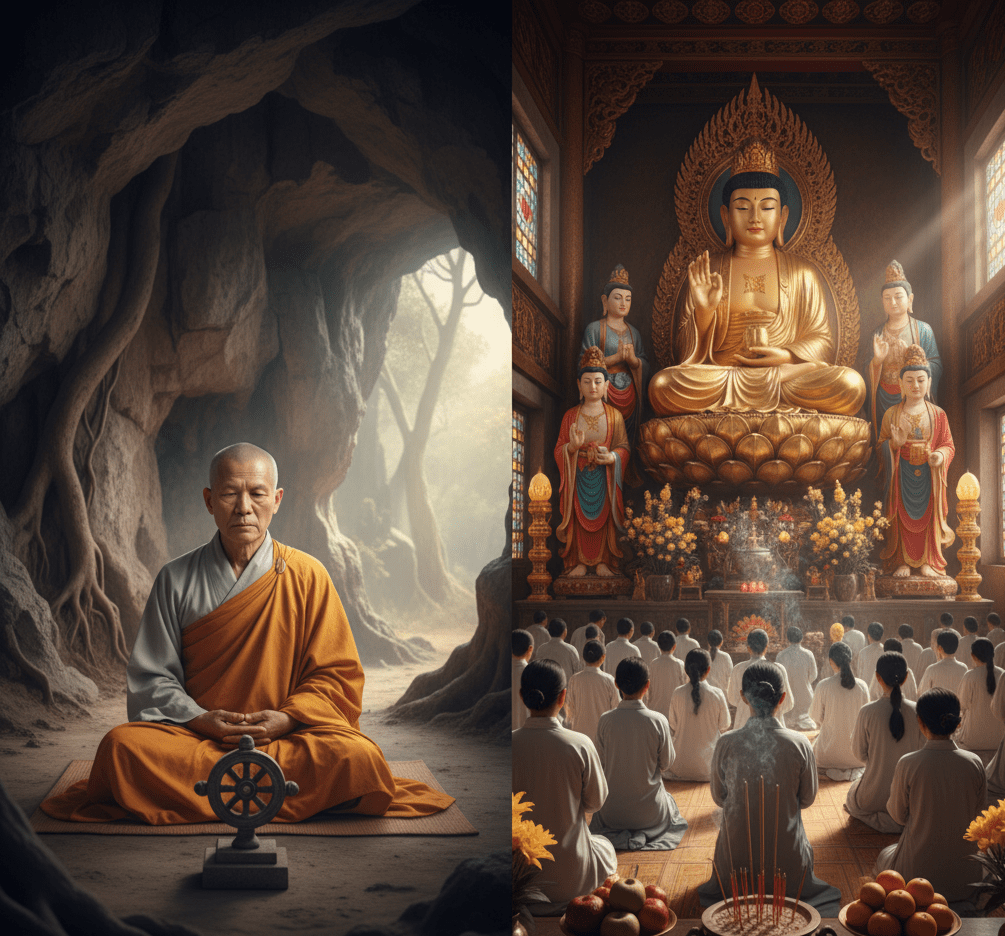
The Sangha (monastic order) was the institution that preserved and propagated the Buddha’s teachings. It was organized as a democratic body of monks (Bhikshus) and later, nuns (Bhikshunis).
Over time, differing interpretations of the monastic rules (Vinaya) and philosophical doctrines led to the formation of different schools. The most significant schism occurred around the 1st century A.D., resulting in the two major modern traditions:
| Aspect | Hinayana (The Lesser Vehicle) | Mahayana (The Greater Vehicle) |
| Goal | Arhat (A perfected person who has achieved Nirvana for himself). | Bodhisattva (An enlightened being who delays Nirvana to help all sentient beings achieve it). |
| Worship | Did not believe in idol worship; focused on self-discipline and meditation. | Introduced idol worship of the Buddha and Bodhisattvas. |
| Salvation | Believed salvation could only be achieved by monks (monastic elite). | Believed salvation was available to all (including lay followers). |
| Language | Used Pali (vernacular language). | Used Sanskrit (classical language). |
| Current Influence | Survives today as Theravada Buddhism (Sri Lanka, Southeast Asia). | Dominant in China, Korea, Japan, Tibet, and Vietnam. |
The first major separation occurred around the time of the Second Buddhist Council (383 B.C.) over differences in how strictly the Vinaya (monastic discipline) should be observed. This initial split laid the groundwork for the major traditions:
- Sthaviravada (Doctrine of the Elders): This was the orthodox, conservative group. They maintained a strict adherence to the early monastic rules and focused heavily on individual practice and self-discipline to achieve the highest ideal. This school is the direct ancestor of modern Theravada Buddhism.
- Mahasanghika (Great Congregation): The liberal group. They advocated for slightly relaxed rules and believed that the Arhat (the ideal of the Sthaviravada) was still imperfect and could backslide from enlightenment. This tradition was crucial as it developed many concepts—like the transcendental nature of the Buddha—that later became central to Mahayana philosophy.
The Major Vehicles (Yanas)
These three traditions are the main forms of Buddhism practiced globally today, representing different approaches to salvation.
| Vehicle | Ideal Goal | Salvation Scope | Language of Canon | Global Presence |
| Theravada (The School of the Elders) | The Arhat (Individual enlightenment and freedom from rebirth). | Primarily monastic; salvation is self-achieved. | Pali | Sri Lanka, Thailand, Myanmar (Burma), Cambodia. |
| Mahayana (The Greater Vehicle) | The Bodhisattva (One who postpones Nirvana to save all sentient beings). | Universal; open to lay practitioners through compassion (Karuna). | Sanskrit | China, Korea, Japan, Vietnam. |
| Vajrayana (The Diamond Vehicle) | Instantaneous Buddhahood in one lifetime. | Esoteric; requires initiation by a Guru (Lama) and tantric practices. | Sanskrit (mixed with local dialects) | Tibet, Nepal, Bhutan, Mongolia. |
The Four Great Philosophical Schools of Indian Buddhism
As Buddhism matured intellectually, complex philosophical disagreements arose, resulting in four major intellectual schools (particularly within the Mahayana and its immediate predecessors), which systematically analyzed the nature of reality, perception, and the self.
- Vaibhāṣika (Direct Realists):
- Core Tenet: Adherents believed that all phenomena (Dharmas) in the external world are real and can be directly perceived through the senses, existing independently of the mind. They relied heavily on the Abhidharma texts.
- Sautrāntika (Inferential Realists):
- Core Tenet: They agreed that external objects exist, but rejected the Vaibhāṣika view of direct perception. They held that we know the external world only indirectly, through inference, based on the sensory data received by our consciousness.
- Mādhyamaka (The Middle Way)
- Founder: Nāgārjuna (c. 2nd century A.D.)
- Core Tenet: This foundational Mahayana school introduced the pivotal concept of Śūnyatā (Emptiness). It posits that all phenomena lack inherent, independent existence (svabhāva). The “Middle Way” avoids the extremes of affirming that things exist permanently (eternalism) and denying their existence entirely (nihilism).
- Yogacāra (The Mind-Only School)
- Founders: Asaṅga and Vasubandhu (c. 4th century A.D.)
- Core Tenet: Also known as Vijnapti-mātra (Consciousness Only), this school argues that all experience is a projection of the mind. The apparent external world is fundamentally an illusion (like a dream) created by consciousness, and only the mind (or consciousness) is truly real. This system offers a profound analysis of the workings of consciousness, particularly with the concept of the store-consciousness.
4. Literature of Buddhism
The core Buddhist canon, the Tripitaka (Three Baskets), was initially compiled orally and later written down.
| Pitaka (Basket) | Content | Language | Significance |
| Vinaya Pitaka | Rules of conduct and discipline for the Sangha (monks and nuns). | Pali | Details the monastic life and regulations. |
| Sutta Pitaka | Contains the main discourses and sermons of the Buddha. | Pali | The largest basket; includes the famous Dhammapada. |
| Abhidhamma Pitaka | Philosophical and metaphysical analyses and commentaries on the Sutta Pitaka. | Pali | Deals with higher doctrine and systematic philosophy. |
Other Important Texts:
- Jatakas: Collection of folk tales and stories describing the previous births of the Buddha. These were crucial for popularizing Buddhism among the masses.
- Milindapanha: A dialogue between the Indo-Greek King Menander (Milinda) and the Buddhist monk Nagasena.
- Mahayana Texts: The Prajnaparamita Sutras (Perfection of Wisdom Sutras) and the Lotus Sutra.
5. Councils, Spread, and Royal Patronage
The four Buddhist councils were crucial in codifying the canon and resolving doctrinal disputes.
| Council | Date | Location | Patron | Significance |
| First Council | 483 B.C. (Shortly after Buddha’s death) | Rajagriha | Ajatashatru | Compilation of the Vinaya Pitaka (by Upali) and Sutta Pitaka (by Ananda). |
| Second Council | 383 B.C. | Vaishali | Kalashoka | Addressed disputes over monastic rules. Resulted in a minor schism between orthodox and liberal schools. |
| Third Council | 250 B.C. | Pataliputra | Ashoka | Codification of the Abhidhamma Pitaka. Monks were sent to spread the Dharma abroad. |
| Fourth Council | 72 A.D. | Kashmir (Kundalvana) | Kanishka | Held under the Mahayana scholar Vasumitra. Led to the formal division into Hinayana and Mahayana sects. |
Royal Patronage and Geographical Spread
Buddhism gained significant traction through the support of powerful monarchs:
- Bimbisara and Ajatashatru (Magadha): Early patrons who welcomed the Buddha.
- Ashoka the Great (Mauryan Empire, 3rd Century B.C.): The greatest patron. After the Kalinga War, he converted and actively supported Buddhism. He erected Pillars and Rock Edicts inscribed with Dharma, appointed Dharma Mahamatras (officials to spread Dharma), and sent missions (Dharma Vijaya) to Sri Lanka, Southeast Asia, and West Asia. The Third Council was held under his guidance.
- Kanishka (Kushan Dynasty, 1st Century A.D.): A major patron of Mahayana Buddhism. He organized the Fourth Council and his patronage led to the development of the Gandhara School of Art, which depicted the Buddha in human form.
The religion spread across South Asia (Sri Lanka, Southeast Asia) via the Pali language (Theravada/Hinayana) and spread across Central Asia, China, Korea, and Japan via the Sanskrit language (Mahayana).
The Sangha and Disciples
The Sangha (community) was established by the Buddha to preserve and propagate the Dharma. It was democratic, operating on rules of consensus, and open to all castes and classes. The early Sangha played a crucial role by institutionalizing the faith.
- Key Disciples:
- Sariputta and Moggallana: The Buddha’s two chief male disciples, renowned for their wisdom and psychic powers, respectively.
- Ananda: The Buddha’s cousin and personal attendant, remembered for his prodigious memory, which was vital in the compilation of the Sutta Pitaka at the First Council.
- Upali: A barber by origin, he was authoritative on the rules of discipline and recited the Vinaya Pitaka at the First Council.
- Prajapati Gotami: The Buddha’s aunt and stepmother, she was the first woman admitted to the Sangha, marking the establishment of the order of nuns (Bhikshunis).
Art and Architecture
Buddhism inspired a vast amount of art, architecture, and sculpture, establishing some of India’s most iconic monuments.
- Early Symbolism: Before Kanishka’s era, the Buddha was never depicted in human form. Early art relied on symbols: the Wheel (Dharmachakra, symbolizing the first sermon), the Bodhi Tree (Enlightenment), the Empty Seat, and the Stupa (Mahaparinirvana).
- Stupas: These are dome-shaped mound structures built over the relics (bones, ashes, possessions) of the Buddha or his chief disciples. They served as commemorative and worship sites. The most famous example is the Sanchi Stupa, greatly expanded under Ashoka.
- Chaityas and Viharas: Chaityas are prayer halls or shrines (often featuring a miniature stupa), while Viharas are residential monasteries for monks. These were often carved directly into rock faces (rock-cut architecture), such as at Ajanta and Ellora, forming massive monastic complexes.
Also Read: Jainism
Causes for the Decline
Despite being the birthplace of Buddhism, the religion gradually declined and largely disappeared from the Indian subcontinent after the 12th century A.D.
| Category | Cause of Decline | Detailed Explanation |
| Internal Factors | Schisms and Loss of Identity | The major split into various sects (Hinayana, Mahayana, Vajrayana) diluted the core message. Mahayana’s inclusion of idol worship and rituals made it less distinct from Hinduism. |
| Loss of Patronage | After the Gupta period, royal patronage diminished. Buddhism became confined mostly to monasteries, separating it from the common people’s daily life. | |
| Corruption in Sangha | With large endowments and land grants, many monasteries became rich and centers of indolence, leading to moral degradation within the monastic order. | |
| External Factors | The Rise of Neo-Brahmanism | The revival and reformation of Hinduism, particularly through the teachings of Shankaracharya and the Bhakti movement, countered Buddhist philosophy and successfully brought back converts. |
| Absorption by Hinduism | Hinduism absorbed Buddha as the ninth incarnation of Vishnu. This made Buddhism merely another sect within the Hindu framework, effectively dissolving its separate identity. | |
| Invasions and Destruction | The most decisive factor was the destruction of major monastic universities (like Nalanda and Vikramshila) and monasteries by Muslim invaders, particularly the Turkish invasion led by Bakhtiyar Khilji in the 12th and 13th centuries. The monastics were either killed or forced to flee to Nepal and Tibet, eliminating the institutional base in India |