
Explore the evolution of Indian Visual Arts, from Harappan town planning to Mughal grandeur and Modernism. This guide details Temple Architecture (Nagara, Dravidian, Vesara), Indo-Islamic styles, intricate Sculptures, and the vibrant tradition of Indian Paintings.
The visual arts of India represent a continuous civilizational journey spanning over five thousand years. This evolution is not merely a chronicle of changing aesthetics but a profound reflection of the shifting socio-political, religious, and philosophical landscapes of the Indian subcontinent. From the utilitarian urbanism of the Indus Valley to the spiritual grandeur of medieval temples and the eclectic fusion of the modern era, Indian visual arts demonstrate an unparalleled ability to assimilate foreign influences while maintaining a core indigenous identity.
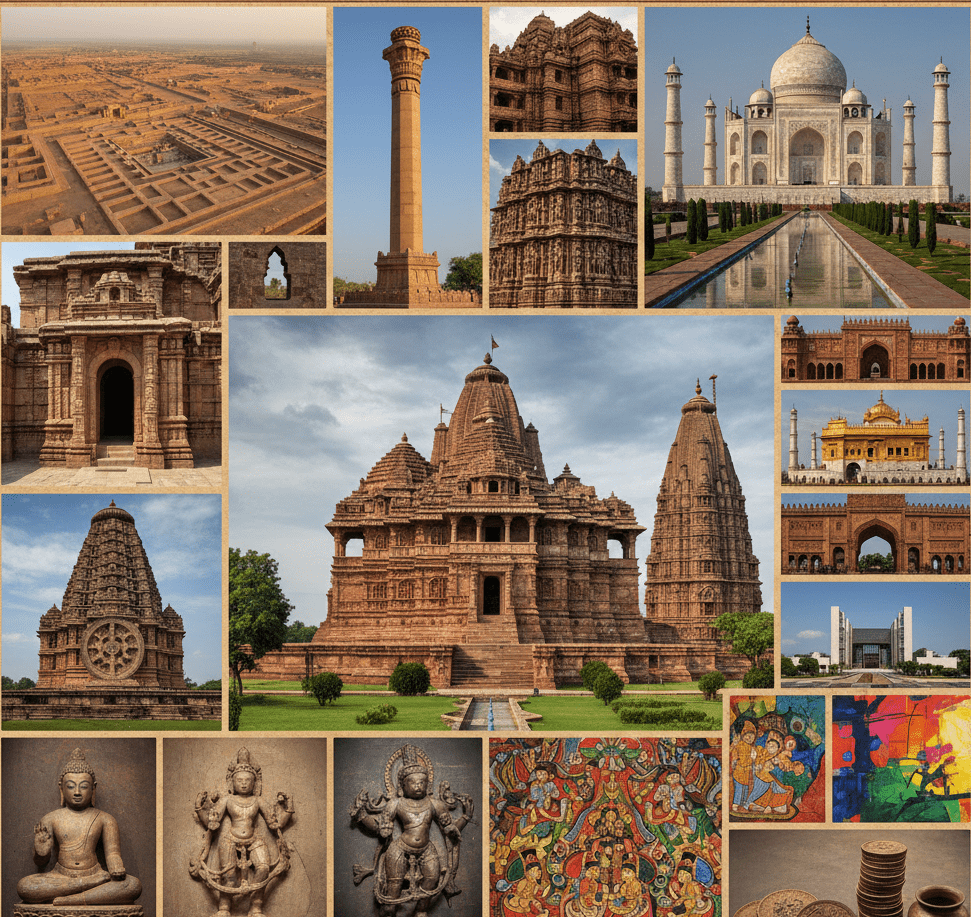
Architecture: The Structural Narrative of India
Harappan Period
The architecture of the Indus Valley Civilization (3300–1300 BCE) was primarily secular and functional. Unlike other contemporary civilizations, the Harappans focused on urban planning rather than monumental religious structures. Key features included the use of standardized burnt bricks, a grid system of streets, and advanced drainage systems. The Citadel and the Great Bath of Mohenjo-daro remain the most significant architectural achievements of this era.
Mauryan Architecture
The Mauryan Empire (4th–2nd Century BCE) marked the transition from wood to stone. King Ashoka played a pivotal role by commissioning monolithic sandstone pillars polished to a mirror-like finish. The era also saw the construction of the earliest Buddhist Stupas, such as Sanchi, and the carving of the Barabar Caves, which served as the prototype for later rock-cut architecture.
Also Read: Mauryan Empire
Post-Mauryan Period
Following the Mauryas, architectural activity intensified in the Western Ghats and Eastern India. This period saw the development of two distinct rock-cut structures: Chaityas (prayer halls with a stupa) and Viharas (monastic residences). The Karle Chaitya and the Udayagiri-Khandagiri caves are prime examples of this phase, showcasing intricate facade carvings.
Gupta Period
Often termed the Golden Age, the Gupta period saw the birth of free-standing structural Hindu temples. The Dashavatara Temple at Deogarh is a landmark, introducing the Shikhara (tower). Architecture moved away from the cave and into the open, establishing the fundamental elements of the Hindu temple: the Garbhagriha (sanctum sanctorum) and the Mandapa (pillared hall).
Regional Diversity in Temple Architecture
The medieval period witnessed a flowering of regional styles across the subcontinent.
Temples of Khajuraho and Odisha
The Khajuraho temples, built by the Chandela rulers, are famous for their Nagara style characterized by a series of graded peaks that resemble a mountain range. In contrast, the Odisha school (Kalinga architecture) emphasizes the verticality of the Deul (tower) and the horizontal lines of the Jagamohana (assembly hall), best seen in the Lingaraja and Konark Sun temples.
Northern and Western Variations
- Gwalior: Features the Teli ka Mandir, which uniquely blends a Dravidian-style roof with Nagara decorations.
- Gujarat: The Solanki style is noted for its lavish carvings and the inclusion of ornate stepwells (Vavs) like Rani ki Vav.
- Rajasthan: Famous for the Dilwara Jain temples, which exhibit incredible marble fretwork.
Eastern and Himalayan Frontiers
- Bengal: Due to the lack of stone, architects used terracotta and brick, creating the Chala style with curved roofs mimicking thatched huts.
- Assam: The Ahom style combined local elements with the Nagara tradition, often using a beehive-shaped Shikhara.
- Himachal and J&K: Himalayan architecture often utilized wood and stone in a pagoda style (HP) or massive stone trefoil arches (Kashmir, such as the Martand Sun Temple).
The Southern Traditions: Pallava to Nayaka
The South Indian tradition, or Dravidian style, evolved under various powerful dynasties.
| Dynasty | Key Architectural Contribution | Representative Example |
| Pallava | Rock-cut Rathas and Shore Temples | Mahabalipuram |
| Chola | Massive Vimanas and Bronze Casting | Brihadisvara Temple, Thanjavur |
| Pandya | Evolution of the massive Gopurams | Meenakshi Temple (early phase) |
| Vijaynagar | Highly ornate pillars and Monolithic sculptures | Vittala Temple, Hampi |
| Nayaka | Elaborate corridors (Prakarams) | Rameswaram Temple |
| Kerala | Sloping roofs and circular sanctums | Vadakkunnathan Temple |
| Rashtrakuta | Monolithic rock-cut wonders | Kailasa Temple, Ellora |
Schools of Temple Architecture: A Comparative Analysis
- Nagara Style: Prevalent in Northern India, characterized by a curvilinear Shikhara and a square plan.
- Dravidian Style: Found in South India, marked by a pyramid-like Vimana and towering gateways called Gopurams.
- Vesara Style: A hybrid style emerging in the Deccan under the Chalukyas, combining features of both Nagara and Dravidian.
- Hoysala Style: A distinct sub-style in Karnataka known for its star-shaped ground plans and intricate soapstone carvings.
| Feature | Gandhara School | Mathura School |
| Influence | Strong Greco-Roman (Hellenistic) influence. | Purely indigenous development. |
| Material | Blue-grey schist stone and later stucco (mud-lime). | Spotted red sandstone. |
| Religious Focus | Primarily Buddhist (Mahayana). | Secular, Buddhist, Jain, and Brahmanical. |
| Depiction of Buddha | Hellenistic features: wavy hair, muscular physique, heavy drapery like a Roman toga. | Fleshy body, shaven head or snail-shell curls, thin muslin-like drapery. |
| Expression | Grave, calm, and realistic. | Joyous, smiling, and spiritually radiant. |
Indo-Islamic Architecture
The arrival of Islamic rulers introduced the arcuate system (arches, domes, and minarets).
- Imperial Style: The Delhi Sultanate introduced the use of red sandstone and the “true arch.”
- Provincial Style: Regional sultanates developed unique flavors, such as the Jaunpur style with its massive pylons or the Bijapur style with its gargantuan domes (Gol Gumbaz).
- Mughal Style: The zenith of Indo-Islamic art, characterized by the use of white marble, bulbous domes, and Pietra Dura inlay work.
- Sikh Style: A synthesis of Mughal and Rajput styles, featuring fluted domes and kiosks (Chhatris).
- Avadh Style: Known for the use of fish motifs and elaborate vaulted halls (Imambaras) in Lucknow.
- Rajput Architecture: Indigenous rulers adopted Islamic features like domes and arches into their forts and palaces but maintained traditional brackets and balconies.
Jaina Art and Modern Transitions
Jaina art is distinguished by its purity and focus on the Tirthankaras, often found in “temple cities” like Palitana.
Modern Architecture and European Influence
The colonial era introduced Western architectural vocabulary to India.
- Portuguese: Introduced the Baroque and Manueline styles in Goa.
- Danish: Left a mark in settlements like Tranquebar with neoclassical influences.
- British: Initially brought Neoclassical styles, which evolved into the Indo-Saracenic Architecture, a grand synthesis of Victorian Gothic, Mughal, and Hindu elements (e.g., Chhatrapati Shivaji Terminus).
- Post-Independence: Marked by a move toward Brutalism and Modernism, led by Le Corbusier (Chandigarh) and Indian masters like Charles Correa.
Sculptures
From Antiquity to the Medieval Age
- Harappan: Notable for the bronze “Dancing Girl” and the steatite “Bearded Priest.”
- Mauryan: Characterized by monumental Yaksha figures and the polished Lion Capital of Sarnath.
- Post-Mauryan: This era saw the rise of the Gandhara school (Greco-Buddhist) and the Mathura school (indigenous red sandstone).
- Gupta Sculpture: Focused on spiritual calmness and the “Sarnath School” of Buddha images.
Religious and Medieval Schools
Jain sculptures emphasized meditative austerity, while Buddhist sculpture evolved from symbolic representations (stupa, footprints) to the human form of the Buddha. The Medieval period saw the rise of local schools like the Pala (Bihar/Bengal) and the exquisite Chola bronzes in the South. Modern Indian sculpture has moved toward abstraction and social commentary.
Paintings: The Visual Spectrum
Mural and Miniature Traditions
Indian painting began with prehistoric rock art and reached its first peak with the Ajanta murals.
- Cave Paintings: Ajanta and Bagh showcase Buddhist themes with high technical finesse.
- Miniatures: These small-scale paintings flourished under the Mughals (secular/courtly) and the Rajputs (religious/mythological).
- Pahari School: Developed in the Himalayan foothills, known for its lyrical beauty (Kangra and Basohli styles).
- Deccan School: Known for its intense colors and Persian influence.
- Modern and Contemporary: From the Bengal School’s revivalism to the Progressive Artists’ Group, Indian painting has evolved into a global contemporary force.
Pottery and Numismatics
The Pottery Tradition
Pottery serves as a vital archaeological marker for dating civilizations.
- Ochre Coloured Pottery (OCP): Associated with the late Harappan/Copper Age.
- Black and Red Ware (BRW): Found across India, marking the transition to the Iron Age.
- Painted Grey Ware (PGW): Linked to the Vedic period in the Gangetic plains.
- Northern Black Polished Ware (NBPW): A high-quality, glossy pottery reflecting the urban wealth of the Mauryan era.
Numismatics: The History of Coinage
Coins provide chronological and economic data. India’s coinage began with silver punch-marked coins, followed by the Indo-Greeks who introduced portraits. The Guptas minted the finest gold coins (Dinars), while the Mughals standardized the silver Rupee, which remains the basis of modern Indian currency.
Conclusion
The visual arts of India are a testament to the country’s enduring spirit and its capacity for cultural synthesis. From the earliest bricks of the Harappans to the contemporary canvases of the 21st century, each layer of art adds to the complex identity of the nation. Understanding these arts is essential for comprehending the religious, social, and political history of South Asia.