
Discover the fascinating Mahajanapadas Period (6th–4th Century BCE) in ancient India. Explore the political landscape dominated by 16 Great States, the difference between Republics (Ganasanghas) and Monarchies (Rajyas), and the eventual rise of Magadha under the Haryanka, Shishunaga, and Nanda Dynasties. Learn how these states laid the foundation for India’s first great empire.
Mahajanapadas Period and Key Dynasties of Magadha
Mahajanapadas (Sanskrit for “Great Kingdoms” or “Great States”) represent a significant period in ancient Indian history, spanning roughly from the 6th to the 4th century BCE. This era, coinciding with the rise of Buddhism and Jainism, witnessed the consolidation of political power from smaller, tribal settlements (Janapadas) into sixteen powerful, urbanized states across the Indo-Gangetic plain. This transformation was fueled by advancements in iron technology, agricultural surplus, and trade.
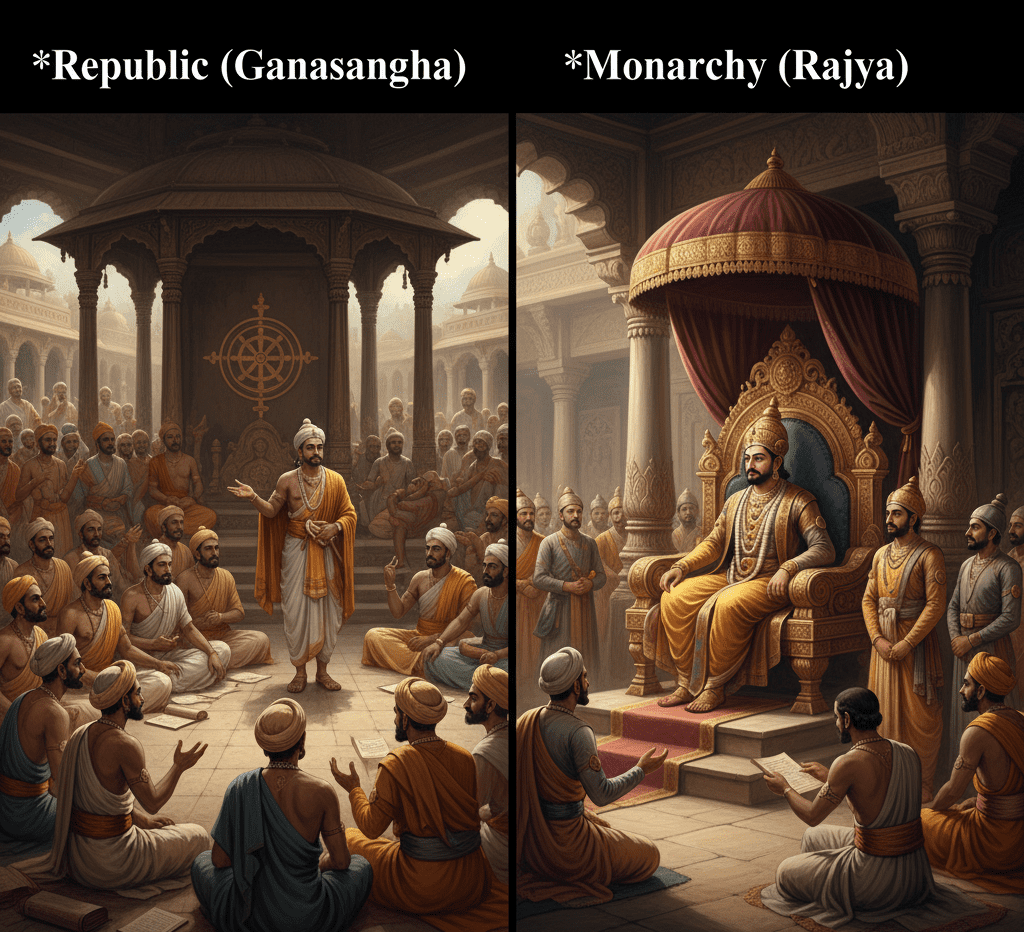
Republics (Ganasanghas) and Monarchies (Rajyas)
The Mahajanapadas displayed two distinct forms of political organization: Monarchies and Republics.
Monarchies (Rajyas)
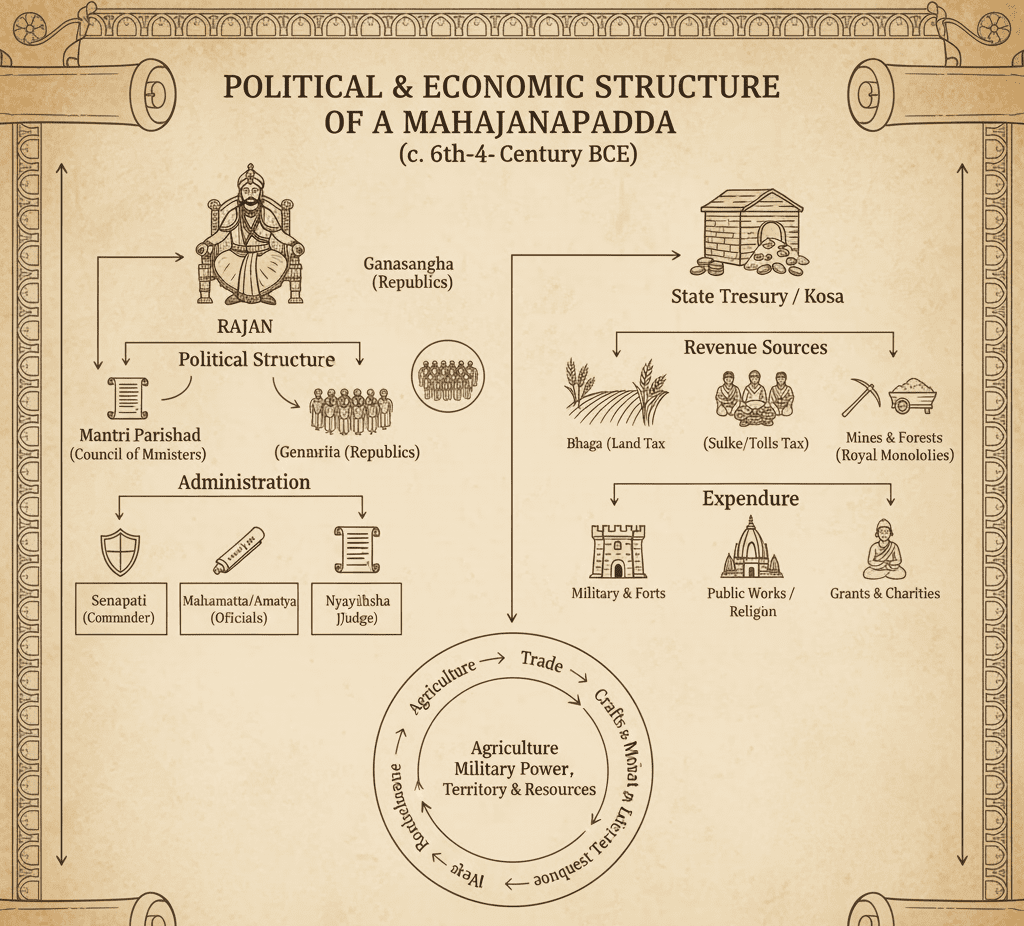
- Definition: States ruled by a hereditary king (Rajan) who held absolute power. The king was often assisted by a council of ministers and commanded a standing army.
- Key Feature: Centralized authority and clear succession rules.
- Examples: Magadha, Kosala, Vatsa, and Avanti were the most powerful monarchies.
Republics (Ganasanghas)
- Definition: States governed by an assembly (Sangha) of representatives, usually drawn from the heads of the prominent Kṣatriya clans. Power was not vested in a single individual.
- Key Feature: Decision-making by deliberation and voting in a public assembly. The elected head was often referred to as a Gana-pati or Sangha-Mukhya.
- Examples: The Vajjis (Vrijjis) and Mallas were the most prominent republics, reflecting an early form of democratic governance.
| Feature | Monarchy (Rajya) | Republic (Ganasangha) |
| Head of State | Hereditary King (Rajan) | Elected Chief/Assembly (Gana-pati/Sangha-Mukhya) |
| Power Structure | Centralized, absolute power | Decentralized, shared among assembly members |
| Succession | Generally hereditary | Based on election/rotation within ruling clans |
| Examples | Magadha, Kosala, Avanti | Vajji, Malla |
The 16 Mahajanapadas
Buddhist texts, such as the Anguttara Nikaya, and Jaina texts, like the Bhagavati Sutra, list sixteen great states that dominated the political landscape.
| Mahajanapada (River Flowing) | Capital City | Modern Location (Approx.) | Type of Government | Significance |
| 1. Anga (Champa River) | Champa | Eastern Bihar | Monarchy | Important center for trade and commerce. |
| 2. Magadha (Ganga, Sone, Champa Rivers) | Rajagriha/Pataliputra | Patna, Gaya (Bihar) | Monarchy | The most powerful and ultimate victor. |
| 3. Kashi (Ganga, Varuna, Asi Rivers) | Varanasi | Varanasi (Uttar Pradesh) | Monarchy | Initially powerful, later absorbed by Kosala. |
| 4. Kosala (Saryu) | Sravasti | Awadh (Uttar Pradesh) | Monarchy | Rival of Magadha, associated with King Prasenajit. |
| 5. Vatsa (Ganga-Yamuna Confluence) | Kaushambi | Allahabad (Uttar Pradesh) | Monarchy | Known for King Udayana. |
| 6. Chedi (Yamuna) | Suktimati | Bundelkhand (Madhya Pradesh) | Monarchy | Mentioned in the Mahabharata. |
| 7. Kuru (Ganga-Yamuna Doab) | Indraprastha/Hastinapura | Delhi-Meerut region | Monarchy/Republic | Traditional homeland of the Kuru clan. |
| 8. Pañchala (Ganga-Yamuna Region) | Ahichchatra, Kampilya | Western Uttar Pradesh | Monarchy/Republic | Divided into North and South Pañchala. |
| 9. Matsya (Banas/Chambal Rivers) | Viratnagar | Jaipur (Rajasthan) | Monarchy | Located south of the Kurus. |
| 10. Surasena (Yamuna) | Mathura | Mathura (Uttar Pradesh) | Monarchy | Associated with the worship of Krishna. |
| 11. Assaka or Ashmaka (Godavari) | Potana | Godavari River (South India) | Monarchy | The only Mahajanapada located south of the Vindhyas. |
| 12. Avanti (Narmada) | Ujjain, Mahishmati | Malwa (Madhya Pradesh) | Monarchy | Major competitor to Magadha, known for King Pradyota. |
| 13. Gandhara (Kabul or Kubha River) | Taxila | Peshawar/Rawalpindi (Pakistan) | Monarchy | Famous center of education and trade. |
| 14. Kamboja (Jhelum or Vitasta River) | Rajapura | Kashmir/Tajikistan border | Monarchy/Republic | Known for its excellent breed of horses. |
| 15. Vajji or Vrijji) (Ganga) | Vaishali | Northern Bihar | Republic (Ganasangha) | A confederacy of eight clans. |
| 16. Malla (Gandak and Rapti) | Kushinara, Pava | Gorakhpur (Uttar Pradesh) | Republic (Ganasangha) | The place of Buddha’s Parinirvana. |
The Rise of Magadha
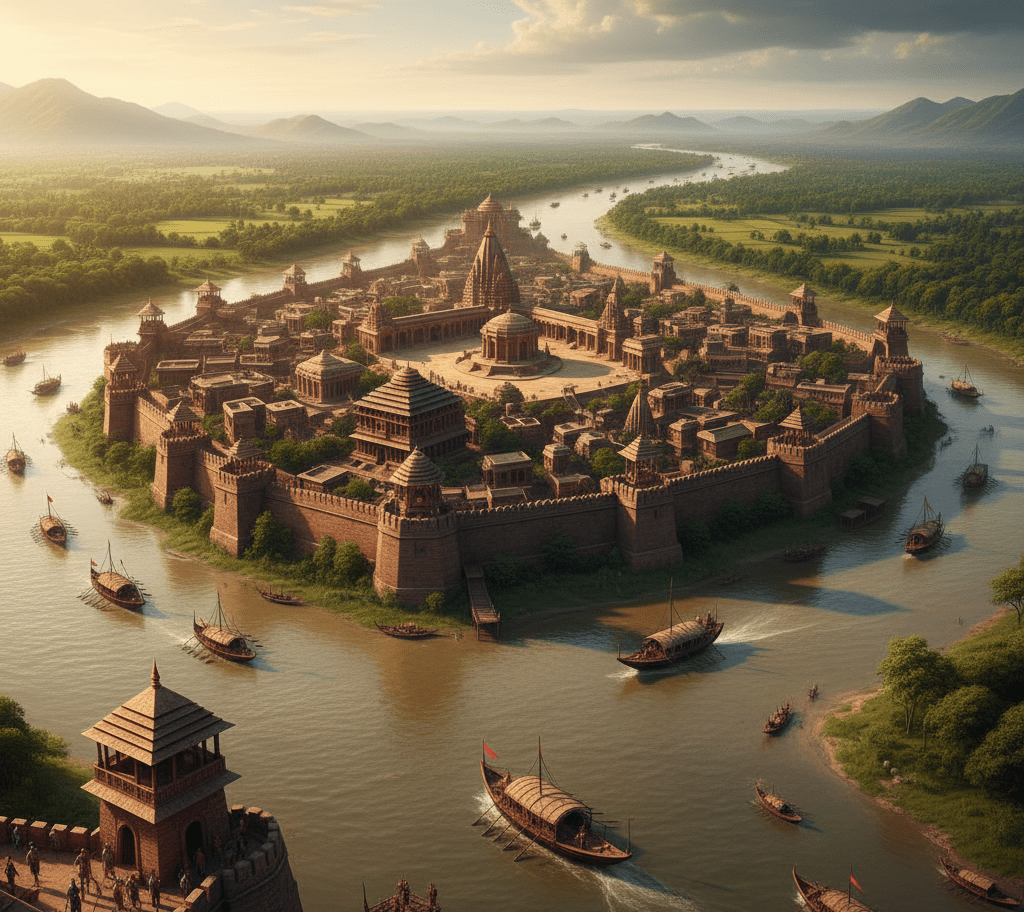
Of the sixteen, Magadha ultimately emerged as the most dominant, establishing the first great empire of India. Its success was due to a combination of factors:
- Geographical Advantage: Located on fertile, mineral-rich land with access to iron ore for tools and weapons.
- Strategic Capitals: Rajagriha was protected by five hills, and later Pataliputra was centrally located, commanding river routes.
- Ambitious Rulers: A succession of powerful and expansionist dynasties.
Key Dynasties of Magadha: The Foundations of an Empire
The rise of Magadha to paramount power among the sixteen Mahajanapadas was primarily due to a succession of ambitious and capable rulers belonging to three key dynasties: the Haryanka, the Shishunaga, and the Nanda. These dynasties consolidated a vast territory, perfected a centralized administration, and built a massive military, paving the way for the later Mauryan Empire.
Haryanka Dynasty (c. 544–412 BCE)
The Haryanka dynasty is considered the first dynasty to rule over the consolidated Magadha kingdom, initiating its long period of supremacy.
| Ruler (Timeline Approx.) | Key Achievements and Significance | Political Strategies |
| Bimbisara (c. 544–492 BCE) | Founder of the Haryanka dynasty and a contemporary of the Buddha and Mahavira. | Used a dual policy of Matrimonial Alliances (e.g., with Kosala, Vaishali, and Madra) to gain territories and secure borders, and Conquest (e.g., annexation of Anga). He was the first to have a standing army. |
| Ajatashatru (c. 492–460 BCE) | Defeated the powerful Vajji Confederacy (Vaishali), a major rival, after a 16-year war. Successfully conquered Kosala and expanded Magadha’s territory significantly. | Used new weapons like the Mahashilakantaka (a stone-throwing war engine/catapult) and Rathamusala (a chariot with an armed mace). Convened the First Buddhist Council at Rajagriha. |
| Udayin (c. 460–444 BCE) | His greatest contribution was shifting the capital from Rajagriha to Pataliputra (modern-day Patna). | Recognized Pataliputra’s strategic importance, located at the confluence of the Ganga and Son rivers, providing natural defense and a central hub for riverine trade. |
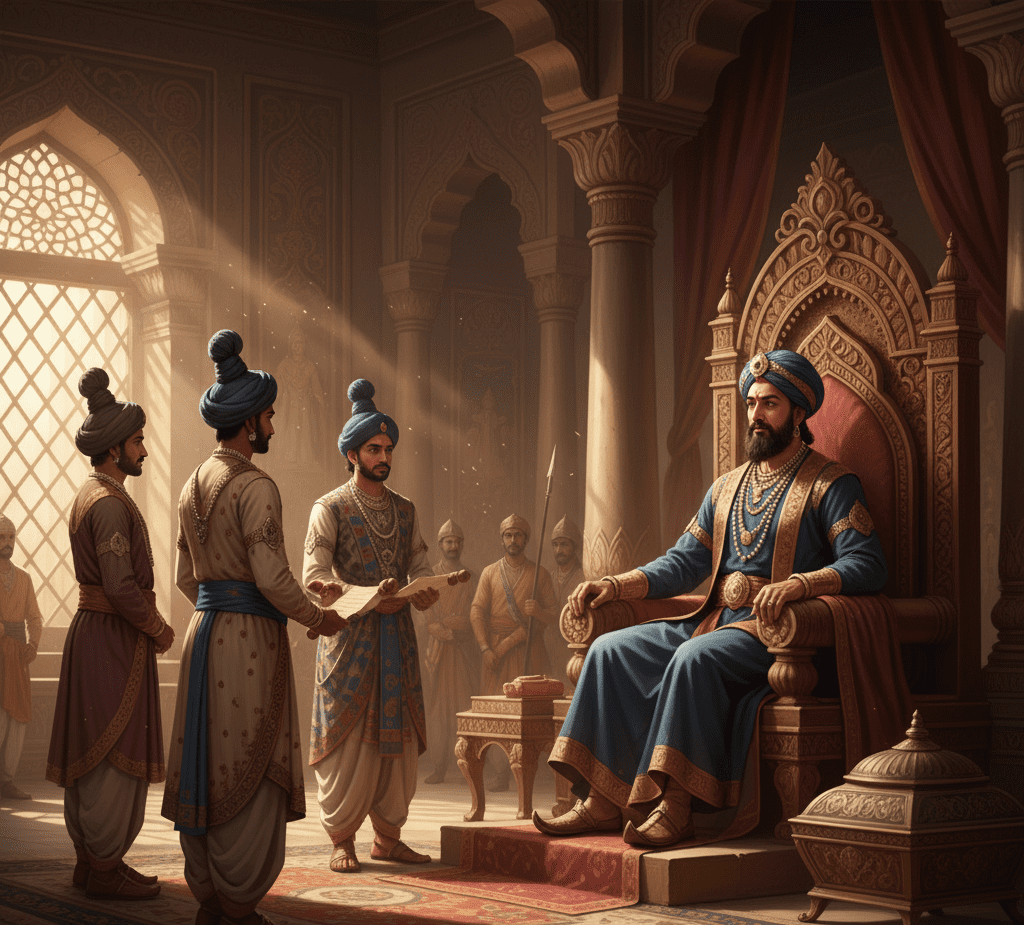
The dynasty suffered from internal conflicts, with tradition claiming that the successive rulers killed their fathers to seize the throne, earning the dynasty the nickname “Patricides’ Dynasty.” The last ruler, Nāgadāsaka, was overthrown by a popular revolt, leading to the rise of his amatya (minister), Shishunaga.
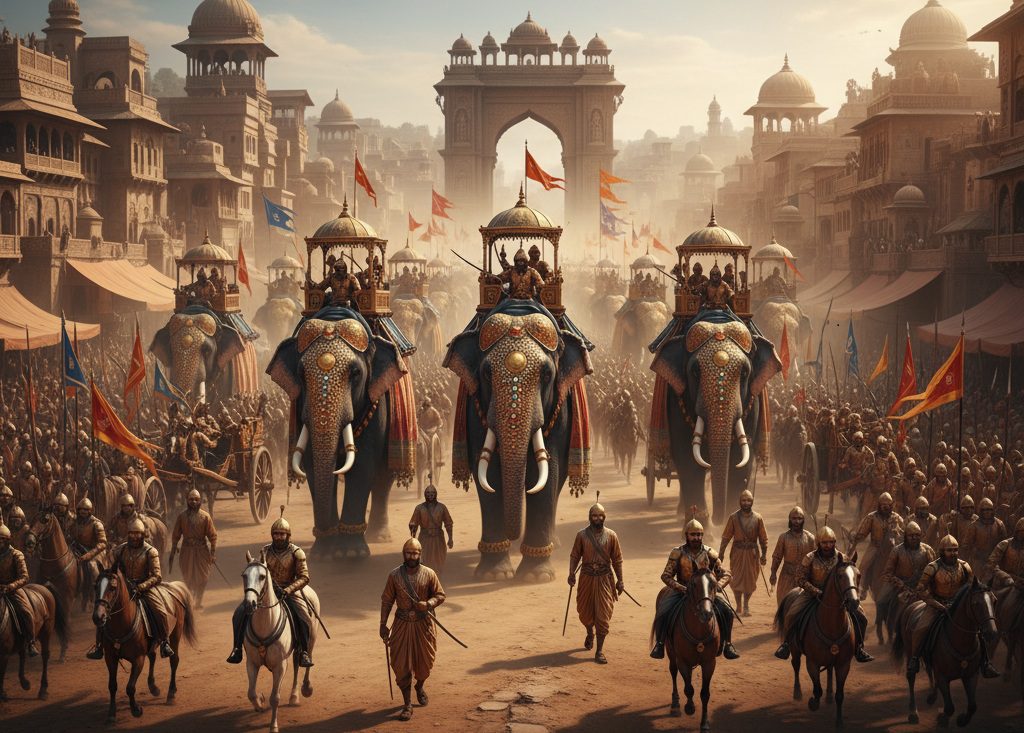
Shishunaga Dynasty (c. 412–344 BCE)
The Shishunaga dynasty further consolidated Magadha’s power and decisively eliminated its most powerful remaining rival.
| Ruler (Timeline Approx.) | Key Achievements and Significance | Consolidation Strategy |
| Shishunaga (c. 412–395 BCE) | Founder of the dynasty, originally an amatya (minister) of the last Haryanka king. | His greatest achievement was the annexation of Avanti (with its capital Ujjain), which ended the century-long rivalry between Magadha and the Pradyota dynasty of Avanti, completing the political dominance of Magadha in Northern India. Temporarily shifted the capital to Vaishali. |
| Kalashoka (also known as Kākavarṇa) (c. 395–367 BCE) | Reigned for nearly three decades, maintaining the empire’s territorial integrity. | Presided over the Second Buddhist Council at Vaishali in 383 BCE, a century after the Buddha’s death, to settle disputes over monastic rules. Permanently shifted the capital back to the strategically superior Pataliputra. |
The dynasty’s rule, though short, was crucial for integrating the crucial western territories, especially Avanti, into the burgeoning Magadhan empire. The dynasty ended with the overthrow of the last ruler (possibly Mahanandin) by the powerful Mahapadma Nanda.
Nanda Dynasty (c. 344–321 BCE)
The Nanda dynasty is renowned for being the first great empire-building dynasty of India, setting the stage for the Mauryas. They were known for their immense wealth, massive standing army, and non-Kshatriya origins.
| Ruler (Timeline Approx.) | Key Achievements and Significance | Military and Economic Power |
| Mahapadma Nanda (c. 344 BCE onwards) | Founder of the Nanda dynasty and considered the first true empire-builder of India. | Puranas describe him as “Sarva-Kshatriyantaka” (destroyer of all Kshatriyas) and “Ekarāt” (sole sovereign), signifying his extensive conquests that spread Magadha’s territory further into Kalinga (Odisha) and perhaps as far south as the Godavari river valley. |
| Dhana Nanda (Last Ruler) (c. 329–321 BCE) | Contemporary of Alexander the Great’s invasion (326 BCE). | Inherited a formidable standing army, which Greek accounts estimated at 200,000 infantry, 20,000 cavalry, and 3,000–6,000 war elephants. The fear of this massive army led Alexander’s troops to mutiny at the Beas River, preventing their march into Magadha. |
The Nandas developed a highly centralized and efficient administrative system, which included a systematic tax collection that generated the vast wealth they were famous for. However, this same system, characterized by excessive taxation and the ruler’s perceived low-caste origins, made the last Nanda ruler, Dhana Nanda, intensely unpopular. This public discontent was strategically exploited by Chanakya to install Chandragupta Maurya after overthrowing Dhana Nanda, marking the end of the Nanda dynasty and the beginning of the Maurya Empire.