
Russian Forces Advancing into Ukraine
Context:
- Russia has claimed military advances into Dnipropetrovsk, a major Ukrainian industrial region, marking a significant expansion beyond the four territories it previously claimed to annex.
- This marks a notable escalation in the ongoing war, now in its third year, amid stalled peace efforts and ongoing military and economic pressure on Ukraine.
Key Highlights:
- First Reported Entry into Dnipropetrovsk: Russian forces have reportedly entered the Dnipropetrovsk region, which had not been previously claimed by Russia.
- Strategic Importance: Dnipropetrovsk is a vital mining and industrial hub with a pre-war population of ~3 million. Further Russian advances could undermine Ukraine’s economy and defense capabilities.
- Military Update: Russia’s Defence Ministry stated that a tank unit had reached the western border of the Donetsk region and was advancing into Dnipropetrovsk.
- No Ukrainian Response Yet: Kyiv has not officially responded to the Russian claim.
- Broader Territorial Claims: Russia had claimed annexation of Donetsk, Lugansk, Kherson, and Zaporizhzhia in 2022, despite not having full control over them.
S. Jaishankar’s diplomatic visit to France and Belgium
Context: External Affairs Minister (EAM) S. Jaishankar has embarked on a week-long visit to France and Belgium as part of India’s diplomatic outreach post Operation Sindoor, with a focus on garnering international support for its counter-terrorism stance, strengthening bilateral ties, and furthering strategic cooperation with the EU and key European nations.
Key Highlights:
- Countries Visited: France and Belgium (third European visit in recent months).
- Objective: Deepen India’s relations with the EU, France, and Belgium; support India’s fight against terrorism; promote India-EU FTA; discuss IMEC and global strategic cooperation.
France Agenda:
- Bilateral talks in Paris with French Foreign Minister Jean-Nicolas Barrot.
- Attend Mediterranean Raisina Dialogue in Marseille, a key port city in the proposed India-Middle East-Europe Economic Corridor (IMEC).
Belgium Agenda:
- Hold India-EU Strategic Dialogue with Kaja Kallas, the EU’s High Representative.
- Meet Belgian Deputy PM Maxime Prevost to:
- Discuss bilateral issues.
- Raise Mehul Choksi’s repatriation.
- Push India-EU Free Trade Agreement (FTA) ahead of 2025 deadline.
Geopolitical Engagement:
- Promote India’s stance on the Pahalgam terror attack and retaliatory Operation Sindoor.
- Seek support from the UN, UNSC, and FATF for counter-terror initiatives.
G-7 Summit Prep:
- Lay groundwork for PM Modi’s bilateral meetings during the upcoming G-7 summit in Canada (Kananaskis, Alberta), where India is invited as a special guest.
Meitei radical group Arambai Tenggol
Context: Fresh violence erupted in Imphal Valley, Manipur, after the CBI arrested A. Kanan Singh, a member of the Meitei radical group Arambai Tenggol, for his alleged role in the 2023 ethnic violence. The arrest triggered large-scale clashes, vandalism, and a shutdown call across five districts. This reflects the ongoing fragile law and order situation in the state despite previous attempts at stabilization.
Key Highlights:
Arrest and Clashes:
- Kanan Singh, ex-police head constable and Arambai Tenggol leader, was arrested by CBI at Imphal airport.
- He is allegedly involved in multiple criminal cases linked to the 2023 Meitei-Kuki-Zo ethnic violence.
- 4 other group members were detained for questioning.
- Violent clashes broke out between Arambai Tenggol supporters and security forces.
Government Response:
- Internet and mobile data suspended for 5 days in five districts: Imphal East, Imphal West, Bishnupur, Kakching, Thoubal.
- Prohibitory orders under Section 163 of Bharatiya Nagarik Suraksha Sanhita imposed.
- 10-day shutdown called by Arambai Tenggol; incidents of self-immolation threats reported.
Political and Security Engagement:
- MLAs met Governor Ajay Kumar Bhalla, urged intervention and peace-building.
- The governor assured that steps are underway to restore normalcy.
- Top security officials attended the meeting at Raj Bhavan.
NIA Arrests in Separate Case:
- Three insurgents were arrested in connection with a January 2024 attack on security forces in Moreh, Tengnoupal district.
- Accused: Thangminlen Mate, Kamginthang Gangte, and Hentinthang Kipgen.
- The attack had killed two commandos and injured several others.
Stratospheric Aerosol Injection (SAI)
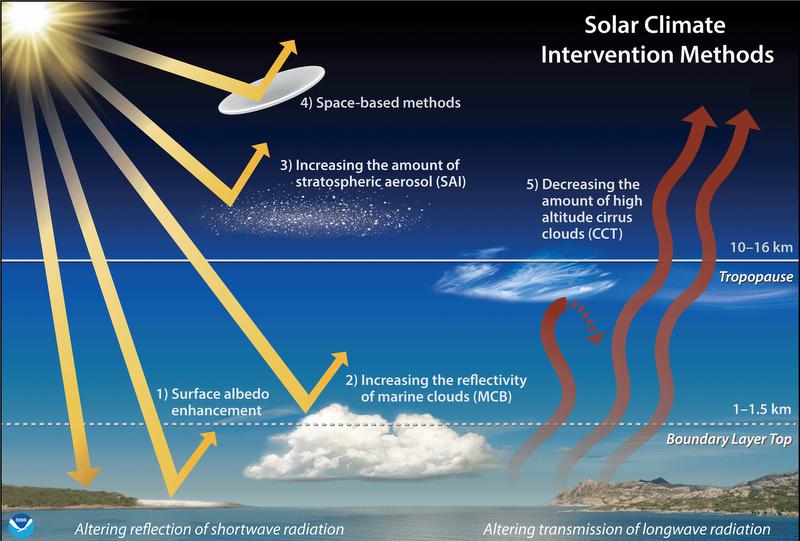
What is SAI?
- Stratospheric Aerosol Injection (SAI) is a solar geoengineering technique where reflective aerosols (e.g., sulphur dioxide) are injected into the stratosphere (~20 km altitude).
- Goal: Reflect sunlight and cool the Earth’s surface.
- Inspiration: Mimics volcanic eruptions like Mount Pinatubo (1991) which led to temporary global cooling.
New Research Findings (Earth’s Future journal):
- Led by Alistair Duffey, PhD scholar at University College London.
- Proposes low-altitude aerosol injections (13 km) over polar and extratropical regions instead of the equator.
- Uses existing aircraft (e.g., modified Boeing 777F), reducing costs and deployment time.
- Simulations via UK Earth System Model 1 (UKESM1).
Findings:
| Goal | Sulphur Dioxide Needed Annually | Altitude | Region |
| Cool planet by 0.6°C | 12 million tonnes | 13 km | Each hemisphere’s spring & summer |
| Cool planet by 1°C | 21 million tonnes | 13 km | Same as above |
| Alternative (more efficient): | 7.6 million tonnes | High-altitude, subtropics | Requires advanced aircraft |
- Existing jets can reach 13 km in polar/extratropical regions where the stratosphere starts lower.
- Higher injections are longer-lasting but need expensive aircraft.
Risks & Concerns:
- Environmental risks: Acid rain, ozone layer damage.
- Uneven cooling: Stronger in the poles, weaker in the tropics (where warming is worse).
- Masking effect: Could delay climate mitigation (false sense of security).
- Geopolitical risks: One country’s action affects the whole globe.
- Governance issues: Difficult to regulate and ensure global consensus.
- A 2022 international coalition called for a moratorium on solar geoengineering due to these issues.
Policy Context:
- In 2021, the US National Academies advised funding geoengineering R&D with transparency.
- Still, global skepticism persists over unilateral deployment and its fairness.
MagIC Cryo-Electron Microscopy
What is Cryo-EM?
- A high-resolution imaging technique that allows scientists to visualize the 3D structure of biological molecules (like proteins) by freezing them and then imaging with electron microscopy.
- Limitation: Requires highly concentrated samples, which is a challenge when studying rare molecules.
What is MagIC?
MagIC = Magnetic Isolation and Concentration Cryo-EM
- Developed by: U.S. researchers (2024)
- Published in: eLife, May 2024
- Advantage: Enables imaging of samples 100 times more dilute than earlier methods (as low as 0.0005 mg/ml).
How It Works:
- Magnetic Beads (50 nm):
- Molecules of interest are attached to tiny magnetic beads.
- A magnet clumps them together, concentrating them for imaging.
- Beads are easy to spot, helping scientists locate dense regions faster.
- DuSTER (Duplicated Selection To Exclude Rubbish):
- A computational workflow that filters out background noise.
- It:
- Picks each particle twice.
- Retains particles matching both times.
- Discards the rest.
Impact:
| Feature | Traditional Cryo-EM | MagIC Cryo-EM |
| Minimum concentration | High | 0.0005 mg/ml |
| Sample requirement | >100 nanograms/grid | 5 nanograms/grid |
| Imaging speed | Slow | Faster |
| Rare molecule imaging | Difficult | Easier |
Colombian Senator Miguel Uribe Injured in Assassination Attempt
Context
- Uribe is not yet a formal presidential candidate, but is a prominent conservative opposition leader.
- His mother, journalist Diana Turbay, was kidnapped and killed in 1991 during a rescue operation from Pablo Escobar’s group.
- Colombia has faced decades of political violence involving leftist rebels, right-wing paramilitary groups, and drug cartels.
Key Incident
- Who: Colombian Senator Miguel Uribe, 39, of the opposition Democratic Centre party.
- What: Shot and critically injured during a 2026 presidential campaign event.
- When & Where: June 8, 2025, in a public park in Fontibon, Bogota (capital of Colombia).
- How: Shot from behind by an armed individual; videos show head injury and bleeding.
Suspect and Investigation
- Suspect: A minor under 15 years, caught carrying a 9mm Glock pistol.
- Focus: Investigating who ordered the attack and security lapses.
- Reward Offered: ~$730,000 for credible information.
- Defence Minister: Confirmed suspect custody and hospital visit.
Iran Rejects Latest U.S. Nuclear Proposal Over Sanctions Issue
Background
- The U.S. and Iran have been engaged in Omani-mediated nuclear talks since April 2025, aiming to replace the 2015 Joint Comprehensive Plan of Action (JCPOA).
- The JCPOA was abandoned by the Trump administration in 2018, leading to reimposed U.S. sanctions and rising nuclear tensions.
Latest Developments
| Date | Event |
| May 31, 2025 | Iran received a new U.S. proposal after the fifth round of nuclear talks. |
| June 8, 2025 | Iranian Parliament Speaker Mohammad Bagher Ghalibaf rejected the U.S. plan on state TV, saying it does not mention sanctions relief. |
| June 4–8, 2025 | Iran’s Supreme Leader Ayatollah Khamenei and FM Abbas Araghchi reiterated Iran’s right to uranium enrichment. |
Iran’s Position
- Accuses the U.S. of dishonesty and pushing for a unilateral deal.
- Insists on:
- Sanctions relief as a precondition.
- Right to uranium enrichment under the Nuclear Non-Proliferation Treaty (NPT).
- No compromise on nuclear sovereignty.
U.S. Position
- Donald Trump (now back in office) has:
- Reinstated the “maximum pressure” sanctions campaign.
- Maintained that any Iranian uranium enrichment is unacceptable (“red line”).
Uranium Enrichment Context
| Aspect | Detail |
| IAEA Finding | Iran is the only non-nuclear-weapon state enriching uranium up to 60% (weapons-grade = 90%). |
| Iran’s Claim | Its nuclear program is peaceful, and enrichment is legal under the NPT. |
| Khamenei’s Statement | Called enrichment “key” to Iran’s nuclear strategy. |
Significance of the Census in India
Historical Background
| Aspect | Detail |
| Ancient mentions | Kautilya’s Arthashastra and Ain-i-Akbari under Akbar |
| First modern Census | 1881 (British India), under W.C. Plowden |
| Frequency | Every 10 years (decennial); uninterrupted from 1881 to 2011 |
| 2021 Census | Postponed due to COVID-19 |
Legal & Administrative Setup
| Authority | Role |
| Union Govt. | Census is a Union List subject under the Constitution |
| Census Act, 1948 | Empowers Centre to conduct the Census |
| Census Commissioner | Appointed by Centre to supervise |
| State roles | Directors of Census Operations appointed; local staff (teachers, etc.) engaged |
Two Phases of the Census
- House Listing Phase
- Focus: Housing & amenities
- Last in 2011: 35 questions (e.g., drinking water, kitchen, fuel, vehicles, tech access)
- Population Enumeration Phase
- Focus: Personal/demographic details (name, sex, age, SC/ST status, religion, language, occupation)
Why is Census 2027 Significant?
- Caste Enumeration
- First caste-based Census for Hindus since 1931
- Previous post-Independence Censuses included only SC/ST categories
- Strong demands from civil society and opposition parties
- Needs extensive preparatory work
- Delimitation & Seat Redistribution
- First Census after 2026 delimitation freeze ends
- Will influence the redrawing of parliamentary and assembly constituencies
- Raises concerns among southern and smaller States about losing political weight
- Women’s Reservation
- 33% reservation for women in Lok Sabha and State Assemblies
- To be implemented using data from this Census (likely from 2029 elections)
Concerns Raised by States
- Southern, Northeastern & Smaller States:
- Fear political marginalization due to lower population growth
- Demand a freeze on Lok Sabha seat numbers
Need for Consensus:
- Uniform formula needed for proportionate seat allocation
- Delimitation must not be rushed before the 2029 general election
Way Forward
- Ensure accurate caste enumeration with transparent methodology
- Address States’ concerns through dialogue and consensus
- Use Census data carefully for affirmative action and reservation planning
- Phase-wise and consultative approach to delimitation and reservation reforms
Prelims Facts
| Question | Answer |
| First synchronous Census in India | 1881 |
| Last caste enumeration for Hindus | 1931 |
| Legislation governing Census | Census Act, 1948 |
| Authority for Census in India | Union Government |
| Reservation to be implemented after the Census 2027 | One-third for women (Lok Sabha & Assemblies) |
| Delimitation freeze ends | 2026 |
India’s Plan to Localise EV Manufacturing
Key Provisions of the Policy
| Provision | Details |
| Customs Duty Cut | Reduced from 70-100% to 15% on Completely Built Units (CBUs) of EVs |
| Price Cap for Imports | Applies to EVs priced ≥ $35,000 |
| Time Limit | Scheme valid for 5 years |
| Investment Requirement | Minimum ₹4,150 crore in India over 3 years |
| Localisation Targets | 25% localisation within 3 years, 50% in 5 years |
| Import Cap | Max 8,000 vehicles/year at reduced duty |
| Duty Forgone Cap | Capped at ₹6,484 crore total |
Intended Benefits
- Attract global EV players (e.g., Tesla, VinFast) to invest in India
- Facilitate technology inflow and infrastructure development
- Boost Make in India by phasing in localisation
- Enhance consumer choice and drive EV adoption
Challenges & Criticisms
Technology Transfer Doubts
- Experts like Shouvik Chakraborty stress the need for mandatory technology sharing
- Countries are reluctant to share proprietary EV tech
Weak Domestic Ecosystem Risks
- India may become just an assembly base without an R&D focus
- Lack of skilling, innovation, and public R&D investment
Narrow EV Focus
- The policy mostly benefits four-wheeler EVs, not two- or three-wheelers
- In FY25, EV sales composition:
- Electric 3-wheelers: 57% of category
- Electric 2-wheelers: 6.1%
- Passenger EVs: 2.6%
- Commercial EVs: 0.9%
- India is already the largest market for electric 3-wheelers (IEA, 2024)
Domestic Industry Concerns
- Tata Motors opposed lower import duties (Dec 2023), citing:
- Potential disruption to the level playing field
- Need for support to domestic OEMs during early industry growth
China Example
- China dominates with 70% of global EV production (2024)
- Success due to local skilling, public R&D, and ecosystem building
What Should India Focus On?
| Recommendation | Details |
| Build R&D Ecosystem | Focus on innovation, not just assembly |
| Skill Development | Invest in workforce training for EV tech |
| Public Transport EVs | Emphasise e-buses, 2-wheelers, 3-wheelers more |
| Local Ecosystem Support | Prioritise Indian OEMs like Tata, Mahindra |
| Balanced Policy | Ensure FDI doesn’t undermine domestic players |
Prelims Facts
| Question | Answer |
| Customs duty under the new EV scheme | Reduced to 15% for select vehicles |
| Localisation target in 3 years | 25% |
| Investment required for eligibility | ₹4,150 crore |
| The year India missed its decennial census | 2021 (due to COVID-19) |
| % of electric passenger vehicle sales in FY25 | 2.6% |
| India’s leading EV segment (2024) | 3-wheelers |
Defence Production in India
Context
- Post Operation Sindoor, there has been renewed interest in India’s indigenous defence capabilities.
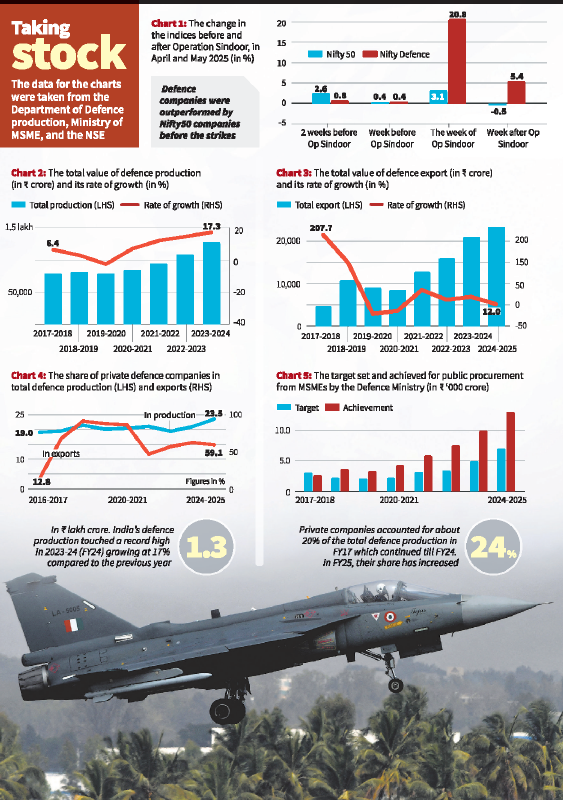
- Govt data shows record-high defence production and exports in recent years.
Key Highlights
1. Domestic Defence Production
| Year | Production Value | Growth |
| FY24 | ₹1.3 lakh crore | +17% YoY |
| FY23 | ₹1.1 lakh crore | Exceeded ₹1 lakh crore mark |
| FY20 | Contraction of 2.5% | Pandemic effect |
| FY25 (Apr–Dec 2024) | ₹90,000 crore (provisional) | Target: ₹1.6 lakh crore |
Trend: Consistent double-digit growth since FY22.
2. Defence Exports
| Year | Export Value |
| FY23, FY24 | > ₹20,000 crore |
| Pre-FY20 | < ₹10,000 crore |
| FY25 Target | ₹30,000 crore |
Includes: Small arms, protective gear, artillery, etc.
Private companies dominate export share via export authorisations.
3. Private Sector & MSME Contribution
| Sector | FY17 | FY24 | FY25 |
| Private share in defence production | 20% | 20% | ~24% |
| MSME procurement | ₹3,000 cr (FY18–FY20) | — | ₹13,000 cr in FY25 |
- MSMEs supply components and subsystems.
- Govt has mandatory procurement targets from MSMEs to promote inclusivity.
4. Stock Market Impact
| Event | Defence Stocks (Nifty Defence Index) | Nifty50 Index |
| Week of Operation Sindoor | +21% | +3.1% |
| Following Week | +5.4% | −0.5% |
Stocks of 18 companies, both public (e.g., HAL) and private (e.g., Paras Defence), surged post-operation.
Challenges
- Still dependent on imports for major platforms and advanced weaponry.
- Share of defence in total government expenditure has been declining.
- Risk of the private sector being outpaced by DPSUs unless supported with R&D and capital.
India in Global Context
- India spends more on defence as % of GDP than many emerging market peers.
- Yet, indigenous ecosystems still catching up with nations like China, Israel, and South Korea.
Prelims facts
| Question | Answer |
| India’s defence production in FY24 | ₹1.3 lakh crore |
| Export target for FY25 | ₹30,000 crore |
| Private sector share in FY25 | ~24% |
| Defence procurement from MSMEs in FY25 | ₹13,000 crore |
| Export items | Small arms, artillery, protective gear |
| Trend in defence stocks post Operation Sindoor | Rose by 21% |
Way Forward
| Focus Area | Recommendation |
| R&D & Tech | Encourage private R&D and reduce import dependency |
| MSME Support | Continue procurement mandates, offer skill & capital support |
| Balanced Budgeting | Increase % share of defence in public spending for long-term goals |
| Export Ecosystem | Strengthen global market access for Indian arms & tech |
North Sikkim’s Chaten region
Context
- North Sikkim’s Chaten region was hit by multiple landslides due to heavy rainfall.
- The disaster led to loss of lives, stranded civilians and Army personnel, and severed road and communication links.
- The incident highlights India’s vulnerability to climate-induced disasters, especially in the Himalayan region.
- It underscores the importance of swift disaster response mechanisms involving the State Government and Armed Forces.
Key Highlights
- Date of incident: June 1, 2025
- Trigger: Heavy rainfall leading to landslides
- Area affected: Chaten, North Sikkim
- Resulted in:
- Road and telecom network disruption
- Casualties among Army personnel
Government Response
- The state government responded to distress calls
- Arranged helicopter sorties in coordination with the Army and Air Force
- Reaffirmed commitment to citizen safety and timely evacuation
Connectivity Crisis
- Landslides caused total road blockage
- Telecommunication breakdown hindered early coordination
Broader Implications
- Reflects the need for:
- Improved early warning systems
- Strengthened disaster infrastructure in remote areas
- Resilient Army logistics in border zones
- Emphasizes the importance of climate-resilient planning in the Eastern Himalayas
India and the United States: bilateral trade negotiations
Context
- India and the United States are engaged in bilateral trade negotiations, focusing on agricultural market access.
- The U.S. is pushing for lower tariffs and greater market access for its farm products in India.
- India is evaluating the impact on its farmers, especially smallholders, before finalising any agreement.
- The first phase of the India-U.S. trade agreement is expected to be concluded by September–October 2025.
Key Highlights
India’s Stance
- Union Agriculture Minister Shivraj Singh Chouhan reaffirmed India’s commitment to protecting farmers’ interests.
- India will assess both gains and losses before finalising any trade deal.
- The priority is to avoid hurting the agricultural and rural economy.
U.S. Demands
- The U.S. is seeking market access for products such as:
- Corn, Soybeans, Animal feed, and Other horticultural products
- These goods face high import tariffs in India — up to 39-50% on average.
Trade Balance (as per NITI Aayog report)
- U.S. exports to India (agri & allied products): $2.22 billion (2022–24 average)
- India’s exports to the U.S. (agricultural produce): $5.75 billion
- India’s key agri-exports to the U.S.:
- Frozen shrimp, Basmati rice, Spices, Processed cereals, Value-added food products
Concerns on the Indian Side
- Fear of price volatility and market disruption due to imported products
- Worries about the livelihood impact on small/marginal farmers
- Strong possibility of rural backlash if dairy and agri markets are liberalised
Way Forward
- India aims for a balanced agreement, promoting trade without harming farmers
- Decision will be data-driven, based on national interests, not pressure
- Continued dialogue and diplomacy to shape the contours of the trade deal
Second Indian to go to space
Context
- Shubhanshu Shukla, an Indian Air Force pilot, is set to become the second Indian to go to space.
- He will travel aboard the Axiom-4 mission to the International Space Station (ISS).
- The mission is being launched by SpaceX in collaboration with Axiom Space.
Key Highlights
Mission Details
- Spacecraft: SpaceX’s Dragon capsule
- Rocket: Falcon 9
- Launch site: Kennedy Space Centre (KSC), Florida
- Launch date/time: Tuesday, 5:52 p.m. IST
- Destination: International Space Station (ISS)
Shubhanshu Shukla
- Age: 39 years
- Profession: Indian Air Force pilot
- Nickname: “Shux”
- Native of: Lucknow, India
- Will become the second Indian in space after Rakesh Sharma (1984)
Crew Composition (Axiom-4)
- Commander: Peggy Whitson (USA)
- Mission specialists:
- Tibor Kapu (Hungary)
- Slawosz Uznanski-Wisniewski (Poland)
- Shubhanshu Shukla (India)
Mission Preparation
- The spacecraft and rocket were rolled out to Launchpad 39A.
- Crew conducted a pre-launch inspection of the Dragon capsule.
Rhodes Scholarship Trust
Context
- The Rhodes Scholarship Trust plans to increase the number of Rhodes Scholarships for Indian students.
- The aim is to better align the number of awards with India’s large population.
Key Highlights
About the Rhodes Scholarship
- It is a prestigious international scholarship for studying at the University of Oxford, U.K.
- Offered by the Rhodes Trust, based at Rhodes House, Oxford.
India-Specific Developments
- Currently, 6 scholarships are awarded annually to Indian candidates.
- From 2028 onwards: The number of scholarships is expected to increase.
- The move is intended to reflect India’s large population size (1.5+ billion).
Statement by Richard Trainor
- CEO of the Rhodes Trust and interim warden of Rhodes House.
- He emphasized that India deserves more scholarships based on its population.
- The expansion is part of a broader effort to ensure fair representation globally.
Other Regions in Focus
- Alongside India, the Trust also aims to increase scholarships for:
- China
- Africa
Nomadic Elephant (17th edition)
Context: India and Mongolia are conducting a joint military exercise to improve cooperation and coordination between their armed forces.
Key Highlights
Exercise Name and Location
- Name: Nomadic Elephant (17th edition)
- Dates: May 31 to June 13, 2025
- Venue: Special Forces Training Centre, Ulaanbaatar, Mongolia
Objective
- Enhance interoperability and operational capabilities in:
- Counter-terrorism
- Precision sniping
- Non-conventional warfare
- Conduct operations in semi-urban and mountainous terrain under a UN peacekeeping mandate.
Key Features
- Exchange of best practices between contingents.
- Simulated UN peacekeeping missions to reflect real-world multinational operations.
- Tactical drills for semi-urban and high-altitude combat situations.
- Focus on coordination, preparedness, and mutual trust.
Bilateral Defence Relations
- The exercise is a symbol of growing defence cooperation between India and Mongolia.
- Conducted annually and alternately in both countries.
- Last edition: Umroi, Meghalaya (India) in July 2024
Cultural Significance
- Also promotes cultural understanding and camaraderie among troops.
COVID-19 cases
Context: India is witnessing a gradual rise in COVID-19 cases, prompting health authorities to enhance preparedness and response measures.
Key Highlights
- Active Cases: 6,133
- New Infections (last 48 hours): 769
- Total Deaths since January 2025: 65
- Deaths in last 24 hours: 6
- Cases on May 22, 2025: 257
Severity and Management
- Most cases are mild and are being managed under home care, according to official sources.
- No widespread hospitalisation surge reported yet.
Worst-Affected States
- Kerala (most affected)
- Gujarat
- West Bengal
- Delhi
Government Response and Preparedness
- Drills are being conducted at health facilities to check readiness.
- Instructions issued to ensure:
- Availability of oxygen
- Isolation beds
- Ventilators
- Essential medicines
Meetings and Surveillance
- Technical review meetings were held on June 2 and 3 under Sunita Sharma, Director-General of Health Services.
- Participants included representatives from:
- Disaster Management Cell
- Emergency Management Response Cell
- NCDC, ICMR, IDSP
- Central Govt Hospitals
- State and UT health departments
- Surveillance: State and district units are closely monitoring:
- ILI (Influenza-Like Illness)
- SARI (Severe Acute Respiratory Illness)