
Dialogue with the Kuki-Zo insurgents
Context
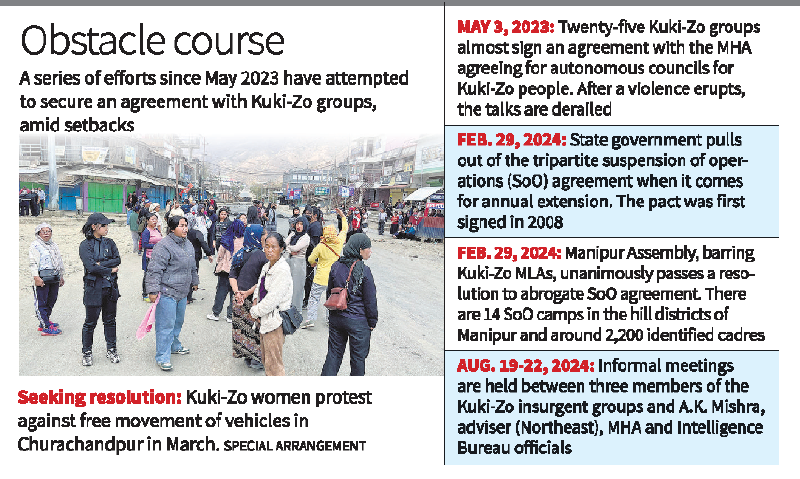
- The Union Home Ministry will resume talks with Kuki-Zo insurgent groups in Manipur after two years.
- Talks are scheduled on June 9, 2025, involving A.K. Mishra (NE Adviser, MHA) and IB officials.
- These groups are under a Suspension of Operations (SoO) agreement signed in 2008, with periodic renewals.
- The Manipur government withdrew from the pact on Feb 29, 2024, citing security concerns.
- Talks aim to renegotiate the pact with stringent norms and revised ground rules.
Key Highlights
- Original SoO Objective: Cease hostilities and bring insurgents into political dialogue; cadres were protected from arrest under set conditions.
- Cadres and Camps:
- Approx. 2,200 cadres from 25 groups under UPF and KNO.
- Currently stay in 14 designated camps; may be reduced to 7.
- Camps near Meitei-dominated valley areas likely to be relocated or shut.
- Demand Evolution:
- Before 2023 violence: Demand for autonomous territorial councils.
- After May 2023: Demand shifted to the Union Territory with a legislature for Kuki-Zo areas.
- Violence & Fallout:
- May 3, 2023: Ethnic violence between Meitei and Kuki-Zo erupted.
- Resulted in 250 deaths and 60,000 displaced persons.
- Allegations of SoO cadre violations of ground rules during unrest.
- Stipend Issues:
- Cadres are entitled to ₹6,000/month.
- No payments have been made since May 2023 due to conflict and withdrawal.
- New Conditions for SoO:
- Separate ground rules are being formulated.
- Camps to be monitored; weapons checked regularly.
- No extension of SoO unless these norms are accepted and enforced.
Exam Special Points
| Theme | Relevance |
| Internal Security | As a case study of conflict management in the Northeast. |
| Ethnic Conflicts | Insight into Meitei vs Kuki-Zo tensions and demand for separate administration. |
| Centre-State Relations | Highlights friction when the Manipur government unilaterally withdrew from the tripartite pact. |
| Peacebuilding Frameworks | Use of ceasefire and dialogue as tools for insurgent integration. |
| Governance Mechanisms | Monitoring agencies, designated camps, and stipends – components of insurgent reintegration. |
| Security Forces’ Role | IB and MHA are leading negotiations; security camps are being restructured. |
| Post-conflict Rehabilitation | Economic packages (stipend), camp relocation, and arms monitoring are crucial. |
Delimitation of parliamentary seats
Context
- Issue: Southern States are concerned that the upcoming delimitation of parliamentary seats (post-2026) may reduce their representation if it is based solely on population data.
- Backdrop: In 2001, a constitutional amendment froze seat redistribution until 2026, acknowledging that Southern states had better success in controlling population growth.
- Recent Statement: Andhra Pradesh CM N. Chandrababu Naidu expressed confidence that PM Narendra Modi will handle the issue with sensitivity, keeping national unity and regional sentiment in mind.
Key Highlights
- Naidu’s Confidence in PM:
- CM Naidu trusts that the PM will balance national interest with southern sentiments.
- Emphasised that the PM will take everyone along before proceeding with delimitation reforms.
- Historical Role:
- Naidu was instrumental in the 2001 consensus to delay inter-State redistribution of seats for 25 years under the Vajpayee-led NDA.
- Southern States’ Concerns:
- Population control success has turned into a disadvantage in representation.
- Delimitation purely based on population size may favour northern states with higher growth rates.
- Demographic Shift Warning:
- Naidu highlighted population decline and ageing in the south.
- Urged for demographic management to address labour and productivity challenges.
- Acknowledged migration trends from North to South due to demographic imbalance.
- Future Steps:
- Has not yet spoken directly to the PM but plans to raise the issue at the right time.
- Does not support incentives for childbirth, citing global ineffectiveness.
- Suggests rethinking population policy to sustain economic and social development in the South.
Exam Special Points
| Theme | Relevance |
| Polity &Constitution | Delimitation post-2026 based on population – key constitutional and political issue. |
| Federalism | Reflects the North-South divide and regional sensitivities in national representation. |
| Demographics | Case study in demographic transition – falling birth rates and ageing in Southern India. |
| Governance &Policy | Naidu’s remarks stress the need for proactive population management and inter-governmental dialogue. |
| History of Delimitation | The 2001 constitutional amendment froze seat redistribution till 2026 – UPSC prelims and mains are important. |
| Centre-State Relations | Highlights the role of consensus and negotiation in addressing federal concerns. |
| Ethics &Governance | Balancing national interest with equitable regional representation is a key governance challenge. |
Delhi and Rajasthan begin storing fingerprints
Context of the News
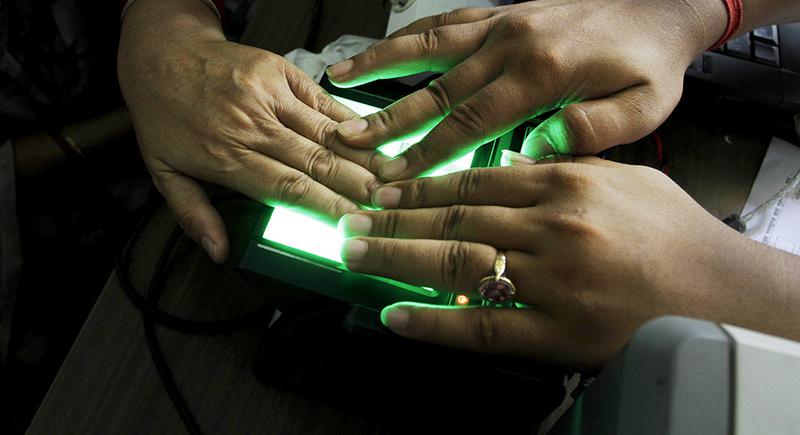
- Delhi and Rajasthan have become the first Indian states to implement the Criminal Procedure (Identification) Act, 2022 on a pilot basis, starting March 2025.
- This Act authorizes law enforcement to record, store, and analyze biometric and physical data of arrested or accused individuals.
- The implementation marks a significant step in policing reforms, with a focus on enhancing investigative capabilities using technology.
Key Highlights
- Scope of Data Collection:
- Includes fingerprints, palm prints, footprints, photographs, iris and retina scans, and handwriting/signature samples.
- DNA collection (from blood or other samples) is yet to be implemented due to limited forensic infrastructure.
- Applicable to all accused individuals, even if not formally arrested.
- Implementation Details:
- Carried out in Delhi and selected police districts of Rajasthan.
- The National Crime Records Bureau (NCRB) is the nodal agency for execution.
- NCRB has finalized Standard Operating Procedures (SOPs) for data collection and analysis.
- Criminal Procedure (Identification) Act, 2022:
- Replaces the Identification of Prisoners Act, 1920.
- Significantly broadens the scope of data collection from convicts and accused persons.
- Aims to modernize crime investigation and maintain a centralized biometric database.
- Future Plans:
- Face recognition and DNA profiling to be introduced across ~1,300 locations in India.
- Collaboration with forensic labs is ongoing to finalize DNA loci pointers for profiling.
- NCRB is developing a central digital platform for biometric data.
Exam Special Points
| Theme | Relevance |
| Polity & Governance | Criminal Procedure (Identification) Act, 2022—important legislation replacing outdated colonial-era laws. |
| Internal Security | Enhances capacity for forensic-based policing and criminal tracking systems. |
| Technology in Policing | Case study in the integration of biometrics, AI, and central databases in criminal investigations. |
| Data Privacy & Ethics | Raises questions on consent, data protection, and surveillance ethics—important for GS Paper II & IV. |
| Criminal Justice System | Relevant for reforms in investigation and trial processes, especially under the CrPC and IPC reforms. |
| Role of Institutions | NCRB’s role in standardizing procedures and data management across states. |
India rejects any equivalence between India and Pakistan
Context of the News
- During British Foreign Secretary David Lammy’s visit to India (June 2025), Indian External Affairs Minister S. Jaishankar delivered a strong diplomatic message: India rejects any equivalence between India and Pakistan in matters of terrorism and conflict resolution.
- The statement was a response to Lammy’s earlier remarks in Pakistan, where he spoke of the U.S. and U.K. working with both India and Pakistan for a ceasefire and dialogue post the Pahalgam terror attack and Operation Sindoor.
Key Highlights
- Zero Tolerance on Terrorism:
- Jaishankar reaffirmed India’s policy of zero tolerance towards terrorism.
- Asserted that India would not accept “perpetrators of evil” being equated with victims of terror.
- Appreciated U.K.’s condemnation of the Pahalgam attack.
- Diplomatic Pushback:
- Strong statement reflects India’s opposition to third-party mediation or “hyphenation” with Pakistan in global diplomacy.
- India has consistently opposed the involvement of external powers in India-Pakistan bilateral issues, including Kashmir.
- Reference to Operation Sindoor:
- Operation Sindoor was a brief military escalation following a terror attack.
- Some global powers had offered mediation, but India rejected such overtures, reinforcing its bilateral approach.
- India-U.K. Bilateral Ties:
- Jaishankar called the India-U.K. Free Trade Agreement (FTA) a potential “milestone”.
- Hinted at ongoing negotiations on defence, trade, and tech cooperation.
- Lammy’s Engagements:
- Also met with Prime Minister Narendra Modi during his visit.
- No official comment from MEA on discussions regarding UNSC terror listings or Pakistan’s role.
Exam Special Points
| Topic | Relevance |
| International Relations (GS II) | India-U.K. bilateral relations, FTA prospects, and global diplomacy principles. |
| India’s Foreign Policy Doctrine | Reiteration of India’s stance: No third-party mediation, especially in Pakistan-related issues. |
| Terrorism & Security (GS III) | India’s firm zero-tolerance policy on terrorism — relevant for both mains and interviews. |
| Diplomatic Terminology | “Hyphenation” – UPSC may test such concepts where India resists being clubbed with adversarial nations. |
| Multilateral Institutions | Indirect mention of UNSC terror committees – useful for understanding India’s stance on global terror regulation. |
| Recent International Visits (2025) | David Lammy’s visit is important under India–UK diplomacy and current events. |
Immigrants (Expulsion from Assam) Order, 1950
Context of the News
- Assam Chief Minister Himanta Biswa Sarma stated that the State may bypass lengthy legal processes and tribunals for deporting “illegal immigrants”.
- Instead, the government may invoke the Immigrants (Expulsion from Assam) Order, 1950, which allows for direct deportation through administrative orders without referring cases to Foreigners Tribunals (FTs) or courts.
Key Highlights
- Use of 1950 Order:
- The Immigrants (Expulsion from Assam) Order, 1950, empowers District Commissioners to issue deportation orders.
- It allows for immediate pushback of individuals found to be residing illegally.
- Avoidance of Legal Route:
- Assam currently has 100 Foreigners Tribunals (FTs) established since 2005 to adjudicate suspected cases of illegal immigration.
- CM stated that these may be bypassed in future actions based on recent observations by the Supreme Court.
- Supreme Court Observation:
- During hearings on Article 6A of the Citizenship Act, 1955, the Constitution Bench noted that the 1950 Order remains valid and can be applied.
- The court’s observation provided a legal basis for bypassing the FT route.
- Impact of NRC Exercise:
- The National Register of Citizens (NRC) update had earlier slowed down the deportation process.
- Over 19 lakh people were excluded from the NRC list in Assam (published in 2019), raising questions about their citizenship.
- Deliberation Underway:
- CM Sarma stated that the government will deliberate before implementing the strategy.
- Emphasized “pushback” as a state policy alternative to prolonged litigation.
Exam Special Points
| Topic | Relevance |
| Polity & Governance (GS II) | Invoking the 1950 Order highlights the role of executive orders and federal structure in citizenship and migration issues. |
| Judiciary | Refers to SC observations on Article 6A – part of the ongoing constitutional review related to the Assam Accord. |
| Internal Security (GS III) | Issue of illegal immigration and its handling is critical for India’s border security and demographic integrity, especially in Assam. |
| Citizenship & NRC | Important context for NRC, CAA, and broader debates on citizenship criteria in India. |
| Ethics & Governance (GS IV) | Raises ethical and legal questions on due process, human rights, and executive discretion. |
| Assam-Specific Issues | Useful for aspirants targeting state services or preparing for questions on northeast India. |
G-7 Summit in Kananskis
Context of the News
- Canada’s Prime Minister Mark Carney has officially invited Prime Minister Narendra Modi to attend the upcoming G-7 Summit in Kananskis, Alberta.
- This move comes amidst ongoing tensions between India and Canada, especially over the 2023 Nijjar killing investigation.
Key Highlights
Invitation to India
- India invited to the G-7 Summit as a guest country.
- Carney called Modi on Friday and extended the invitation.
- Modi responded affirmatively, emphasizing democratic values and people-to-people ties between the two nations.
India’s Global Economic Role
- Carney justified the invitation, citing:
- India’s position as the 5th-largest economy.
- India’s central role in global supply chains, including:
- Energy
- Artificial Intelligence
- Critical minerals
Strategic Relevance
- Carney stated India is among the mainstream global powers and essential to any global dialogue on economic and technological issues.
On the Nijjar Case
- The media raised the Khalistan-related killing of Hardeep Singh Nijjar (June 2023), allegedly involving Indian state actors.
- Carney declined to comment, citing:
- Ongoing legal proceedings in Canada.
- Importance of not interfering in judicial matters.
Exam Special Points
| Topic | Relevance |
| International Relations (GS II) | Highlights India’s participation in G-7 as a guest, reinforcing its role in global governance despite not being a member. |
| Economic Diplomacy | India’s position as the 5th-largest economy is used diplomatically to justify its inclusion in high-level global forums. |
| India-Canada Relations | Despite diplomatic tensions, engagement continues at the highest level, showing the balance of strategic interest and diplomacy. |
| Global Issues Discourse | G-7 discussions expected to cover AI, critical minerals, energy, all key UPSC themes under GS III, and IR. |
| Ethics in International Relations (GS IV) | Carney’s non-interference stance in ongoing legal processes shows adherence to the rule of law and diplomatic restraint. |
Bangladesh Nationalist Party (BNP)
Context of the News
- The Bangladesh Nationalist Party (BNP) has strongly criticized Chief Adviser Muhammad Yunus’s announcement to conduct general elections in April 2026.
- The BNP has reiterated its demand for elections by December 2025, citing both logistical and public sentiment concerns.
Key Highlights
BNP’s Objections
- BNP termed the delay in elections as “unwarranted” and against public sentiment.
- Claimed the 2024 July Uprising was driven by a demand for immediate elections and the restoration of democracy.
- Elections in April may coincide with Ramzan and exams, posing logistical and campaign challenges.
Procedural Concerns
- No clear justification was given for why elections cannot be held in December 2025.
- BNP accused Yunus of overstepping the interim government’s mandate by discussing issues like ports, corridors, and justice reforms.
Criticism of Language and Intent
- BNP said Yunus’s speech “crossed limits of political decorum.”
- Warned that such delays may be used to further stall elections, undermining the democratic process.
Political Context
- BNP has been out of power since 2006 and accuses the ruling Awami League of suppressing democratic rights.
- There has been a long-standing demand for elections under a neutral caretaker government.
- The interim government, led by Muhammad Yunus, is tasked with preparing the ground for the next election.
Taliban Offers Amnesty to Afghan Refugees
Key Highlights
- Offer of Amnesty: Taliban Prime Minister Mohammad Hassan Akhund urged all Afghans who fled after the Western-backed government’s collapse to return without fear of harm.
- Occasion: The offer was made in a message during the Islamic festival of Id-ul-Azha (Eid al-Adha).
- Message Content:
- “Nobody will harm them.”
- Return to your “ancestral land and live in peace.”
- Taliban officials were instructed to ensure services, shelter, and support for returnees.
Geopolitical Context
- US Travel Ban: Recently, President Donald Trump reintroduced a travel ban on 12 countries, including Afghanistan.
- The ban applies to both permanent and temporary immigration.
- The core refugee resettlement programme has also been suspended.
- Pakistan Deportation Drive:
- Since October 2023, nearly 1 million Afghans have fled Pakistan amid mass deportations.
- Many of them are awaiting U.S. resettlement.
Extreme Poverty in India Falls to 5.3% (2022-23)
Key Highlights
- Extreme Poverty Rate:
- Fell from 27.1% (2011-12) to 5.3% (2022-23).
- Reflects massive poverty reduction over a decade.
- Updated Poverty Line:
- World Bank revised the extreme poverty line to $3/day (from $2.15/day in 2021 PPP).
- This revision considers India’s inflation from 2017 to 2021 (~15%).
- 2024 Estimate:
- 5.44% of Indians (≈ 54.7 million people) live on less than $3/day (2021 PPP).
Trend Over Time
| Year | Extreme Poverty Rate (%) | Poverty Line Basis |
| 2011–12 | 27.1% | $2.15/day |
| 2017–18 | 16.2% | $2.15/day |
| 2022–23 | 5.3% | Revised to $3/day (2021 PPP) |
| 2024 | 5.44% | $3/day |
Additional Data
- Lower Middle-Income Country Line:
- Poverty under this metric declined by 33.7 percentage points from 2011-12 to 2022-23.
Proton Emitter: Astatine-188
Key Facts:
- Isotope: Astatine-188 (^188At)
- Significance: Heaviest known proton emitter detected and measured experimentally.
- Half-life: ~190 microseconds.
- Decay Process: Proton emission (rare), followed by alpha decay chains ending in a stable nucleus.
- Produced by: Fusion-evaporation reaction — irradiating a silver target with strontium ions.
- Detection technique: Recoil-Ion Transport Unit recoil separator.
- Shape of nucleus: Strongly prolate (elongated watermelon shape).
Scientific Context:
- Proton Emission:
- Unlike common alpha, beta, and gamma decay, proton emission is rare and occurs at the proton drip line, where adding more protons causes the last proton to “drip” or escape.
- This detection is the first lab-based observation and study of proton emission for such a heavy isotope.
- Nuclear Structure:
- The shape of the nucleus affects proton emission and half-life.
- Theoretical calculations confirmed the shape and helped explain the experimental data.
Contribution & Collaboration:
- Lead institution: University of Jyväskylä, Finland.
- IIT Roorkee’s Department of Physics is involved in theoretical calculations.
- Collaboration includes Universidade de Lisboa, Portugal.
Using Bacteriophages to Combat Antimicrobial Resistance
Context:
- Antimicrobial Resistance (AMR) is a growing global health crisis, with an estimated 5 million deaths annually linked to it, potentially doubling by 2050.
- Antibiotics are becoming less effective as bacteria develop resistance, and pharmaceutical companies are reluctant to invest in new antibiotics due to low financial incentives.
- Bacteriophages (phages) are viruses that naturally infect and kill bacteria. They are abundant in nature and were once used to treat bacterial infections before antibiotics became widespread.
- Due to AMR, phages are being reconsidered as a promising alternative or adjunct to antibiotics.
Key Highlights:
- Phage Therapy: Phages target specific bacteria and have been used for various infections such as burns, ulcers, urinary tract infections, and respiratory infections.
- Two Approaches:
- Use natural phages matched to a patient’s bacterial infection from phage banks.
- Use genetically engineered phages to broaden the range of bacteria targeted.
- Regulatory Status: No Western government has fully approved phages as drugs yet; use is mostly under compassionate or emergency-use authorizations.
- Innovative Solution: Research in Belgium explores a device that isolates bacteria, sequences their genome, uses AI to select or design phages, synthesizes them on-site, and administers treatment, potentially bypassing traditional drug regulations.
- Urgency: AMR demands large-scale, innovative interventions, with phage therapy being a promising frontier, especially when combined with AI and genomic technologies.
U.S. Support to India in the Fight Against Terrorism
Context:
- A multi-party Indian parliamentary delegation led by Congress MP Shashi Tharoor visited Washington to convey India’s position on recent terror-related incidents, specifically the Pahalgam terror attack and Operation Sindoor targeting terror infrastructure in Pakistan and Pakistan-occupied Kashmir.
- The delegation met U.S. Deputy Secretary of State Christopher Landau to discuss these issues and reinforce India-U.S. cooperation on counter-terrorism.
Key Highlights:
- U.S. Commitment: Christopher Landau reaffirmed the United States’ strong support for India in the fight against terrorism.
- Bilateral Relations: The discussion also covered strengthening the broader U.S.-India strategic partnership, including expanding trade and commercial ties.
- Official Statements: The U.S. State Department reiterated its backing of India’s counter-terrorism efforts and highlighted the strategic partnership.
- Senate Engagement: The delegation had a productive meeting with Senator Chris Van Hollen from the Senate Foreign Relations Committee, emphasizing congressional engagement with India on these issues.
- Diplomatic Tone: The meeting was described as warm, candid, and productive by both sides.