
Repo rate and cash reserve ratio (CRR)
Context:
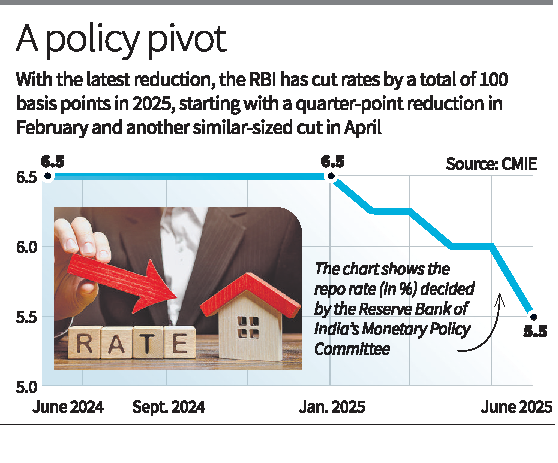
The Reserve Bank of India (RBI) has reduced the repo rate and cash reserve ratio (CRR) to stimulate economic growth amid controlled inflation. These steps are aimed at enhancing liquidity in the banking system, lowering borrowing costs, and improving credit flow. This comes at a time when GDP is projected to grow steadily and inflation is within the RBI’s tolerance band.
Key Highlights:
Monetary Policy Decisions:
- Repo Rate Cut:
- Reduced by 50 basis points to 5.5%, effective immediately.
- Third cut since February 2025.
- Aims to reduce interest rates on loans and support economic activity.
- CRR (Cash Reserve Ratio) Reduction:
- Cut by 100 basis points (1%) staggered during Sept–Nov 2025.
- Final CRR will be 3% of NDTL by the end of November 2025.
- Expected to release ₹2.5 lakh crore into the banking system.
Macroeconomic Indicators:
- Real GDP Growth Forecast for FY 2025–26: Maintained at 6.5%.
- CPI Inflation Forecast for FY 2025–26: Revised down to 3.7%.
- Q1: 2.9%, Q2: 3.4%, Q3: 3.9%, Q4: 4.4%.
Policy Stance Change:
- RBI’s stance changed from accommodative to neutral.
- Indicates that the RBI may adjust rates up or down depending on future data and inflation trends.
Growth & Liquidity Outlook:
- Rural and urban demand expected to strengthen.
- Private consumption, services sector growth, and public capital expenditure to drive momentum.
- Agriculture prospects are bright due to the above-normal monsoon forecast.
- Improving corporate balance sheets and rising capacity utilisation will aid investments.
Monetary Transmission & Credit Health:
- Lower CRR and repo rates to reduce banks’ cost of funds, aiding in cheaper loans.
- Retail segment stress (e.g., personal loans, credit cards) has eased.
- Microfinance sector stress still persists; lenders are tightening credit and collection practices.
Global Economic Watch:
- RBI remains alert to fast-changing global economic developments.
- Further actions will depend on evolving domestic and international macroeconomic trends.
PM Inaugurates Rail Projects in Jammu & Kashmir
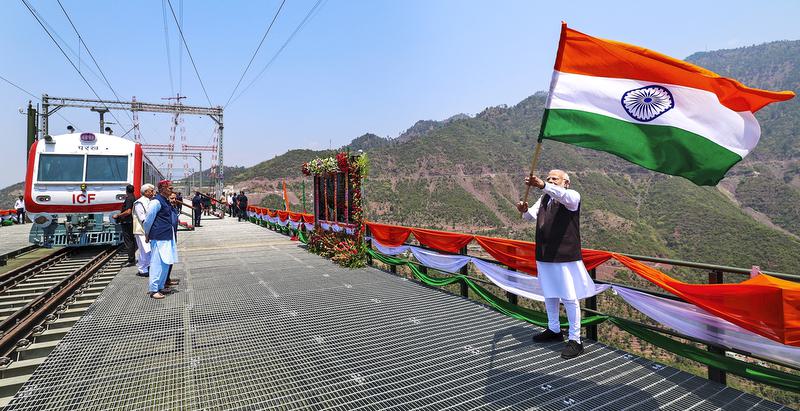
Major Infrastructure Projects Inaugurated:
- Chenab Bridge – The World’s highest railway arch bridge.
- Anji Bridge – India’s first cable-stayed rail bridge.
- Vande Bharat Express – First passenger train service from Katra to Srinagar, linking Jammu to the Kashmir valley and connecting it to the Indian mainland.
Economic Impacts Highlighted:
- Easier and faster movement of Kashmir apples, dry fruits, Pashmina shawls, and handicrafts to Indian markets.
- Railway connectivity is expected to:
- Boost tourism
- Lower transportation costs
- Enhance market access for artisans and local industries
Significance for Exams:
- Chenab Bridge: A Strategic engineering marvel; boosts connectivity in border areas.
- Operation Sindoor: India’s swift response to terror; an example of counter-terror diplomacy.
- Railway Connectivity: Symbol of national integration (“Kashmir to Kanyakumari”).
- Tourism & Trade: Revitalization of regional economy through infrastructure.
- Pashmina & Apples: Keywords for regional export-based questions.
Bangladesh to Hold National Elections in April 2026
Election Announcement
- National elections in Bangladesh will be held in the first half of April 2026, according to interim Chief Adviser Muhammad Yunus.
Political Context
- Bangladesh is in a “state of war”, Yunus claimed, referring to attempts by “domestic and international supporters of the defeated fascist government” to destabilize the interim setup.
- The announcement comes amid pressure from the army chief, Gen. Waker-uz-Zaman, and the Bangladesh Nationalist Party (BNP), who were demanding polls by December 2025.
Remarks Against the Previous Government
- Without naming her directly, Mr. Yunus referred to Sheikh Hasina and her administration as the “defeated fascist government“.
- Accused them of plotting a comeback and attempting to derail reforms post the July uprising.
Legal Proceedings
- The International Crimes Tribunal in Dhaka will take up a case against Sheikh Hasina and former Home Minister Asaduzzaman Khan Kamal on June 16, 2025.
Exam-Ready Insights
| Topic | Relevance |
| Bangladesh Politics | Transition period post-Sheikh Hasina’s rule; interim governance |
| Regional Stability | Accusations of fascism and instability may affect India-Bangladesh relations |
| International Crimes Tribunal (ICT) | Active legal instrument in Bangladesh’s justice system post-1971 |
| Youth Participation in Democracy | Focus on inclusive elections involving young voters |
RBI Reduces Qualifying Asset Threshold for NBFC-MFIs to 60%
Key Announcement
- The Reserve Bank of India (RBI) has reduced the qualifying asset threshold for Non-Banking Financial Companies – Microfinance Institutions (NBFC-MFIs) from 75% to 60% of total assets (excluding intangibles).
- Change to be applied on an ongoing basis.
RBI Compliance Norm
- If an NBFC-MFI fails to maintain the 60% threshold for four consecutive quarters, it must:
- Report to the RBI
- Submit a remediation plan for further regulatory decision.
Objective and Expected Benefits
- Promotes diversification of NBFC-MFI asset portfolios.
- Strengthens the financial health and stability of microfinance institutions.
- Aims to enhance access to credit for poor households.
| Topic | Significance |
| NBFC-MFIs | Key players in financial inclusion and micro-credit delivery |
| Monetary Policy Tools | Example of regulatory flexibility to enhance sector resilience |
| RBI Regulatory Powers | Oversight and conditional compliance mechanism (remediation clause) |
| Financial Inclusion | Helps poorer households access credit under structured microfinance reforms |
RBI’s Steep Rate Cut Meant to Offer Certainty to Stakeholders
Key Decisions (Reiterated from Monetary Policy)
- Policy Repo Rate cut by 50 basis points (bps) to 5.5%
- CRR (Cash Reserve Ratio) cut by 100 bps, staggered over four months
- Policy stance changed from ‘accommodative’ to ‘neutral’
RBI Governor’s Key Points
| Theme | Remarks |
| Inflation Control | “We have won the war against inflation”; CPI forecast cut from 4% to 3.7% |
| Growth Outlook | GDP projected at 6.5%, with scope for further rise |
| Reason for Front-loaded Cut | Wanted to bring clarity and certainty to markets and banks |
| CRR Cut Timing | Even though liquidity release could happen later, early announcement helps planning |
| Policy Stance Shift | “Accommodation was intent; we made it action.” Neutral stance reflects data-dependent outlook |
| Geopolitical Impact | India–Pakistan conflict has no meaningful economic impact, said RBI |
| Topic | Relevance |
| Monetary Policy Tools | Example of front-loaded easing to create market certainty |
| Repo Rate vs CRR | Dual easing signals liquidity infusion + rate transmission |
| Policy Stance (Neutral) | Offers data-driven flexibility for future hikes/cuts |
| Macroeconomic Management | RBI balances inflation targeting and growth support effectively |
PM Modi’s visit to the G-7 Summit in Canada
Context
Prime Minister Narendra Modi has accepted an invitation from newly elected Canadian Prime Minister Mark Carney to attend the G-7 Summit in Kananaskis, Alberta, scheduled for next week. This visit marks a significant development in India-Canada relations, which have been strained in recent years due to issues such as Khalistani separatist activities, the killing of Hardeep Singh Nijjar, and the mutual expulsion of diplomats. The invitation, extended on a phone call, signals a diplomatic reset and a step toward restoring bilateral ties.
Key Highlights
- First visit to Canada by PM Modi since 2015, amid previously strained diplomatic ties.
- PM Modi was invited by Canadian PM Mark Carney to attend the G-7 Summit as a guest invitee.
- The summit will be held in Kananaskis, Alberta, Canada next week.
- The visit may help normalize India-Canada relations, especially after the 2023–24 diplomatic row over Nijjar’s killing.
- Modi emphasized mutual respect and people-to-people ties, aiming to strengthen bilateral cooperation.
- Both leaders agreed on continued law enforcement dialogue and addressing security concerns.
- The visit coincides with two major anniversaries:
- 40 years of the Air India Kanishka bombing (June 23, 1985)
- 2 years since Nijjar’s death (June 18, 2023)
- Modi will meet with other G-7 leaders, including U.S. President Donald Trump, marking a first diplomatic interaction post-Operation Sindoor.
- The short notice of the invite added to the surprise, indicating an effort by Canada to diplomatically re-engage with India.
4th India–Central Asia Dialogue
Context
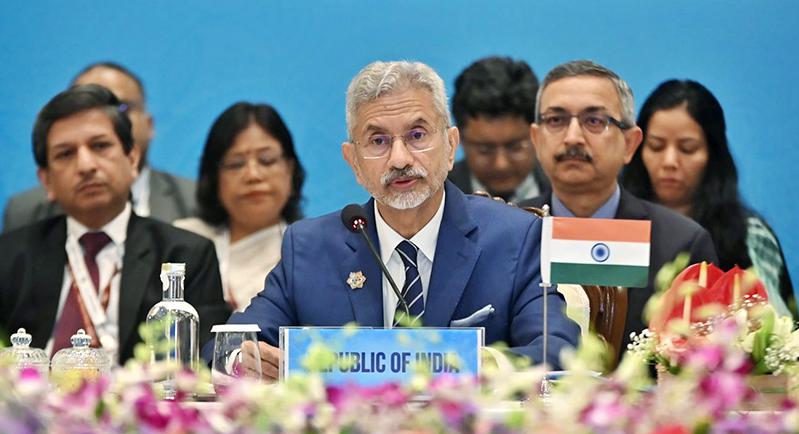
The 4th India–Central Asia Dialogue was held in New Delhi, chaired by External Affairs Minister S. Jaishankar, amid growing concerns over regional security and terrorism. The meeting was marked by a strong show of solidarity by Central Asian nations against the recent Pahalgam terror attack in India. The dialogue also focused on boosting connectivity, trade, and regional cooperation, particularly through mechanisms like the International North-South Transport Corridor (INSTC).
Key Highlights
- Strong condemnation by Central Asian nations of the Pahalgam terror attack (April 22).
- Foreign Ministers from Kazakhstan, Uzbekistan, Kyrgyzstan, Tajikistan, Turkmenistan, and India participated.
- The joint statement emphasized:
- Zero tolerance for terrorism in all forms.
- Opposition to terrorist safe havens, financing, radical propaganda, and cyber misuse.
- Call for perpetrators, organisers, and sponsors of terrorism to be brought to justice.
- India thanked Central Asia for its solidarity post-Pahalgam attack.
- Push for regional connectivity and trade:
- Reaffirmed commitment to the International North-South Transport Corridor (INSTC).
- India supported Turkmenistan and Uzbekistan’s membership in INSTC.
- Agreed on enhancing financial connectivity via:
- Digital payment systems
- Stronger inter-bank relations
- Trade in national currencies
- Dialogue aimed at strengthening strategic, economic, and security cooperation between India and Central Asia.
World’s top defence exporters
Context
Speaking in Udhampur’s Katra, Prime Minister Narendra Modi underscored India’s ambition to become one of the world’s top defence exporters, citing the success of Operation Sindoor as a testament to the country’s growing self-reliance under the Atmanirbhar Bharat initiative. The speech reflects a push to not only boost India’s military capabilities but also stimulate domestic defence manufacturing and employment.
Key Highlights
- Operation Sindoor hailed as a symbol of the strength of Atmanirbhar Bharat (self-reliant India).
- PM Modi declared that India aims to become one of the top global defence exporters.
- In the past decade, India has emerged as a leading defence exporter, moving away from its traditional role as a major importer.
- Employment potential: Defence exports are expected to generate large-scale employment across sectors in India.
- PM urged citizens to uphold the dignity of ‘Made in India’ products not only in defence but also in broader commerce.
- Cited the trust of the Indian armed forces in indigenous weapons and equipment as a reason behind recent military success.
- Reinforced the need for public and private commitment to strengthen the domestic defence manufacturing ecosystem.
The Chenab Bridge
Context
The Chenab Bridge, part of the Udhampur-Srinagar-Baramulla Rail Link (USBRL) project in Jammu & Kashmir, has been engineered to withstand the failure of even one pier without collapsing—a rare and remarkable structural feature. Designed in part by Prof. G. Madhavi Lata from the Indian Institute of Science (IISc), Bengaluru, the bridge is an engineering marvel, combining extreme height, seismic resistance, wind endurance, and geotechnical adaptability in the challenging Himalayan terrain.
Key Highlights
- Bridge Design Resilience: Chenab bridge can remain structurally sound even if one of its eight piers collapses—trains can still operate on it at reduced speed.
- Key Contributor: Conceptualised by Prof. G. Madhavi Lata, a geotechnical engineering expert from IISc Bengaluru, who has worked on the project since 2005 as a consultant for AFCONS Infrastructure.
- Engineering Facts:
- Height: 359 metres above Chenab River (taller than the Eiffel Tower, and equal to 4 Qutub Minars stacked).
- Length: Total length of 1,315 metres with a 467-metre arch span—the largest in India.
- Part of: The USBRL project, which includes 927 bridges overall.
- Wind & Earthquake Resistant:
- Can withstand winds up to 220 km/h.
- Built to resist major Himalayan earthquakes.
- Geotechnical Challenges:
- Foundations rest on fragile Himalayan slopes full of cracks and fissures.
- Stabilisation achieved via cement grouting and steel rock anchors embedded deep into the slopes.
- Required a flexible design approach due to continuous surprises during construction.
- Structural Type: It is India’s only arch-shaped railway bridge, and one of the few in the world, comparable to similar bridges in China.
Elon Musk’s Starlink
Context
Elon Musk’s Starlink, a satellite internet service developed by SpaceX, has received a licence from the Indian government’s Department of Telecommunications (DoT) to provide satellite internet services in India. This license is a major step forward for Starlink’s plan to launch commercial broadband services in the country, making it one of the few companies authorised to offer satellite-based internet connectivity.
Key Highlights
- Licence Granted: Starlink has become the third company after Eutelsat OneWeb and Jio Satellite Communications to get a satellite internet licence from India’s DoT.
- Trial Spectrum: Starlink will receive a trial spectrum allocation within 15-20 days of its application for trials.
- Security Compliance: Before commencing services, Starlink must comply with security regulations, including providing access for lawful interception as mandated by Indian authorities.
- Competition: Another major player, Amazon’s Kuiper, is still awaiting approval to operate in India.
- Service Description: Starlink uses a network of low-earth orbit satellites to provide high-speed broadband internet globally, often described as “broadband beamed from the skies.”
UMEED portal
Context
The Government of India, through the Ministry of Minority Affairs, has launched the UMEED portal—short for Unified Waqf Management, Empowerment, Efficiency and Development—a centralized digital platform designed to improve the management, transparency, and monitoring of Waqf properties across the country. This initiative aims to strengthen the administration of Waqf assets, which are community-owned properties intended primarily for the welfare of the Muslim minority.
Key Highlights
- Portal Launch: The UMEED portal was launched by Union Minister for Minority Affairs, Kiren Rijiju, to enable real-time uploading, verification, and monitoring of Waqf assets.
- Digital Inventory & Geotagging: The portal features a digital inventory of Waqf properties with geotagging, improving accuracy and ease of tracking.
- Transparency & Accountability: It aims to bring greater transparency, accountability, and public participation in the administration of Waqf properties.
- Grievance Redressal & GIS Integration: The platform includes an online grievance redressal system and integrates with GIS mapping and other e-governance tools.
- Public Access: Verified records and reports related to Waqf properties will be accessible to the public, fostering openness.
- Focus on Beneficiaries: The portal is expected to particularly benefit poor Muslims, especially women and children, ensuring Waqf assets serve their original welfare purpose.
- Significance: The initiative is described as a historic step and a firm government commitment to protecting minority rights and enhancing the efficient use of community-owned assets.
Bharatiya Bhasha Anubhag (BBA) initiative by Amit Shah
Context
Union Home Minister Amit Shah launched the Bharatiya Bhasha Anubhag (BBA), or Indian Languages Section, to promote the use of India’s diverse native languages in governance and administration. The initiative aims to reduce the dominance and influence of foreign languages, especially English, in official communication and decision-making processes. This move aligns with efforts to strengthen local languages and bring them to the forefront of government affairs, enabling better engagement with India’s linguistic diversity.
Key Highlights
- Objective: BBA’s goal is to free administration from foreign language influence and enhance governance through mother tongue languages.
- Linguistic Diversity: The Section will serve as a platform to integrate and strengthen all Indian languages in official use, promoting India’s linguistic plurality.
- Policy Backing: ₹56 crore allocated in the Union Budget 2024-25 for developing a translation platform that facilitates language conversion between Hindi and other Indian languages.
- Official Language Rules: Currently, official communication with certain southern states (Region C — Tamil Nadu, Kerala, Karnataka) is mandated in English due to language rules.
- Translation Facilitation: BBA will help address communication gaps by translating correspondence between the Centre and States in their respective official languages, ensuring smoother and respectful dialogue.
- Vision: Amit Shah emphasized that true potential is realized when thinking, analysis, and decision-making happen in one’s mother tongue, aiming for India’s cultural and administrative resurgence.
- Interconnected Languages: The initiative underscores the unity and interconnection of all Indian languages, aspiring to strengthen India’s eternal glorious position through local language empowerment.