
Indus Valley Civilization, flourishing from 3300 to 1300 BCE (or 2600 BC – 1900 BC), was a pioneering Bronze Age society known for its advanced urban planning, crafts, trade, and undeciphered script. Major sites like Harappa and Mohenjo-Daro highlight its sophisticated culture and gradual decline around 1900 BCE.
Indus Valley Civilization
The Indus Valley Civilization (IVC), also known as the Harappan Civilization, represents one of humanity’s earliest and most remarkable urban cultures, flourishing between 3300 BCE and 1300 BCE in the northwestern regions of South Asia. It spanned a vast area, larger than its contemporaries in Egypt and Mesopotamia, with sophisticated cities, meticulous town planning, and breakthroughs in technology, trade, and social organization. The civilization centered around the fertile plains of the Indus and its tributaries—where monumental cities like Harappa, Mohenjo-Daro, Dholavira, and Lothal emerged as hubs of administration, commerce, and culture. The IVC pioneered urban infrastructure, script, standardized weights, and a vibrant economic and artistic life, establishing enduring foundations for future societies across the Indian subcontinent. Its discovery in the 20th century fundamentally reshaped the understanding of early Indian history and highlighted the pivotal role of South Asia in the story of civilization.
IVC Geography and Archaeological Findings
- The IVC extended from northeast Afghanistan, through Pakistan, into northwest India—a span of roughly 1,600 km along the Indus and its tributaries, reaching Gujarat in the south and Haryana in the east.
- Major rivers: Indus, Ravi, Ghaggar-Hakra, Sutlej, Yamuna, and their ancient routes shaped settlement patterns.
- Archaeological methods have revealed over 1,000 sites with town ruins, pottery shards, tools, and burial grounds. Notable discoveries include Mehrgarh (early farming, 7000 BCE), Kalibangan (fire altars), Dholavira (water reservoirs), and Lothal (dockyard).
- Chronology spans Pre-Harappan to Late Harappan eras: 7000 BCE to 1300 BCE, highlighting gradual transitions from villages to planned urban centers.
Major Cities
- Harappa: First discovered, located in present-day Punjab, Pakistan. Featured a granary, well-planned streets, and standardized brick housing. It set the pattern for urban planning in the civilization.
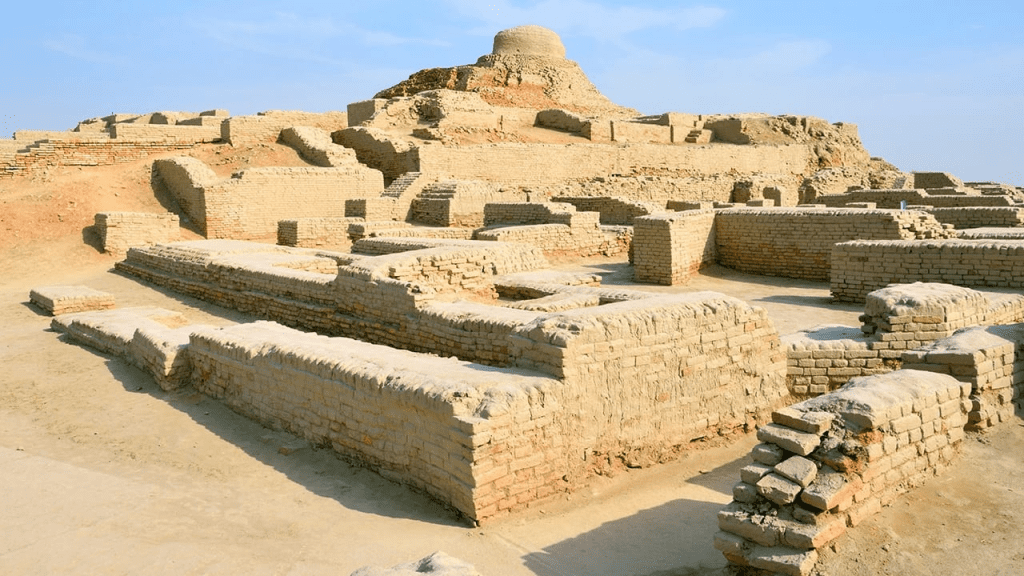
- Mohenjo-Daro: Located in Sindh, Pakistan. Famous for the Great Bath, an advanced drainage system, high citadel, and evidence of multi-story buildings.
- Dholavira: Gujarat, India. Notable for water management—reservoirs, step wells, and three distinct city zones.
- Lothal: Gujarat, with a unique dockyard indicating international trade and bead-making workshops.
- Rakhigarhi: Haryana. Largest known site, with evidence of central planning, pottery, and fortifications.
- Other sites: Kalibangan (ritual fire altars), Surkotada (camel bones), Chanhudaro (crafts), and Banawali (agricultural focus).
Key Features of Major Harappan Cities
Town Planning
- Cities are built on grid layouts, with roads intersecting at right angles.
- Citadel: Raised area for public buildings like granaries, baths, and assembly halls.
- Lower town: Residential areas and workshops.
- Houses were made from uniform baked bricks, typically double-storied, often with rooms surrounding a central courtyard.
- Advanced sanitation: Covered drainage systems, private wells, soak-pits, and public baths.
- Strict zoning separated residential, working, and ritual spaces. Granaries stored surplus grain for emergencies.
IVC Society and Culture
- Egalitarian social structure; little evidence of extreme wealth differences or rulers.
- Communities of skilled artisans, farmers, traders, and merchants.
- Burials reveal varied traditions: coffin burials and pot burials, but no ostentatious graves.
- Education and literacy indicated, although social differentiation was less rigid than in later societies.
- Uniformity across sites suggests strong cultural cohesion, aided by trade and communication networks.
Script and Language
- Harappan script uses over 400 signs, mainly pictographic or glyph-based.
- Inscriptions found on seals, copper tablets, pottery, signboards.
- Shortest scripts: single sign; longest—26 signs on a Dholavira board.
- Still undeciphered: hypotheses include Dravidian, Proto-Indo-European roots, but no consensus.
- Likely used for administrative, accounting, and possibly ritual purposes.
Crafts
- Bead-making: carnelian, agate, lapis lazuli, shell, and faience beads.
- Pottery: black-on-red ware, painted geometric designs, animal motifs.
- Metalwork: tools, weapons, ornaments from copper, bronze, silver, gold.
- Weaving: earliest evidence of cotton use, dyed textiles, spindle whorls.
- Stone carving, shell working, glass and terracotta figurines also flourished.
Religions
- Major deity: Mother Goddess (fertility), depicted as terracotta figurines.
- Pashupati—proto-Shiva figure, seen on seals with yogic posture and surrounded by animals.
- Sacred animals: bull, unicorn, rhinoceros.
- Ritual bathing (Great Bath, wells), fire altars, and water symbolism were prevalent.
- Tree worship: pipal (fig) tree, considered sacred.
- Amulets and charms used for protection; evidence of ancestor worship.
Seals and Images
- Stamp seals made from steatite, terracotta, and copper—over 2,000 found.
- Depicted unicorns, bulls, elephants, tigers, and religious motifs.
- Many seals had short scripts—used for identifying goods, trade, possibly administrative records.
- Figurines: dancing girls (bronze), elaborate jewelry, animal models—vivid glimpses into daily life and ritual.
- Artistic style: realistic animal depictions, geometric human figures, fine craftsmanship.
IVC Economy
- Agriculture was foundational, with surplus grain stored in granaries ensuring food security.
- Craft production contributed significantly: beads, metals, textiles, pottery.
- Weights and measures facilitated extensive local and long-distance trade.
- Marketplaces within cities spurred specialization and commerce.
Harappan Trade
- Vast trade network, using barter for goods like grains, beads, metals, precious stones.
- Maritime trade: Lothal and Sutkagendor were vital ports for business with Mesopotamia, Oman.
- Exported cotton, textiles, beads; imported silver, tin, lapis lazuli, luxury goods.
- Seals and weights standardized trade, ensured authenticity and fair transactions.
Agriculture
- Main crops: wheat, barley, peas, sesame, dates, mustard, and cotton—the first documented cotton cultivation in the world.
- Ploughs, sickles, and granaries indicate controlled and efficient agriculture.
- Irrigation: canals and wells supplied water, supported multiple cropping cycles.
Domestication of Animals
- Cattle (Bos indicus), buffalo, goats, sheep, pigs, fowl, dogs, and cats—kept for milk, meat, labor, and transport.
- Possibly tamed elephants and camels for heavy work and long-distance travel.
- Horses were absent in the early phase; camel bones present at Surkotada suggest later introduction.
Weights and Measures
- Stone weights: cubical with flat sides, based on binary and decimal ratios (e.g., 1, 2, 4, 8… up to 13.7 kg).
- Standardized across sites, aiding fair trade and market regulation.
- Measures ensured consistency in construction, trade, and administration.
- Rulers and scales for length, volume—evidence of advanced mathematical understanding.
Decline of Harappan Culture
- Began around 1900 BCE; reasons are complex:
- Climate change led to prolonged droughts, flooding, and river course shifts.
- Gradual breakdown of urban planning, sanitation, and trade networks.
- Soil exhaustion and agricultural failure reduced sustainability.
- There are theories of migration, internal strife, and possible external invasions, but recent research favors environmental stress as the primary cause.
- Cities were abandoned, and populations dispersed towards the Ganga-Yamuna plains.
Timeline Table: Indus Valley Civilization
| Phase | Dates (BCE) | Key Features |
| Pre-Harappan | 7000–3300 | Neolithic farming, Mehrgarh, early settlements |
| Early Harappan | 3300–2600 | Proto-urban towns, trade networks |
| Mature Harappan | 2600–1900 | Planned cities, script, trade, peak prosperity |
| Late Harappan | 1900–1300 | Decline, dispersal, ruralization |
| |
Summary Table: Cultural and Technical Achievements
| Aspect | Details |
| Urbanism | Grids, drainage, multi-zone cities |
| Technology | Brick-making, metallurgy, pottery |
| Arts | Terracotta, beads, seals, jewelry |
| Religion | Mother goddess, proto-Shiva, animal/tree worship |
| Script | Pictographic, as yet undeciphered |
| Trade | Local/global, ports, seals, standardized weights |
| Agriculture | Crop rotation, surplus management, irrigation |
| Animal Husbandry | Multiple domestic species, draft animals |
| Decline | Environmental stress, dispersal |
Conclusion
The Indus Valley Civilization stands as a testament to ancient ingenuity, demonstrating how humans could create highly organized, large-scale urban societies thousands of years ago. Its legacy is seen in its advanced architecture, city planning, refined craft industries, and long-distance trade networks. Despite the mysteries that surround its undeciphered script and the causes of its decline, the civilization’s achievements in social infrastructure, technology, and environment management set lasting standards in world history. The IVC’s balanced approach to urban life, communal harmony, and technological innovation remains a guiding reference in studying and understanding the roots of not only Indian, but world civilization.