
ONE-LINER Current Affairs
Government Schemes & Initiatives
- PMUY was launched in 2016 to provide LPG connections to deprived households for clean cooking fuel.
- Ujjwala 2.0 aimed to add 1.6 crore connections by Dec 2022 with special focus on migrant families.
- As of March 2025, 10.33 crore PMUY connections distributed; LPG distributors rose 83% from 2014 to 2024.
- India’s social security coverage rose from 19% (2015) to 64.3% (2025), per ILOSTAT.
- PM-SYM, PMJJBY, APY, PMSBY, and Ayushman Bharat are key social protection schemes in India.
Economy & Trade
- India reduced basic customs duty on crude edible oils from 20% to 10% to reduce the import burden.
- India is the world’s largest importer of edible oils, with palm oil forming 57% of imports.
- Major edible oil crops: soybean (34%), mustard (31%), groundnut (27%)—together make up 92% of domestic production.
- National Mission on Edible Oils – Oil Palm (NMEO-OP) was launched in 2021 to boost domestic production.
- MDR (Merchant Discount Rate) on UPI payments has remained waived since 2020.
Environment & Biodiversity
- Eurasian otter, a Near Threatened species, was sighted in South Kashmir recently.
- Bhagirathi Eco Sensitive Zone (BESZ) covers 4179.59 sq km between Gaumukh and Uttarkashi; notified in 2012.
- BESZ aims to protect the pristine stretch of the River Ganga, supervised under a Zonal Master Plan.
- India objected to the EU’s Carbon Border Adjustment Mechanism (CBAM), effective from 2026, citing trade fairness.
- CBAM is part of the EU’s ‘Fit for 55’ strategy to cut emissions by 55% by 2030.
Security & Defence
- Exercise Khaan Quest 2025, held in Mongolia from 14–28 June, focuses on UN peacekeeping under Chapter VII.
- Indian Coast Guard (ICG) responded to a burning cargo ship off Kerala’s coast inside India’s EEZ.
- Maritime disasters increase due to old ships, hazardous cargo, piracy, and strait congestion.
- India is signatory to MARPOL (1973); not a party to Bunker Convention, HNS Convention, or Wreck Removal Convention.
Regulations & Legal
- UGC issued show-cause notices to HEIs for violating the Anti-Ragging Regulations, 2009.
- Anti-ragging rules mandate sensitization, committees, punishments, and parent-student undertakings.
- Raghavan Committee (2007) & Supreme Court (2009) reinforced anti-ragging mechanisms like helplines and monitoring.
Science & Technology
- Mistral (French startup) launched Europe’s first Reasoning-based Language Model (RLM) in 2025.
- RLMs use chain-of-thought reasoning, unlike traditional LLMs reliant on data and computation.
Space & Astronomy
- Major Lunar Standstill observed during the Strawberry Moon of June 2025.
- This rare event occurs every 18.6 years, causing the moon to rise/set at extreme positions on the horizon.
International Affairs
- Lokpal of India adopted the motto: “Empower Citizens, Expose Corruption”.
- Lokpal is formed under the Lokpal and Lokayuktas Act, 2013, and includes 1 Chairperson + 8 Members.
- Schengen Area has 29 countries (25 EU + 4 non-EU); internal border checks are abolished.
- India is the Vice President of IALA (International Marine Aids to Navigation), which became an IGO in 2024.
Fisheries
- Only 29% of deep-sea fish stocks are sustainably fished, per the FAO 2025 report.
- The WTO Fisheries Subsidies Agreement prohibits support for IUU fishing and overfished stock exploitation.
Air India Flight Crash
- An Air India Boeing 787-8 aircraft (London-bound) crashed shortly after takeoff from Ahmedabad, killing 241 people.
- The crash site was a medical college hostel in Meghani Nagar, about 5 km from the airport.
- 242 people were on board: 230 passengers + 12 crew members; only 1 passenger survived.
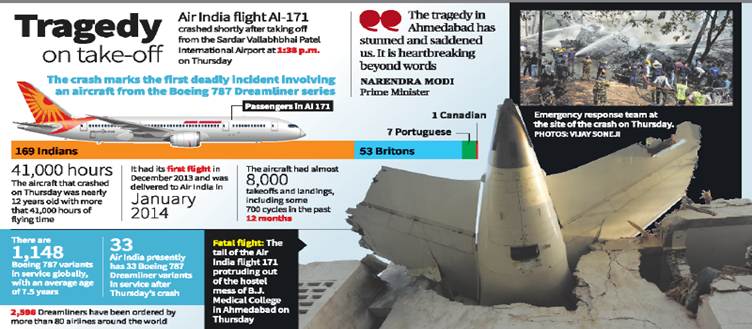
CREDIT: THE HINDU
Retail Inflation
- Retail inflation fell to 2.8% in May 2025, the lowest in 75 months (since Feb 2019).
- Average retail inflation for Apr-May 2025-26 stood at 2.99%, the lowest for any first two months since 2017–18.
- Food & beverages inflation dropped to 1.5% in May, from 2.1% in April 2025.
- Vegetable prices contracted by 13.7%, pulses by 8.2%, spices by 2.8%, and meat by 0.4%.
- Edible oils and fruits recorded double-digit inflation, offsetting broader food deflation.
- Persistent edible oil inflation is due to reduced oilseed sowing, global price rise, and import dependence.
- The government reduced basic customs duty on crude edible oils from 20% to 10% to ease prices.
- Inflation in intoxicants (paan, tobacco, etc.) rose to 2.4% in May, from 2.1% in April.
- Housing inflation rose slightly to 3.2%, from 3.1% in April 2025.
- Clothing and footwear inflation remained unchanged at 2.67%.
- RBI is expected to pause further interest rate cuts despite inflation easing, due to earlier front-loaded cuts.
Global Gender Gap Report 2025
- India ranked 131 out of 148 countries with a gender parity score of 64.1%.
- India’s rank fell from 129 in 2024, marking a relative decline in gender parity.
- The Global Gender Gap Index is based on four dimensions:
1. Economic participation and opportunity
2. Educational attainment
3. Health and survival
4. Political empowerment
- India’s score in Economic Participation improved by +0.9% to 40.7%; earned income parity rose from 28.6% to 29.9%.
- Labour force participation rate remained unchanged at 45.9%.
- India scored 97.1% in educational attainment, showing gains in female literacy and tertiary enrolment.
- Health and survival parity improved, due to better sex ratio at birth and healthy life expectancy.
- Political empowerment parity declined for the second consecutive year; female MPs fell from 14.7% to 13.8%.
- India ranks among the lowest in South Asia, above only Maldives (138) and Pakistan (148).
- Bangladesh ranked 24, best in South Asia, up 75 places due to gains in political and economic participation.
- Global gender gap closed by 68.8%, but full parity expected only after 123 years at current pace.
- Top 5 countries in gender parity: Iceland, Finland, Norway, UK, New Zealand.
Golden Hour & Emergency Medical Response – India (2025)
- Golden Hour refers to the first 60 minutes after trauma, crucial for survival in strokes, cardiac arrests, and injuries.
- Urban traffic congestion significantly delays ambulance response and is a critical but underrecognized cause of preventable deaths.
- Delhi’s average ambulance response time rose from 13 mins (2014) to over 17 mins (2025), despite a fleet increase.
- CAG (2021) audit in Karnataka found 90,000 crash victims lacked timely care; 6,000 cases had >30 min dispatch delays.
- The national average ambulance response time is 25–30 minutes, worse in rural areas.
- GPS-based tracking enables route optimisation, live tracking, and pre-hospital alerts; response times cut by 12–15% in Chennai and Kolkata.
- Traffic signal override systems allow ambulances to auto-trigger green lights; pilot projects show reduced journey times.
- Bike ambulances under Karnataka’s ‘Platinum Ten Minutes’ initiative arrived within 6 minutes, stabilising one-third of trauma cases in Bengaluru.
- Only 20% of urban traffic signals support digital override; majority use manual or timer-based systems.
- Tech issues like GPS loss, dead devices, and software glitches still hinder efficiency.
- 62% of ambulance drivers report motorists don’t yield; 45% must plead for passage weekly, highlighting public apathy.
- Strict enforcement of ambulance right-of-way laws and public awareness is essential to save lives.
- Conclusion: Delay in emergency care due to traffic is not just a delay, but often a preventable death.
AC Temperature Regulation – Scientific & Policy Insights
Government Proposal
- The Ministry of Power proposes fixing the AC temperature range between 20°C and 28°C for homes, hotels, and cars.
- The default setting of 24°C was earlier proposed by the ministry in 2018 and 2021 after BEE’s recommendations.
- Each 1°C increase in AC temperature saves ~6% electricity, per the Bureau of Energy Efficiency (BEE).
- Potential national savings: 20 billion units/year if all adopt the 24°C default setting.
- Connected AC load projected at 200 GW by 2030 in India.
Health Risks of Low AC Temperatures
- Temperatures below 18°C can cause vasoconstriction, sympathetic activation, and increased blood pressure (6–8 mmHg).
- Prolonged exposure under 18°C linked to hypertension, asthma, respiratory infections.
- Infants and older adults are more vulnerable due to weaker thermoregulation.
- WHO 2018 guidelines recommend 18°C as minimum safe indoor temp in cold climates.
- 2014 study: Indoor temps under 18°C responsible for 9% of hypertension risk.
- 2016 study: Indoor temps <18°C linked to higher BP, low Vitamin D, weaker lung & grip strength (among people 50+).
- 2013 study: Bedroom temperatures below 16°C led to reduced lung function in children.
- 2022 UK study: Cold homes double the risk of depression and anxiety, regardless of income.
Technical Details: How an AC Works
- ACs function using a vapour-compression cycle with a refrigerant for heat transfer.
- Evaporator absorbs room heat; compressor (most power-consuming) raises vapour temp to ~90°C.
- Condenser releases heat to the outside; expansion valve reduces pressure before returning to the evaporator.
- ACs are most efficient when refrigerants operate in their optimal heat-exchange temperature range.
Comfort vs. Efficiency
- Thermal comfort is when body core (37°C) and skin temps are maintained without sweating/shivering.
- ASHRAE-55 & ISO 7730 standards base comfort on predicted mean vote, adjusted for culture, clothing, and cooling type.
- Comfortable indoor range for light clothing: 20–24°C (can radiate 100W metabolic heat efficiently).
- Sleep studies: 16–19°C improves sleep for healthy adults, but >19°C preferred for elderly/infants.
Global Context
- As of 2022, there were 2 billion ACs globally; residential ACs tripled between 2000 and 2022.
- Asia-Pacific: 43% population still lacks access to adequate cooling.
Japan–China Military Tensions
- Japan raised “serious concern” over Chinese J-15 jets flying within 45 metres of a Japanese P-3C patrol aircraft.
- The close encounter occurred above the Pacific Ocean and lasted about 40 minutes on Saturday.
- Another incident on Sunday involved a Chinese jet crossing 900 metres in front of a Japanese P-3C for 80 minutes.
- The Chinese jets took off from the aircraft carrier Shandong, operating jointly with Liaoning — a first-time dual deployment in the Pacific.
- China defended the action, accusing Japan of provocative reconnaissance near its military operations.
- Japan’s Defence Ministry noted that both carriers were spotted near southern Japanese islands, including Iwo Jima, ~1,200 km from Tokyo.
- Liaoning entered Japan’s Exclusive Economic Zone (EEZ) near Minamitorishima, Japan’s easternmost island, without violating territorial waters.
- Chief Cabinet Secretary Yoshimasa Hayashi warned such maneuvers risk accidental collisions.
- The encounters mark growing Chinese naval reach, now extending towards Guam, a U.S. Pacific military base.
- Aircraft carriers (Shandong & Liaoning) are key tools for long-range power projection in Indo-Pacific waters.
IAEA–Iran Nuclear Tensions
- IAEA Board of Governors formally censured Iran for non-compliance with nuclear obligations — first such move in 20 years.
- The resolution was introduced by the U.S., France, UK, and Germany, with 19 countries voting in favour, Russia, China & Burkina Faso opposing, 11 abstentions, and 2 non-voters.
- Iran announced plans to build a new enrichment facility in a “secure location” and hinted at further retaliatory measures.
- Iran called the resolution “political” and claimed it had no choice but to respond.
- The censure could trigger restoration of UN sanctions on Iran later in 2025.
- New U.S.–Iran talks are scheduled in Oman this Sunday, amid escalating tensions.
- Donald Trump warned of potential Israeli or U.S. airstrikes if diplomacy fails.
- U.S. personnel and families are being moved from West Asia due to heightened security threats.
- U.S. embassy in Jerusalem restricted staff travel to outside Tel Aviv, Jerusalem, and Be’er Sheva areas.
- The developments raise regional security concerns and reflect the fragile status of nuclear diplomacy with Iran.
Evaluation & Reform of Central Government Schemes
- Finance Ministry mandates that Central schemes must show positive evaluation outcomes to be continued beyond FY 2025–26.
- All schemes must have a ‘sunset date’, to ensure time-bound review and accountability.
- Third-party evaluation is being conducted for fully funded Central schemes; NITI Aayog is appraising Centrally Sponsored Schemes (CSS).
- A total of 54 Central Schemes and 260 Centrally Sponsored Schemes are due for reappraisal by March 31, 2026.
- These schemes span across health, education, women and child welfare, agriculture, tribal affairs, infrastructure, and environment.
- Outlay limits: For any scheme continuing into the 16th Finance Commission (FC) cycle (2026–2031), 5-year outlay must not exceed 5.5 times the average annual expenditure during FY 2021–22 to 2024–25.
- Ministries have the flexibility to shift funds between schemes, but total spending must remain within approved limits.
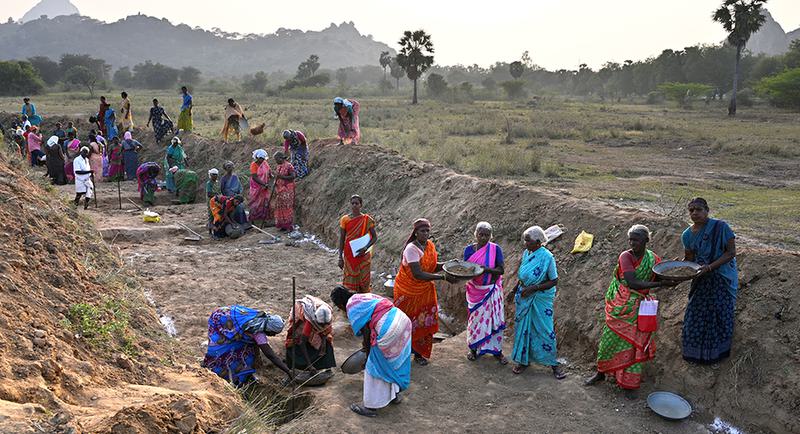
- MGNREGS and other demand-driven schemes will also be capped based on projected beneficiaries and fixed outlays.
- Any increase in beneficiaries beyond projections must be approved by the Department of Expenditure.
- All schemes will now function as fund-limited, ensuring budget control and performance-linked continuation.
India–Canada Relations at the G-7 Summit
- PM Modi and Canadian PM Mark Carney to meet on the sidelines of the G-7 Summit (June 15–17, 2025) in Canada.
- MEA spokesperson Randhir Jaiswal stated the meeting aims to reset bilateral ties based on mutual respect and shared interests.
- Security concerns between India and Canada are being addressed through existing diplomatic mechanisms.
- This is PM Modi’s first multilateral engagement after the completion of Operation Sindoor.
- India’s participation in the G-7 was described by PM Carney as imperative due to its global stature.
- India–Canada ties deteriorated in 2023–24 after former PM Justin Trudeau accused Indian agents of the killing of pro-Khalistan figure Hardeep Singh Nijjar.
- In return, India raised concerns about Khalistan separatists and criminal networks operating from Canadian soil.
- The Modi–Carney meeting aims to de-escalate tensions and restore constructive diplomatic engagement.
Civil Aviation & Aircraft Safety – Post-Ahmedabad Crash Response
- Praful Patel, ex-Civil Aviation Minister, defended India’s “robust” aviation safety monitoring system.
- Patel was the minister during the induction of Boeing 787 Dreamliner aircraft into Air India’s fleet.
- The crashed Boeing 787 in Ahmedabad was 11 years old and had completed numerous flights, including a Delhi–Ahmedabad sector earlier that day.
- Patel emphasized that 787 Dreamliners are globally trusted long-haul workhorses used by many airlines.
- He stated that the pilots were experienced, and the cause of the crash requires a detailed official inquiry.
- Patel urged against speculation and highlighted the role of DGCA as a competent safety oversight authority.
- The crash has reignited global scrutiny of Boeing aircraft safety, including the Dreamliner model.