
ONE-LINER Current Affairs
International Affairs & Security
- India’s first INTERPOL Silver Notice was issued to track the assets of an ex-French Embassy officer in a visa fraud case.
- Silver Notice helps with cross-border asset recovery and information sharing; CBI is India’s National Central Bureau (NCB) to INTERPOL.
- INTERPOL HQ: Lyon, France; has 196 member countries, including India.
India in the Global Gender Gap Report 2025
- India ranked 131 out of 148 countries, slipping from 129 in 2024; parity score: 64.4%.
- Bangladesh (Rank 24) is best in South Asia; the global gap closed to 68.8%, full parity expected in 123 years.
- India’s performance:
- Economic Participation: 40.7% (+0.9%)
- Educational Attainment: 97.1%
- Health & Survival: improved due to better sex ratio and life expectancy
- Political Empowerment: fell due to a drop in women MPs (13.8%) and ministers (5.6%)
Refugee Crisis & UNHCR Report
- 123.2 million forcibly displaced people globally by the end of 2024; 40% are children.
- Major displacement from Sudan, Syria, Afghanistan, and Ukraine.
- 73.5 million internally displaced; key challenges include food insecurity, social tension, and unemployment.
- Global Compact on Migration (2018) & World Bank’s GPFD (2009) are major initiatives.
IAEA–Iran Nuclear Dispute
- IAEA censured Iran after 20 years; 19 of 35 members voted in favour.
- Iran is accused of stockpiling enough 60% enriched uranium to build nine nuclear bombs.
- May lead to UN Security Council sanctions under the JCPOA (2015 Nuclear Deal).
Space & Science
- Solar Orbiter (ESA–NASA) captured the first images of the Sun’s poles; it helps understand the solar cycle and magnetic field dynamics.
- Other solar missions: NASA Parker Probe (2018), India’s Aditya-L1 (2023), PUNCH (2025).
Defence & Technology
- Rudrastra UAV (Hybrid VTOL) successfully tested in Pokhran.
- Range: 170 km | Endurance: 1.5 hrs | Warheads: Precision-guided
- Developed by Solar Defence & Aerospace Ltd.
- Types of drones by structure: Rotary, Fixed-Wing, Hybrid VTOL; by weight: Nano to Large.
Astronomy
- Cosmic Dawn microwave signal (~13 billion years old) detected by CLASS telescope in Chile.
- Cosmic Dawn marks the formation of the first stars & galaxies post-Big Bang.
Economy & Finance
- RBI Bond Buyback: Improves liquidity, reduces the government’s gross borrowing.
- Zero-Coupon Bonds: Issued at a discount, no periodic interest; highly sensitive to rate changes.
Artificial Intelligence
- India’s first Agentic AI ‘Kruti’ launched by Krutrim.
- Performs autonomous tasks: booking cabs, paying bills, etc.
- Represents a shift from SaaS (software-as-a-service) to Service-as-a-Software.
Military Exercise
- PASSEX Naval Exercise held between India and the UK in the Northern Arabian Sea.
Agriculture & Farmers
- Govt approved procurement of summer Moong under Price Support Scheme (PSS).
- PSS is part of PM-AASHA, which also includes PDPS, MIS, PSF.
- Procurement at MSP through Central Nodal Agencies for pre-registered farmers.
Culture & Awards
- Sonal Mansingh awarded Srimanta Sankardev Award, Assam’s top cultural honour.
- Srimanta Sankardev: 15th-century saint of Assam; founder of Ekasarana Dharma, composer of Kirtana Ghosha, creator of Ankiya Naat & Bhaona, developer of Sattriya dance.
Aviation
- Mayday Call: International distress signal meaning “Help me”, coined in the 1920s; adopted in aviation in 1927.
Israel–Iran Military Escalation
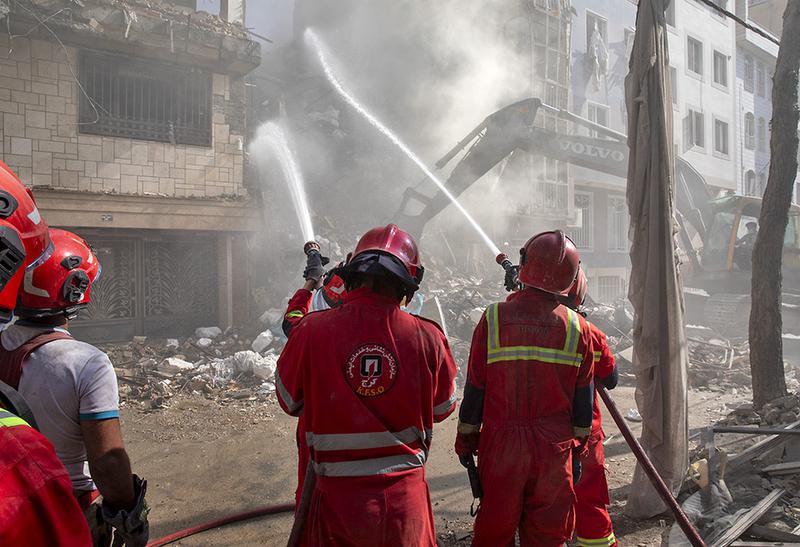
- Israel launched a major military strike on Iran, targeting its nuclear and military infrastructure using warplanes and smuggled drones.
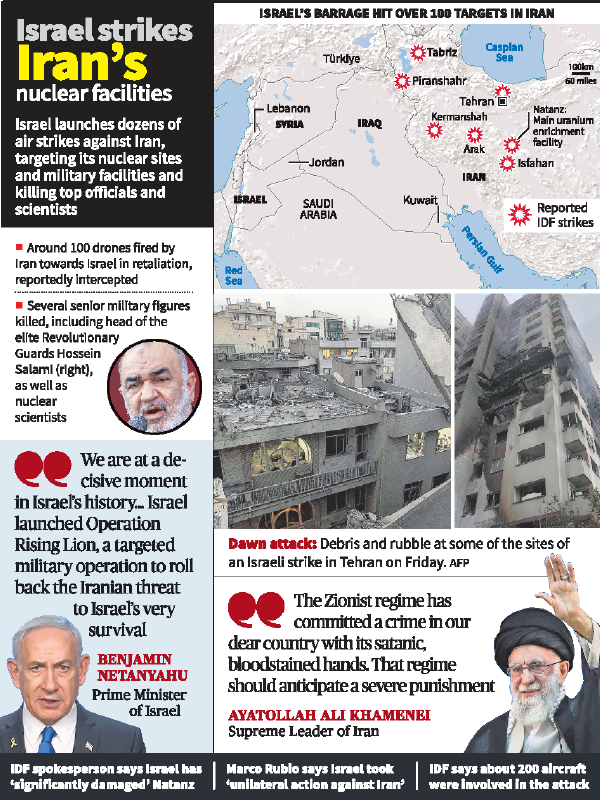
- The operation targeted about 100 Iranian sites with 200 Israeli aircraft, including the Natanz nuclear facility and missile launchers near Tehran.
- Mossad positioned drones and weapons inside Iran in advance, hitting air defences and missile sites.
- The attack killed three top Iranian military leaders:
- Gen. Mohammad Bagheri – head of armed forces
- Gen. Hossein Salami – chief of the Revolutionary Guard
- Gen. Amir Ali Hajizadeh – head of ballistic missile program
- Iran retaliated with drone and missile strikes on Israel, triggering air raid sirens in Jerusalem and Tel Aviv.
- Explosions and fires reported in Tel Aviv, especially in high-rise buildings in the Dan region; rescue operations underway.
- Israel’s National Fire Service reported multiple major incidents across Tel Aviv after Iran’s missile retaliation.
- The escalation followed IAEA’s censure of Iran for nuclear non-compliance a day earlier.
- Iran’s Supreme Leader warned of “severe punishment”; Iran requested an emergency UN Security Council meeting.
- The U.S. was informed by Israel beforehand; American diplomats were pulled from Baghdad, and evacuation orders were issued regionally.
- Global leaders called for de-escalation, while regional countries condemned the Israeli offensive.
Israel–Iran Conflict: Strategic Background
Strategic & Historical Context
- Israel considers Iran’s nuclear & missile programmes an “existential threat”, citing repeated regional aggression.
- Israel has previously conducted covert operations, including the 2020 assassination of Mohsen Fakhrizadeh, Iran’s top nuclear scientist.
- In April 2014, Israel directly bombed the Iranian embassy in Damascus, signaling escalation.
- Israel’s June 13, 2025, attack is the largest direct military strike on Iran since the 1979 revolution.
Recent Regional Shifts
- On October 7, 2023, Hamas’s attack triggered Israel’s regional offensives against Hamas (Gaza), Hezbollah (Lebanon), and the Syrian regime.
- The fall of Bashar al-Assad’s regime in Dec 2024 disrupted Iran’s regional defence network (“Axis of Resistance”).
- Assad’s Syria served as a crucial Iran–Hezbollah link; with its collapse, Iran’s regional deterrence weakened significantly.
- Israel’s Oct 2024 strike on Iranian missile systems left Iran’s nuclear assets exposed for further attacks.
U.S.–Israel Coordination under Trump
- President Trump initially delayed Israeli plans, hoping for diplomatic leverage over Iran.
- Trump sought to force Iran into a new deal that would completely dismantle its nuclear program, unlike the JCPOA (2015).
- Following failed diplomacy, Trump gave the “green light” for Israeli strikes to pressure Iran further.
- The Natanz enrichment site was attacked, but Fordow and Isfahan were reportedly spared to retain negotiating leverage.
Current U.S. Stance
- Trump: “Next round of attacks are already planned” unless Iran accepts the U.S. deal quickly.
- U.S. envoy Steve Witkoff is still open to talks with Iran in Muscat, signaling conditional diplomacy.
Iran’s Strategic Dilemma
- Retaliating militarily risks further Israeli escalation and potential U.S. involvement.
- Accepting U.S. demands could be seen as a humiliating surrender with high political cost.
- Escalating the war may drag the U.S. directly into conflict, increasing regional instability.
Economic Impact of Israel–Iran Conflict on India
Oil Supply and Price Shock
- India imports ~80% of its crude oil requirement; hence, global price hikes directly impact India, even with minimal direct imports from Iran.
- Global oil prices surged 8% in one day following Israel’s strike on Iran.
- 20% of global oil passes through the Strait of Hormuz, near Iran — disruptions here could affect supplies from Iraq, Saudi Arabia, and the UAE, India’s key suppliers.
Export Costs and Supply Chains
- Access to the Suez Canal and Red Sea was disrupted, forcing the rerouting of ships via the Cape of Good Hope.
- Rerouting adds 15–20 days per ship and increases freight by $500–$1,000 per container.
- Export cost escalation estimated at 40–50%, affecting engineering and other goods exports from India.
Macroeconomic Impact
- Potential rise in domestic inflation due to imported crude price hikes.
- Gold prices crossed ₹1 lakh per 10g, driven by safe-haven demand and long-term inflationary concerns.
- Analysts expect temporary price spikes, with oil likely to stabilize once geopolitical uncertainty eases.
Forest Rights Act (FRA) Implementation – New Central Intervention (2025)
Key Development
- Centre sanctioned 324 district-level FRA cells across 18 States/UTs, for the first time since FRA (2006).
- 17 State-level FRA cells have also been approved under the Dharti Aba Janjatiya Gram Utkarsh Abhiyaan (DAJGUA).
About DAJGUA
- Launched in October 2024, it includes 25 schemes from 17 Union ministries targeting 68,000+ tribal-dominated villages.
- FRA cell setup and functioning are based on DAJGUA rules, not the principal FRA legislation.
Function of FRA Cells
- These cells will assist Gram Sabhas and claimants with paperwork and data management, not interfere in FRA decision-making.
- Aimed at speeding up pending FRA claim disposals, especially post-District Level Committee (DLC) approval stage.
Funding Details
- FRA cells are funded by the Grants-in-aid General from the Union Ministry of Tribal Affairs.
- Budget: ₹8.67 lakh per district FRA cell, ₹25.85 lakh per State FRA cell.
Current Status & Pendency
- As of March 2025:
- 51.11 lakh total FRA claims filed
- 14.45% (≈7.39 lakh) pending
- 42% of 43 lakh disposed claims were rejected
- Highest FRA cell sanctions:
- Madhya Pradesh (55), Chhattisgarh (30), Telangana (29), Maharashtra (26), Assam (25), Jharkhand (24)
- High pendency: Assam (~60%), Telangana (~50.27%)
Concerns Raised
- Experts warn of a “parallel FRA mechanism” outside FRA’s legal purview, risking decentralised rights.
- Traditionally, FRA implementation was State-led, with the Centre providing only training and advisory support.
Axiom Mission 4 – Postponement & ISS Technical Glitch
- Axiom Mission 4, carrying Indian astronaut Gp. Capt. Shubhanshu Shukla to the ISS has been postponed again.
- The delay is due to a pressure-related technical issue in the Zvezda service module of the International Space Station (ISS).
- NASA and Russia’s Roscosmos are jointly investigating the issue, including recent leak signatures after repair.
- Cosmonauts inspected and sealed internal surfaces; the module is currently holding pressure post-intervention.
- The mission is being launched aboard a Falcon 9 rocket by Axiom Space in coordination with NASA.
- No new launch date has been announced as of now; further troubleshooting may be required.
Montreal Convention
- The Montreal Convention, adopted in 1999 under ICAO, standardises rules for international air carriage
- It establishes a two-tier liability system, enabling strict liability up to 128,821 SDR (≈ ₹1.5–1.8 crore) for passenger injuries or deaths, with higher claims requiring proof of carrier negligence
- The treaty removes the requirement to prove willful neglect for proven damages up to the first-tier limit, simplifying compensation
- It also expands jurisdiction rights, allowing families to sue in the country where they reside, and mandates liability insurance for carriers.
- In the Air India Ahmedabad crash, families can claim ~₹1.5 crore per passenger under this Convention
- The Tata Group paid ₹1 crore per passenger, supplementing but not replacing the statutory Montreal liability
CROPIC (Collection of Real-time Observations & Photo of Crops)
- CROPIC, launched under PMFBY and funded by the Fund for Innovation and Technology (FIAT), uses AI and field photographs to monitor crop health and automate loss assessment
- Farmers and field officials will capture 4–5 geo-tagged crop images per season via a mobile app, forming a digital “crop signature” database
- AI algorithms process images on the cloud to detect crop type, growth stage, health issues, damage, and predict mid-season yield losses
- Pilot rollout across 50 districts per season during Kharif 2025 and Rabi 2025–26, expanding nationwide in 2026
- Aims: enhance crop monitoring, speed up PMFBY insurance claims, improve data transparency, and build agro-climatic insights
- Technological stack: mobile crowd-sourced imagery, cloud-based AI, computer vision models, web dashboard for officials
- Benefits: early detection of disease/stress, reduced yield loss, optimized inputs (water, fertiliser, pesticides), resource efficiency, sustainable farming
- Challenges: infrastructure gaps, training AI for diverse crops and geographies, affordability for smallholders, data privacy, and technology adoption barriers.