
Rain Batters Northeast India
State-wise Impact:
Assam
- People affected: 3.64 lakh in 19 districts
- Severe rainfall: Silchar (42 cm), Karimganj (35 cm), Hailakandi (30 cm)
- Transport: Roads & trains disrupted (esp. Barak Valley section)
- Warning: River levels are rising due to upstream rainfall in Arunachal
Manipur
- People affected: 3,800+
- Houses damaged: 883
- Worst-hit district: Imphal East
- Political response: Congress blamed incomplete flood control projects
Mizoram
- Landslides: Recorded at 211 locations
- Houses collapsed: 60; 69 abandoned
- Power infrastructure hit: 7 substations damaged
- Road blockages: 83 locations
Sikkim
- Tourists stranded: 1,500 (esp. in Mangan district)
- Cause: Road blockages from landslides
- Missing persons: 9 (after a vehicle fell into Teesta River)
Arunachal Pradesh
- Rescue mission: 14 people (13 from Assam, 1 from Arunachal) rescued from Bomjir river by IAF Mi-17 helicopter
Tripura
- Families affected: Over 1,300
- Response: Evacuation underway in West Tripura
Government Response:
- Union Home Minister Amit Shah: Spoke to CMs of Assam, Arunachal, Sikkim, and Manipur Governor
- IAF Involvement: Rescue via Mi-17 helicopter
- Local advisories: Issued for riverbank and low-lying areas in Assam
Key Concerns:
- Incomplete Flood Management and Border Area Programme (Manipur)
- Potential public health crisis due to displacement and waterlogging
- Infrastructure failure in electricity, roads, and transportation
Indian Summers and the Adaptation Challenge
- Heat waves in India have intensified:
- Once brief, now prolonged and frequent
- Heat wave definition (IMD):
- ≥40°C (plains), ≥30°C (hills) + 4.5°C above normal for 2+ days
- Heat wave days rose from 177 (2010) to 536 (2024) — a 200%+ increase
Heat-Related Mortality
- Govt Data (2000–2020): 20,615 heatstroke deaths
- Issue: Many deaths occur outside hospitals → underreported or misclassified (e.g., cardiac arrest, respiratory failure)
- Better estimate:
- Global Burden of Disease Study (2021): ~1.56 lakh heat-related deaths in India
- Based on excess mortality analysis (difference from seasonal average)
Economic and Productivity Impact
- 2022 heatwave:
- Wheat yield ↓ by 4.5% (up to 15% in some districts)
- Peak power demand: 207 GW → grid strain and blackouts
- Outdoor labour productivity hit: workers forced to choose between income and health
- McKinsey Global Institute: Heat may impact 2.5–4.5% of GDP by 2030
Traditional Adaptation Practices
- Architecture: Mud houses, sandstone courtyards, jaalis, stepwells — created passive cooling systems
- Daily routines: Sunrise to noon work, rest in the afternoon, resume in the evening
- Cultural practices like Navtapa (May 25–June 2) align with peak summer, promoting rest, hydration, and cooling foods
- Problem: These practices faded due to modern construction, lack of incentives, and rigid urban work cycles
Modern Adaptation: Efforts & Gaps
Success Stories:
- Ahmedabad’s Heat Action Plan (2014):
- Credited with avoiding ~1,190 deaths annually
- Other cities (Bhubaneswar, Nagpur): Focus on green cover, cool rooftops
Challenges:
- Many Heat Action Plans:
- Advisory only, no legal mandate or budget
- Limited climate-trained officers
- No integration into master plans
- Poor outreach to vulnerable groups:
- Alerts via English/Hindi, apps → inaccessible to rural poor, migrants
- Lack of oral/local language warnings
Rural Blind Spot
- No rural heat action plans despite high vulnerability
- Schemes like MGNREGA, NHM, GPDP don’t address heat explicitly
- Panchayats lack funds, training, and manpower
- Loss of traditional assets: water bodies, tree cover, stepwells
Risk Communication & Policy Needs
- “Feels like” temperatures can be 6–10°C higher than reported → leads to underestimation of health risk
- Heat warnings must:
- Use local languages
- Be multi-platform: radio, posters, announcements
- Be tailored to low-literacy, off-grid populations
Way Forward: Institutional and Policy Reforms
- Immediate Actions:
- Localised heat action plans (urban + rural) under Disaster Management Act 2005
- Cooling shelters, shaded rest points, water stations, real-time alerts
- Mainstreaming in Programs:
- PM Awas Yojana: Promote natural ventilation, reflective roofs
- MGNREGA, NHM: Include heat resilience tasks
- Finance tools: 15th Finance Commission grants, District Mineral Fund
- Systemic Reforms:
- Update National Building Code for passive cooling mandates
Clear roles for IMD, NDMA, SDMAs, ULBs, Panchayats
SpaceX’s Starship Mars Mission
Mission Timeline & Vision
- Elon Musk plans to launch Starship to Mars by the end of 2026 (uncrewed).
- Coincides with Mars-Earth alignment window (occurs every 2 years; next after 2026 is 2028).
- First flight would carry robotic “Optimus” humanoids (Tesla-designed).
- Human crewed missions planned for 2nd or 3rd landing.
Mass Deployment Plan
- Musk envisions 1,000–2,000 Starship launches every 2 years.
- Goal: Rapidly build a self-sustaining human colony on Mars.
Technical & Logistical Challenges
- Success hinges on complex manoeuvres:
- In-orbit refueling after launch is a major hurdle.
- Musk gives a 50% probability of achieving the 2026 deadline.
- If missed, the next Mars window is 2028.
Starship Testing Status
- 9th test flight (May 27, 2025):
- Disintegrated ~30 mins after launch, failed major test goals.
- Webcast cancelled without notice.
- Earlier test flights (Jan, Mar 2025):
- Exploded shortly after liftoff.
- Musk termed the May failure a “data-rich” event and promised faster test cadence.
NASA & Starship
- NASA plans to use Starship to land astronauts on the Moon by ~2027 (Artemis mission).
- Part of broader goal: send humans to Mars in the 2030s.
Iran Nuclear Issue
UN IAEA Report Highlights
- Iran’s uranium stockpile:
- ➤Now estimated at 9,247.6 kg
- ➤ Enriched up to 60%, nearing 90% weapons-grade level
- This level is ~45 times the limit set by the 2015 Iran nuclear deal (JCPOA).
Iran’s Reaction
- Foreign Minister Abbas Araghchi warned of retaliation if European powers misuse the IAEA report to reimpose sanctions.
- Araghchi told IAEA Director-General Rafael Grossi:
- Iran will respond to any inappropriate action by Britain, France, and Germany.
- Urged Grossi to stop parties from “exploiting” IAEA findings for political purposes.
Europe’s Stand
- Britain, France, and Germany (E3) warned of:
- Reimposing UN nuclear sanctions
- If Iran’s nuclear programme is deemed a security threat to Europe
IAEA Review Meeting
- The IAEA Board of Governors will review Iran’s activities in Vienna from June 9, 2025.
Iran’s Position
- Denies pursuing nuclear weapons.
- Claims enrichment is for civilian nuclear energy needs.
U.S.–Iran Diplomacy
- Ongoing nuclear negotiations between Iran and the U.S., mediated by Oman.
- Araghchi confirmed:
- Receipt of “elements” of a U.S. proposal.
- Iran will respond based on its “national interests and rights.”
U.S. Proposal Details
- Described by White House Press Secretary Karoline Leavitt as:
- A “detailed and acceptable” offer to Iran.
- It is not a full draft but in bullet-point format (per The New York Times).
Background
- JCPOA (2015): Iran nuclear deal between Iran and P5+1 (US, UK, France, Russia, China + Germany).
- 2018: The U.S. under President Trump withdrew unilaterally, reimposing sanctions.
- Since then, Iran has escalated enrichment activities.
Bangladesh: Jamaat-e-Islami Cleared to Contest Elections
Supreme Court Verdict
- On June 1, 2025, the Appellate Division of the Bangladesh Supreme Court, led by Chief Justice Syed Refaat Ahmed, ruled:
- Election Commission (EC) must restore Jamaat-e-Islami’s party registration.
- EC to decide whether Jamaat can use its traditional “scale” election symbol.
Background
- 2013: Bangladesh SC canceled Jamaat’s registration, declaring it unfit for elections.
- 2018: EC scrapped Jamaat’s registration, following the 2013 court order.
- August 2024: Total ban imposed by PM Sheikh Hasina’s government before her ouster in a mass protest.
- Post-August 2024: Ban lifted by interim government, allowing Jamaat to appeal for legal restoration.
Recent Developments
- The June 2025 verdict ends a decade-long legal battle.
- Jamaat lawyer Mohammad Shishir Manir expressed hope for a “vibrant parliament.”
Release of JeI Leader
- May 2025: Top Jamaat leader ATM Azharul Islam (on death row for 1971 war crimes) was freed by the same Supreme Court.
- Accused of collaborating with Pakistani army during the 1971 Liberation War.
- Interim government’s law adviser Asif Nazrul welcomed the decision, crediting the July-August 2024 mass movement.
Role of SAD Movement
- Students against Discrimination (SAD): Key platform behind Sheikh Hasina’s ouster.
- Jamaat backed SAD during the 2024 mass uprising.
Implications
The ruling revives Jamaat-e-Islami as an electoral force in Bangladesh after more than a decade of political and legal isolation, possibly reshaping the post-Hasina democratic landscape.
| Term | Explanation |
| Jamaat-e-Islami (JeI) | The right-wing Islamist party opposed the 1971 war |
| Scale symbol | The traditional electoral symbol of the Jamaat |
| ATM Azharul Islam | JeI leader, acquitted of 1971 war crimes |
| SAD (Students against Discrimination) | A movement that led to the 2024 regime change |
| Appellate Division | The highest judicial authority in Bangladesh |
India as the Fourth Largest Economy: Fact or Illusion?
IMF 2024 Estimates
- India’s GDP (2025): $4,187.03 billion (Market Exchange Rate basis)
- Japan’s GDP (2025): $4,186.43 billion
- India will become the 4th largest economy after:
- United States
- China
- Germany
IMF projects India will become the 3rd largest economy by 2028 (MER basis).
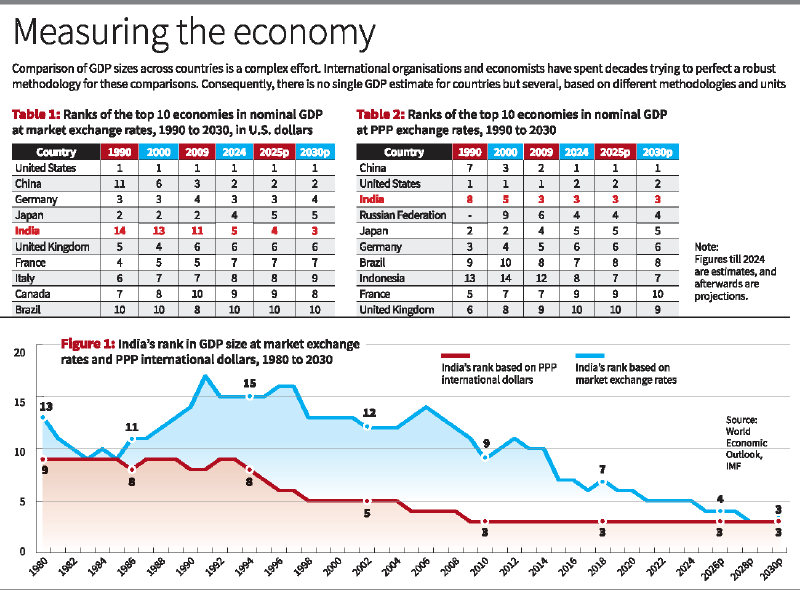
Two Methods to Compare GDP
| Method | Key Characteristics | India’s Rank |
| Market Exchange Rate (MER) | Based on current currency exchange rates | 4th (2025 est.) |
| Purchasing Power Parity (PPP) | Adjusts for price level differences across countries | 3rd (since 2009) |
- MER Issues:
- Volatile exchange rates
- Ignores domestic purchasing power
- PPP Advantage:
- Captures real purchasing capacity
- Prices of goods/services are lower in developing countries
Example: A haircut in New York = $30 vs. ₹200 (~$2.4) in Mumbai
Limitations of GDP as a Measure
- Doesn’t reflect:
- Income inequality
- Health, education, or standard of living
- Gender disparities in unpaid labor
- The politicisation of statistics can distort public understanding
Example of distortion: Claim that India’s GDP = $15 trillion (PPP) used to suggest parity with the US (without context)
Per Capita GDP (2024) – MER Basis
| Country | Per Capita GDP ($) | Rank (out of 196) |
| India | $2,711 | 144th |
| Vietnam | $4,536 | – |
| Sri Lanka | $4,325 | – |
- Even in PPP terms, India’s per capita GDP rank was 127th in 2024.
- India has a high GDP due to a large population, but a low GDP per capita.
- This is termed the “Big Economy Illusion”.
Conclusion
India may be the world’s 4th largest economy in size (MER), but this does not reflect living standards, income equality, or social well-being.
Alternative indicators for meaningful comparison:
- Human Development Index (HDI)
- Literacy & health indicators
- Inequality measures (Gini Index)
- Labor participation & wage levels
- Environmental sustainability
Exams
| Concept | Explanation |
| MER vs PPP | Two different methods for GDP comparison |
| Big Economy Illusion | Large GDP ≠ , high well-being |
| India’s PPP Rank | 3rd since 2009 |
| India’s GDP Rank (MER) | 4th in 2025 (projected), 3rd by 2028 |
| Per Capita GDP (2024) | India = $2,711; Rank = 144th (MER) |
Telangana’s Composite Backwardness Index
Initiative: Development of a Composite Backwardness Index (CBI)
- Purpose: To quantify the backwardness of castes objectively and independently of their population size
- Survey base: Caste Survey covering 3.5 crore residents with 74 questions
Who Designed It?
- Committee: 11-member Expert Working Group
- Chairperson: Justice B. Sudarshan Reddy (Retd. Supreme Court Judge)
- Member-Convener: Praveen Chakravarthy, economist and data expert
Index Structure
| Feature | Detail |
| Scale | 0 to 126 points |
| Interpretation | Higher score = Higher backwardness |
| Methodology | Quartile distribution (castes grouped into 4 levels of backwardness) |
| Total Castes Ranked | 245 castes |
| Indicators Used | 42 indicators across 9 categories |
Nine Indicator Categories
- Education
- Income
- Housing
- Land Ownership
- Access to Technology
- Living Conditions
- Debt & Borrowing
- Social Discrimination
- Other quality-of-life measures
Significance
| Point | Explanation |
| Data Revolution | Replaces population-based quotas with evidence-based rankings |
| Objective Measurement | First such scientific quantification of caste-level backwardness |
| Comparative Context | Mandal Commission (1980s) covered only 50 lakh people with 11 questions |
| Transparency Urged | Mr. Chakravarthy recommends aggregated public release of data, ensuring privacy |
Implications
- Policy Reforms: Likely to inform targeted affirmative action, welfare schemes, and reservations
- Model for India? Could inspire other states or even national-level caste-based policy evaluations
- Social Justice Paradigm Shift: Moves from size-based to needs-based approach to backwardness
Entry of Foreign Law Firms in India
Recent Development
- Authority: Bar Council of India (BCI)
- Provision: Allows foreign law firms and lawyers to practice only in non-litigious matters
- Permitted Scope:
- Only on foreign and international law
- Reciprocal basis only (i.e., if Indian lawyers can similarly practice in those countries)
Historical Background
| Year | Event |
| 2000 | 40,000+ lawyers marched to Parliament against foreign law firms; the protest included police clashes |
| 2018 | The Supreme Court ruled that foreign lawyers/firms cannot practice in India in any legal capacity |
| March 2023 | BCI issued a draft notification allowing foreign lawyers in non-litigious roles (challenged in Delhi HC) |
| May 2025 | Formal rules notified by BCI permitting foreign legal practice in a limited scope |
Legal & Policy Concerns
| Issue | Detail |
| Advocates Act, 1961 | Does not currently allow foreign lawyers to practise in India |
| Reciprocity | Critics argue Indian lawyers aren’t granted equal access abroad |
| Judicial Scrutiny | 2023 notification is still under Delhi HC consideration |
| SC Precedent (2018) | Banned all forms of foreign legal practice in India without law amendments |
Implications
- Could enhance legal professionalism and global integration
- It may help young Indian lawyers collaborate with global firms
- Raising legal and constitutional questions unless the Advocates Act is amended
- The reciprocity clause is seen as symbolic, not real, since Indian lawyers face significant barriers abroad
COVID-19 Update & Expert View
Current COVID-19 Situation in India
| Metric | Data |
| New active cases | 685 |
| Total active cases in 2025 | 3,395 |
| Source | Union Health Ministry |
Cause of Recent Surge
- Driven by Omicron sub-variants
- The virus may have minor mutations, but the strain is still Omicron
- A similar mild surge was reported in Southeast Asian countries
Immunity & Vaccine Impact
- No major threat, thanks to:
- Widespread vaccination
- Some people receiving booster doses
- Infections now mostly lead to mild symptoms:
- Fever (≈2 days)
- Cough, body ache, headache
Precautionary Advice
| Group | Recommendation |
| All individuals | Mask when symptomatic, handwashing, no public spitting |
| High-risk groups (elderly, diabetes, heart/lung disease, hypertension) | Remain cautious |
GST Collections – May 2025 Highlights
| Category | Amount |
| Gross GST Collection (May 2025) | ₹2,01,050 crore |
| Gross GST Collection (April 2025) | ₹2.37 lakh crore (Record High) |
| Gross GST Collection (May 2024) | ₹1,72,739 crore |
| YoY Growth (May 2025) | 16.4% |
| Net GST Mop-up (after refunds) | ₹1.74 lakh crore (+20.4% YoY) |
Domestic vs Import Transactions
| Type | Amount | Growth |
| Domestic Transactions | ₹1.5 lakh crore | ↑13.7% |
| Imports | ₹51,266 crore | ↑25.2% |
- Import-driven Growth: Imports led the rise in collections more than domestic consumption.
State-wise Trends
| State Category | Growth Rate (approx.) |
| High-Growth States | Maharashtra, West Bengal, Karnataka, Tamil Nadu (↑17–25%) |
| Moderate Growth States | MP, Haryana, Punjab, Rajasthan (↑10%) |
| Low-Growth States | Gujarat, Andhra Pradesh, Telangana (↑6%) |
Growth not uniform—sectoral/seasonal factors at play (as per Deloitte India’s M.S. Mani).
Expert Opinions
- Pratik Jain (PWC): Sustained 16% growth may allow GST rate rationalisation.
- Saurabh Agarwal (EY): Expect steady or slightly higher collections in June due to geopolitical tensions.
- Vivek Jalan (Tax Connect): Growth is import-driven, not consumption-driven; export refunds lag behind.
Key Takeaways
| Topic | Fact |
| Highest GST (April 2025) | ₹2.37 lakh crore |
| May 2025 Collection | ₹2.01 lakh crore (↑16.4% YoY) |
| Growth led by | Import GST (↑25.2%) |
| Net Collection after Refunds | ₹1.74 lakh crore |
| Major issue noted | Non-uniform State-wise growth |
| Rate Rationalisation | Under discussion, supported by strong revenue |
| Import vs Export | Imports up; export refunds not matching |
India and 🇪🇺 European Union to Conduct Joint Naval Exercise
Key Points:
- Participants:
- From European Union Naval Force (EUNAVFOR):
- ESPS Reina Sofia (Spanish Navy)
- ITS Antonio Marceglia (Italian Navy)
- Indian Navy ships and aircraft
- From European Union Naval Force (EUNAVFOR):
- Purpose of Exercise:
- Enhance interoperability between Indian Navy and EUNAVFOR
- Practice complex tactical maneuvers
- Prepare for joint operations against non-traditional maritime threats such as piracy and smuggling
- Focus area: Indian Ocean Region (IOR)
- Pre-Exercise Activities:
- ESPS Reina Sofia and ITS Antonio Marceglia made their first port visit to Mumbai (May 26 – June 1) under EU aegis
- High-level interactions between commanders:
- Rear Admiral Davide Da Pozzo (EUNAVFOR)
- Rear Admiral Vidyadhar Harke (Indian Navy)
- Discussions held on strengthening maritime cooperation and expanding military collaboration
- Political Context:
- Exercise follows talks between Prime Minister Narendra Modi and EU President Ursula von der Leyen, emphasizing joint commitment to international peace and security
Conclusion:
- Reflects India’s growing strategic partnerships with international bodies like the European Union
- Enhances India’s maritime security and collaborative defense efforts in the Indo-Pacific
- Part of India’s “Act East” and “Security and Growth for All in the Region (SAGAR)” initiatives
- Emphasizes multilateral cooperation against maritime threats
Air India Exploring Alternatives to Turkish Aircraft Maintenance
Key Details:
- Current Situation: Air India currently sends Boeing 777 legacy aircraft and leased aircraft (from Delta and Etihad) to Turkish Technic (a Turkey-based MRO provider) for maintenance.
- Reason for Reconsideration: Calls to boycott Turkish services arose due to Turkey’s support for Pakistan during a recent India-Pakistan military conflict.
- Air India’s Response: CEO Campbell Wilson acknowledged public sentiment and said alternatives are being explored, but shifting maintenance is not an overnight or easy solution.
- Maintenance Challenges:
- Retrofit/refurbishment of Air India’s 13 legacy Boeing 777 aircraft delayed.
- Limited “heavy refresh” planned instead (new carpets, seat covers).
- Lack of domestic capacity for wide-body aircraft maintenance; some aircraft are sent to AIESL (India), Abu Dhabi, Singapore, and Turkiye.
- Additional Operational Issues:
- Pakistan airspace closure causes rerouting, longer flights (fuel stops in Vienna for routes to Toronto, Washington D.C., Chicago).
- Air India has requested a $600 million annual subsidy from the Indian government to compensate for this disruption.
- Some flights operate below passenger and cargo capacity due to longer routes.
- Ongoing Efforts: Optimizing flight routes and operations to reduce impact on passengers and finances.
Conclusion:
- Reflects geopolitical impact on civil aviation operations
- Highlights challenges in maintenance, repair, and overhaul (MRO) capacity in India for wide-body aircraft
- Shows Air India’s efforts to navigate operational disruptions due to regional tensions
- Relevant to understanding aviation sector dynamics and India’s strategic economic responses
INSV Tarini
Context: Defence Minister Rajnath Singh commended the increasing participation of women in the Indian Armed Forces, highlighting their significant roles in both counter-terrorism operations and maritime expeditions.
Key Highlights:
- Operation Sindoor: Women personnel played a crucial role in India’s recent counter-terrorism operation against targets in Pakistan and Pakistan-occupied Kashmir.
- Navika Sagar Parikrama II: Lieutenant Commanders Dilna K and Roopa A completed a historic circumnavigation of the globe in double-handed mode, covering 25,600 nautical miles over eight months. Their journey included port calls in Fremantle (Australia), Lyttleton (New Zealand), Port Stanley (Falkland Islands), and Cape Town (South Africa).
- Recognition: The Defense minister lauded the officers’ courage and endurance, describing their voyage as the epitome of ‘Nari Shakti’ (women’s power). He also praised their mental resilience in overcoming challenges during the expedition.
- Inspiration for Future Generations: A photo essay book titled ‘Breaking Waves, Making History’ was released, chronicling the expedition and aiming to inspire future generations, especially young women, to pursue similar endeavors.
AMCA stealth fighter prototypes
Context: India has officially approved the development of its first indigenously designed fifth-generation stealth fighter jet, the Advanced Medium Combat Aircraft (AMCA).
This strategic move aims to enhance the Indian Air Force’s capabilities and reduce dependence on foreign military technology.
Key Highlights:
- Prototype Development: The Defence Ministry has sanctioned the creation of five AMCA prototypes, with the first flight anticipated by 2028 and full-scale production targeted for 2035.
- Design Features: The AMCA will be a twin-engine, stealth multirole fighter jet equipped with advanced avionics, supercruise capability, and an internal weapons bay to minimize radar cross-section.
- Public-Private Collaboration: In a significant policy shift, the project will involve both public sector entities like Hindustan Aeronautics Limited (HAL) and private Indian companies, fostering a competitive and innovative development environment.
Strategic Significance: The AMCA is designed to counter regional threats, including China’s J-20 and Pakistan’s J-10C aircraft, thereby strengthening India’s defense posture in a rapidly evolving geopolitical landscape