
India Established Advantage After Initial Air Losses: CDS
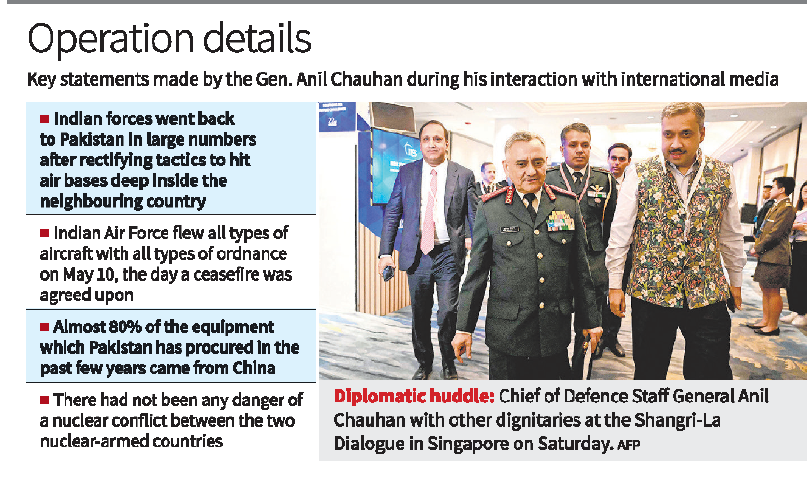
Context: Chief of Defence Staff (CDS) General Anil Chauhan gave his first detailed international media briefing after Operation Sindoor, India’s military retaliation against Pakistan for the April 22 Pahalgam terror attack (26 civilians killed).
Key Points
India’s Military Operations
- Initial Setback: Confirmed Indian air losses on May 7—first official acknowledgment.
- Rectification: Tactical mistakes were corrected, enabling India to:
- Conduct precision airstrikes on May 7, 8, and 10.
- Penetrate Pakistani air defences with impunity.
- Hit targets with accuracy “up to a metre”.
Pakistan’s Claims Rejected
- Pakistan’s claim of shooting down six Indian jets, including 3 Rafales, was labeled “absolutely incorrect” by Gen. Chauhan.
- However, he did not reveal exact Indian losses, only emphasized all IAF pilots returned.
China’s Role
- Gen. Chauhan noted that ~80% of Pakistan’s defence equipment is sourced from China.
- Suggested Chinese companies likely provided technical support (OEM maintenance, refinement, etc.) during the conflict.
Nuclear Angle Denied
- Both Indian and Pakistani military officials denied any nuclear threat during the conflict.
- Gen. Chauhan stated both sides showed “rationality” in decision-making.
Statements from Other Officials
- Air Marshal A.K. Bharti (DG of Air Operations): Refused to share numbers/platforms lost; emphasized combat includes losses, and all IAF pilots are safe.
Strategic Context
- Gen. Chauhan was in Singapore for the Shangri-La Dialogue, where he addressed future warfare and defence innovation.
- His remarks followed those by Pakistani General Shamshad Mirza, who said India-Pakistan troop reduction post-ceasefire was “almost complete”.
COVID-19 Cases
National COVID-19 Situation
- Total active COVID-19 cases in India: 3,395
- Top contributing states:
- Kerala: 1,336 cases
- Maharashtra: 467 cases
- New active cases reported: 685
- Total COVID-19-related deaths so far: 26
- Recent 24-hour deaths: 4 (Delhi, Karnataka, Kerala, Uttar Pradesh)
Global Context
- WHO report (May 28): Global SARS-CoV-2 activity rising since mid-February
- Test positivity rate: Reached 11%
- Rise most notable in:
- Eastern Mediterranean
- South-East Asia
- Western Pacific
- Countries showing early spike: Singapore, Hong Kong, Bangkok
Wastewater Surveillance Insight
- City: Bengaluru
- Findings by TIGS (Tata Institute for Genetics and Society):
- Significant spike in COVID-19 viral load in wastewater
- Increase noted before clinical cases rose
- Indicates a “silent wave” underway
Iran Increases Uranium Stockpile to Near Weapons-Grade Levels
IAEA Report Findings
- Uranium enriched up to 60%: 408.6 kg as of May 17
- Increase since February 2025: 133.8 kg
- Percentage increase: ~50%
- February 2025 stockpile: 274.8 kg
- 60% enrichment is just below weapons-grade (90%)
Agency Involved
- IAEA (International Atomic Energy Agency), Vienna
- Described the enrichment rise as alarming
- Urged Iran to urgently change course and comply with ongoing investigations
Iran’s Official Stand
- Foreign Minister: Abbas Araghchi
- Stated that nuclear weapons are “unacceptable”
- Reaffirmed Iran’s longstanding non-proliferation stance
Political Context
- The report surfaces amid:
- Ongoing Iran–U.S. nuclear negotiations
- Efforts by former U.S. President Donald Trump to broker a new deal
Implications
- Iran’s enrichment level is nearing weapons-grade capability
- Raises global security and non-proliferation concerns
- Could impact diplomatic talks and the sanctions framework
Trump Announces Doubling of Steel and Aluminium Tariffs
Key Announcement
- Tariffs on steel and aluminium imports will be increased from 25% to 50%
- Applies to all countries (no exemptions mentioned)
- Aimed at protecting domestic industries, especially U.S. steel
Background
- Since resuming the presidency in January 2025, Trump has:
- Imposed new tariffs on both allies and adversaries
- Revived his 2017–2020 policy of aggressive trade protectionism
- Caused disruptions in the global trade order
Political and Economic Implications
- May boost U.S. domestic steel/aluminium sectors
- Likely to provoke retaliatory tariffs or trade tensions
- Could affect:
- Global supply chains
- Consumer prices
- Market stability
Pentagon Chief Warns China is ‘Preparing’ for Military Action in Asia
Context:
- U.S. Defence Secretary Pete Hegseth made a strong statement at the Shangri-La Dialogue in Singapore on June 1, 2025.
- Warned of a credible military threat from China, particularly in the Indo-Pacific, and vowed that the U.S. would remain in the region.
Key Highlights
China’s Military Posture
- China is “credibly preparing” to use military force to alter regional power dynamics.
- Engaged in military drills near Taiwan and the Scarborough Shoal, signalling readiness for a blockade or invasion.
- Beijing is accused of:
- Militarising the South China Sea
- Conducting cyberattacks
- Harassing regional neighbours
- Violating international maritime rulings
U.S. Response and Position
- The Indo-Pacific is now America’s “priority theatre”.
- U.S. is:
- Reorienting defence policy to deter China
- Deepening ties with Japan, the Philippines, and other allies
- Pledging that China will not invade Taiwan under Trump’s leadership
- Hegseth urged allies to increase defence spending, citing NATO countries as examples (e.g., Germany pledging to reach 5% of GDP in defence spending).
U.S.-China Tensions Beyond Military
- The remarks come amid escalating trade and tech tensions:
- Trump accuses China of violating trade de-escalation deals
- Both countries had paused tariffs for 90 days, but talks are deadlocked
Chinese Response
- China’s embassy in Singapore called Hegseth’s speech:
- “Provocative and instigating”
- “A smear campaign” and part of the “China threat narrative”
- Rear Admiral Hu Gangfeng, representing China at the forum, said:
- The U.S. is “stirring up trouble and destabilising Asia-Pacific”
- China sent no top defence officials to the summit
Strategic Implications
- Indicates growing risk of regional conflict, especially around:
- Taiwan
- South China Sea
- Philippines-China maritime tensions
- Reflects shift in U.S. strategic doctrine under Trump 2.0 towards hard deterrence and military alliances in Asia
Beware Beaches Near River Mouths
Target Compounds Tracked
- 12 human-made pollutants, including:
- Octinoxate (sunscreen chemical)
- Dibenzylamine (tire rubber additive)
- Methamphetamine (illicit drug)
- Prescription drugs, pesticides, and biocides
- Benzoylecgonine (cocaine metabolite) used as proxy for sewage pollution
Key Findings
- 10 out of 12 pollutants were more concentrated in river-influenced water.
- Air near river mouths had dirtier aerosols, especially:
- Octinoxate
- Methamphetamine
- Dibenzylamine
- Strong correlation with benzoylecgonine, indicating a common sewage origin
Aerosolization Estimates
- From 1 km of beach, potentially aerosolised annually:
- 1 kg octinoxate
- 100 g methamphetamine
- Several grams tire additives
- Global projection:
- 40,000 tonnes of octinoxate
- 50 tonnes of dibenzylamine
- Drift overland via onshore breezes
Public Health Implications
- Inhalation exposure for people living/working near coastlines (e.g., fisherfolk, slum communities)
- Chronic exposure risks are unknown, but may involve:
- Sunscreen residues
- Illicit drug traces
- Agricultural and industrial pollutants
Conclusion
- This study adds a new dimension to water pollution — it pollutes rivers and seas, and air via aerosols, affecting coastal populations.
- Raises alarm for environmental policy and public health monitoring, especially in India and other developing countries where untreated wastewater is common.
Lab-Grown Bat Organs: A Step Forward in Pandemic Prediction
Why Bats Matter
- Bats are ecologically important: pollination, seed dispersal, pest control.
- They host numerous viruses without showing symptoms.
- Viruses originating in bats have caused major human diseases (e.g., Nipah, SARS, MERS, COVID-19).
- However, limited knowledge exists about how viruses interact with bat biology.
Challenges in Bat Virus Research
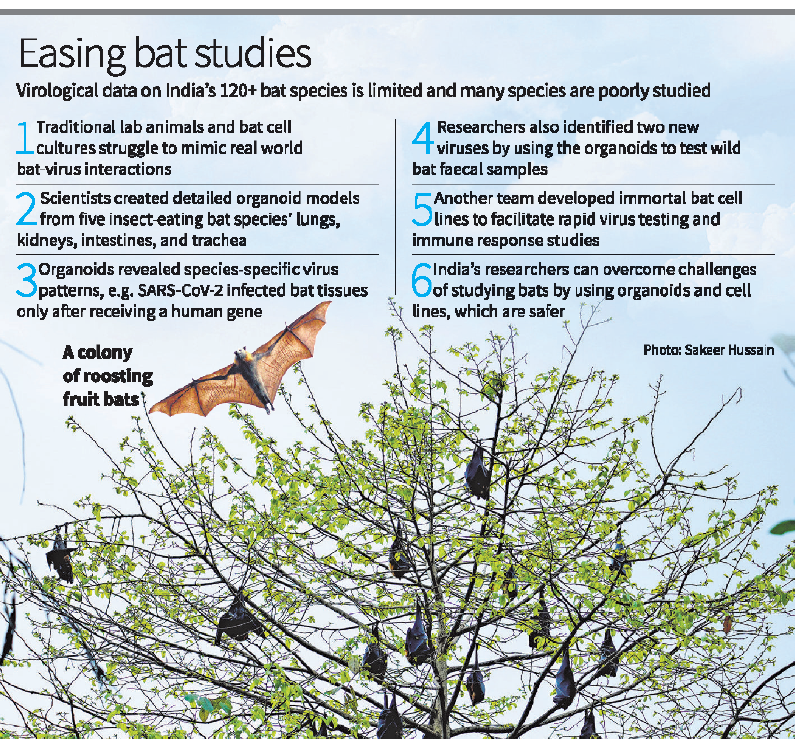
- Primary bat cells are hard to culture.
- Existing bat cell lines may not support virus replication due to the loss of key host receptors.
- Previous bat organoids were limited to one species and one organ.
Breakthrough Study in Science
- Researchers developed the most comprehensive bat organoid platform so far.
- Organoids were developed from 5 insect-eating bat species from Asia and Europe.
- Organs modeled: trachea, lungs, kidneys, intestines.
Key Features of Organoids
- Mimic real tissues: goblet cells, alveoli, etc.
- Virus testing:
- MERS-CoV replicated well in bat respiratory organoids.
- SARS-CoV-2 could not infect unless human gene TMPRSS2 was added.
- Two new viruses isolated from bat faeces: a mammalian orthoreovirus and a paramyxovirus.
Complementary Study in PLOS Biology
- Developed immortalised bat cell lines from Carollia perspicillata (fruit bat from Central/South America).
- Organs: kidney, brain, liver, spleen.
- Supported replication of:
- MERS-CoV
- Vesicular stomatitis virus
- Andes orthohantavirus
- Useful for high-throughput testing and immune response studies.
Key Observations Across Both Models
- SARS-CoV-2 failed to infect natural bat cells/organoids unless human gene was added.
- MERS-CoV replicated in both.
- Immune responses were activated, similar to real bat physiology.
- Cell lines being distributed via ATCC (a major biological material repository).
Relevance for India
- India has 120+ bat species but lacks virological data.
- Evidence of Ebola/Marburg antibodies in bats/humans in the Northeast.
- Nipah virus outbreaks in Kerala, likely from fruit bats.
- Constraints: biosafety issues, legal hurdles, limited infrast
Steps Forward
- April 2025: India launched an inter-ministerial scientific initiative to study zoonotic disease risks.
- Bat organoids and cell lines can:
- Boost surveillance of emerging viruses
- Improve pandemic preparedness
- Reduce reliance on risky live animal handling
Conclusion
- Lab-grown bat tissues represent a major advancement in understanding zoonotic viruses.
- They offer a safe, scalable, and species-relevant platform for research.
- Could be crucial tools for India to monitor viral threats and prevent future pandemics.
Indian Iron and Steel Exporters Fear $1 Billion Loss Due to U.S. Tariffs
India’s Export Exposure
- In FY 2025, India exported $4.56 billion worth of iron, steel, and aluminium products to the U.S.
- $587.5 million in iron and steel
- $3.1 billion in articles of iron or steel
- $860 million in aluminium and related articles
What’s Changing?
- The U.S. plans to double existing tariffs under Section 232 of the Trade Expansion Act, currently at 25%.
- This could lead to a $1 billion loss in India’s exports of metals and related products.
Market Impact (GTRI Data)
- Current steel prices:
- U.S.: $984/tonne
- EU: $690/tonne
- China: $392/tonne
- New tariffs may push U.S. steel prices to around $1,180/tonne, potentially hurting U.S. domestic industries (auto, construction, manufacturing).
Industry Response
Pankaj Chadha (Chairman, EEPC India)
- Warned against uncertainty in tariffs.
- Urged exporters to diversify to other markets.
- Called on the government to negotiate exemption from Section 232, like the U.K. received.
S.C. Ralhan (President, FIEO)
- Said higher duties would hurt semi-finished & finished goods, especially pipes and auto steel parts.
- Expressed concern about loss of price competitiveness.
- Urged the government to resolve this bilaterally to prevent exporters from being unfairly disadvantaged.
India’s WTO Response
- India issued a formal notice at WTO to potentially impose retaliatory tariffs on U.S. goods.
- India imports ~$2 billion worth of iron, steel, aluminium and related goods from the U.S.
Broader Concerns
- Sudden tariff hikes send negative signals to global trade and supply chains.
- The tariff war could escalate, harming both countries’ manufacturing sectors and economic relations.
Conclusion
- The doubling of tariffs by the U.S. may:
- Severely impact Indian engineering exports
- Trigger retaliatory trade actions
- Necessitate strategic diversification and diplomatic intervention
India Engages U.S. Over FATF Grey List Plans for Pakistan
High-Level Visit
- Foreign Secretary Vikram Misri visited the U.S. for three days as part of India’s diplomatic outreach post Operation Sindoor (anti-terror strikes in Pakistan).
- He met several senior U.S. officials, including:
- Christopher Landau – U.S. Deputy Secretary of State
- Michael Faulkender – U.S. Deputy Secretary of the Treasury
- Jeffrey Kessler – Under Secretary of Commerce
- Steve Feinberg & Elbridge Colby – U.S. Department of Defense officials
FATF Focus: Grey Listing Pakistan
- India aims to push for Pakistan’s re-inclusion in the FATF ‘grey list’ during the upcoming June plenary session.
- Discussions with the U.S. Treasury included coordination in FATF processes and financial institution collaboration.
- This move follows India’s counter-terror operations and comes amid increased global attention on Pakistan’s terror financing risks.
Key Agenda Areas
1. FATF & Financial Coordination
- Strengthening ties in international financial institutions.
- Coordination over FATF’s decisions regarding terror financing.
2. Trade & Technology
- Talks on the India-U.S. Bilateral Trade Agreement.
- Cooperation in critical and emerging technologies.
- Focus on the three pillars of the bilateral relationship: Technology, Trade, and Talent.
3. Defence & Security
- India and the U.S. reaffirmed a robust defence partnership.
- Discussion areas:
- Co-production and co-development of defence systems.
- Joint military exercises and logistics sharing.
- Enhancing interoperability between both armed forces.
Contextual Remarks
- U.S. President Donald Trump claimed using the trade card to help de-escalate the India-Pakistan military standoff, making the timing of Mr. Misri’s visit diplomatically significant.
Conclusion
- India is leveraging its strategic partnership with the U.S. to:
- Push Pakistan’s accountability at global platforms like FATF.
- Deepen trade, tech, and defence cooperation.
- Strengthen its position post-anti-terror actions.
Colombia Withdraws Condolence Message to Pakistan
Indian Delegation in Colombia
- A nine-member all-party Indian parliamentary delegation, led by Congress MP Shashi Tharoor, visited Colombia.
- Purpose: To explain India’s zero-tolerance policy on terrorism and clarify its military response (Operation Sindoor) after the Pahalgam terror attack.
Condolence Controversy
- Colombia had earlier stated on May 8, offering “heartfelt condolences” to Pakistan for the loss of lives after India’s retaliatory strikes.
- India objected to the statement, highlighting Pakistan’s role in cross-border terrorism.
Diplomatic Clarification
- Tharoor met Colombian Vice-Foreign Minister Rosa Yolanda Villavicencio and other officials.
- He conveyed India’s disappointment and concern over the condolence message.
- Colombia assured that the statement was withdrawn and that it now supports India’s stance.
Support for India’s Sovereignty
- Indian delegation also met:
- Alejandro Toro – President of the Second Commission of the Chamber of Representatives.
- Jaime Raul Salamanca – President of the Chamber of Representatives.
- Both officials expressed strong support for:
- India’s right to self-defence,
- Protection of territorial integrity and sovereignty.
Other Points
- No official confirmation from MEA (New Delhi) yet on Colombia’s retraction.
- The visit is part of India’s broader diplomatic outreach following Operation Sindoor (targeted strikes on terror infrastructure in Pakistan).
Conclusion
- India’s diplomacy successfully reversed a diplomatic misstep by Colombia.
- The incident underscores the importance of international narrative control during cross-border military responses.
India Accuses Pakistan of Violating the Indus Waters Treaty via Terrorism
Key Points:
- India’s stance:
- At the first UN conference on glaciers held in Dushanbe, Tajikistan, Minister of State for Environment Kirtivardhan Singh said Pakistan should stop blaming India for breaching the Indus Waters Treaty (IWT).
- India argues that Pakistan’s ongoing cross-border terrorism disrupts the treaty’s implementation and itself constitutes a violation of the treaty.
- Misuse of the forum:
- Singh condemned Pakistan’s attempts to bring unrelated issues to the UN glaciers forum, calling it a misuse of the platform.
- Need for reassessment:
- Singh mentioned fundamental changes since the treaty was signed in 1960, including:
- Technological advances
- Demographic shifts
- Climate change
- Persistent cross-border terrorism
- These changes demand a reassessment of the treaty’s obligations.
- Singh mentioned fundamental changes since the treaty was signed in 1960, including:
- Treaty’s spirit:
- The treaty was signed in goodwill and friendship, requiring all parties to honor it in good faith.
- Terrorism from Pakistan undermines this spirit and the treaty’s practical functioning.
Pakistan’s Response:
- Prime Minister Shehbaz Sharif warned India against suspending the treaty, calling it an illegal and unilateral move that endangers millions dependent on the Indus Basin water.
- His comments came in the context of India suspending the treaty after the April 22 Pahalgam terrorist attack, which killed 26 people.
Background:
- The Indus Waters Treaty (1960), brokered with the World Bank, governs the sharing of the Indus River system between India and Pakistan.
- India suspended the treaty as a punitive action against Pakistan for harboring terrorists after the Pahalgam attack.
Conference Details:
- The UN conference on glaciers focuses on the crucial role of glaciers in global ecology and water issues.
- Attended by over 2,500 delegates from 80 countries and 70 international organizations.
India Showcases Cultural Renaissance at Osaka World Expo
Event Details:
- The World Expo 2025 is underway in Osaka, Japan, from April 13 to October 13, with the theme “Designing future society for our lives”.
- It aims to foster innovation and global cooperation to tackle challenges like the Sustainable Development Goals (SDGs).
India Pavilion Highlights:
- Curated by the Indira Gandhi National Centre for the Arts (IGNCA), the pavilion offers an immersive civilisational experience.
- It focuses on India’s soft power and cultural renaissance, weaving together ancient philosophies and modern ambitions.
- The design pays tribute to Bodhisattva Padmapani from the Ajanta Caves, symbolizing compassion, enlightenment, and knowledge.
- The pavilion reflects the theme ‘Connecting Lives’, showcasing India’s values of inclusivity, sustainability, and progress.
- It also highlights India’s space programme as part of its technological achievements.
Footfall: The pavilion recorded a single-day visitor count of 13,141, indicating strong interest.
Neolithic Habitation Site with Early Metallurgy Unearthed in Assam
Location: Daojali Hading, Dima Hasao district, Assam (in the Langting-Mupa Reserve Forest near National Highway 27)
Significance:
- Confirmed as a Neolithic habitation zone dating back more than 2,700 years.
- Discovery of a furnace and iron slag indicates early metallurgical activity in the region.
Historical Background:
- The site was first uncovered in the 1960s during the construction of the Lumding-Haflong road, damaging much of the area.
- Systematic excavations between 1962-64 by Gauhati University revealed polished double-shouldered celts, cord-marked pottery, mortars, pestles, and jadeite stone, confirming Neolithic culture links to broader Eastern and Southeastern Asia.
Recent Survey:
- Led by Shring Dao Langthasa and Bhubanjoy Langthasa from the North Cachar Hills Autonomous Council’s Archaeology Department, with collaboration from experts at IIT Guwahati and North Eastern Hill University.
- Recovered artefacts consistent with earlier findings, plus the discovery of a furnace and iron slag, confirming early iron metallurgy.
Importance:
- Demonstrates the presence of advanced prehistoric community life and technology in Northeast India.
- Supports theories of early metal use and cultural connections with neighboring Asian regions.
Future Directions:
- Calls for more research, including radiocarbon dating and comparative studies with other Neolithic sites.
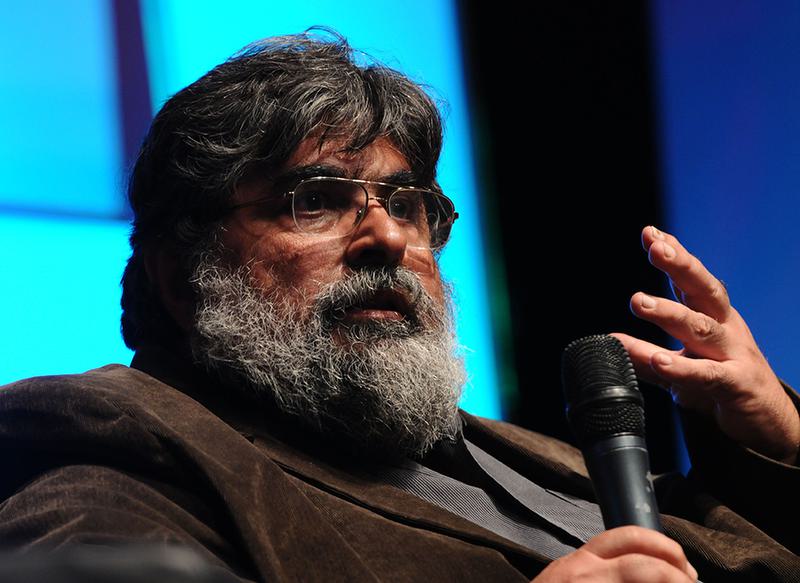
Valmik Thapar, Wildlife and Tiger Conservationist
Legacy:
- Renowned for nearly 50 books on tigers, especially from Ranthambore, Rajasthan.
- Famous wildlife photographer and passionate tiger conservationist for over four decades.
- Co-founder of the Ranthambhore Foundation, working closely with local communities.
- Served on multiple government committees, including the National Board for Wildlife and a Supreme Court-appointed wildlife panel.
Conservation Approach:
- Known for hands-on fieldwork, engaging with forest officials, scientists, activists, and villagers alike.
- Advocated for innovative tourism benefiting both wildlife parks and local people.
- Critical of Project Tiger’s implementation and vocal about the complex balance between the forest rights of tribal people and tiger conservation.
Views on Wildlife Management:
- Opposed introducing cheetahs to Kuno National Park, citing ecological unsuitability and historical context.
Tributes:
- Jairam Ramesh, former Environment Minister, praised Thapar’s passionate knowledge and candid advice.
- Family described him as equally respectful to officials and forest guards, speaking fearlessly on conservation issues.
Indian Space Situational Assessment Report (ISSAR) for 2024
Context: The Indian Space Research Organisation (ISRO) has released the Indian Space Situational Assessment Report (ISSAR) for 2024, highlighting the growing challenges of space debris and orbital congestion.
Key Highlights of ISSAR 2024:
- ISRO conducted 10 CAMs in 2024 to protect its satellites from potential collisions with space debris and other objects.
- The year witnessed three major on-orbit break-up events, adding approximately 702 fragmented objects to the space debris population.
- There were 261 launch attempts globally in 2024, with 254 successful launches, resulting in 2,963 objects placed in orbit.
- ISRO successfully conducted five launches from Sriharikota, deploying eight Indian satellites, one foreign satellite, and six rocket bodies into their designated orbits.
- As of December 31, 2024, India has 22 operational satellites in Low Earth Orbit (LEO) and 31 in Geostationary Orbit (GEO).
- ISRO emphasizes the urgent need for a globally accepted STM framework to manage the increasing congestion in Earth’s orbit and ensure the safety of space operations.
India’s First Gene-edited Sheep
Context: India has achieved a significant milestone in animal biotechnology with the development of its first gene-edited sheep by researchers at Sher-e-Kashmir University of Agricultural Sciences and Technology (SKUAST), Kashmir.
Key Highlights:
- Pioneering Achievement: SKUAST-Kashmir scientists have successfully developed India’s first gene-edited sheep, marking a historic milestone in the field of animal biotechnology.
- CRISPR-Cas9 Technology: The gene editing was performed using CRISPR-Cas9 technology, adhering to international biosafety protocols.
- Muscle Growth Enhancement: By targeting the myostatin gene, which regulates muscle growth, the edited sheep exhibits a 30% increase in muscle mass compared to normal sheep.
- Non-Transgenic Approach: The edited sheep contains no foreign DNA, distinguishing it from transgenic organisms and potentially easing regulatory approval under India’s evolving biotech policy framework.
- Research Leadership: The project was led by Professor Riaz Ahmad Shah, Dean of the Faculty of Veterinary Sciences at SKUAST-Kashmir, who previously contributed to the cloning of India’s first Pashmina goat, ‘Noori’, in 2012.
- Implications for Livestock Industry: This development opens avenues for enhancing livestock productivity and resilience, with potential applications in improving meat yield and disease resistance.