
U.S. May Curb Student Visa Processing
Context: The Trump administration, led by Secretary of State Marco Rubio, has signaled a clampdown on international student visas by slowing down processing and introducing stricter vetting protocols. This is expected to have a major impact on Indian applicants.
Key Highlights of the News:
- New Directive from Marco Rubio:
- Secretary of State Marco Rubio issued a cable directing all U.S. embassies to halt the addition of new visa appointment capacity for F, M, and J visa categories.
- This restriction is in place until enhanced social media screening systems are operational.
- Scope of the Order:
- Applies to student (F), vocational (M), and exchange visitor (J) visas globally.
- Pre-scheduled interviews for visa applicants will not be affected at this stage.
- Emphasis on Social Media Vetting:
- Earlier in April, Rubio had already issued a directive to screen social media profiles of visa applicants, especially those critical of the U.S. and allies like Israel.
- The vetting is expected to expand and intensify as per the new cable.
- Impact on Indian Students:
- The policy could delay or disrupt study plans for lakhs of Indian students applying for U.S. education.
- Comes amid an already challenging environment due to deportation notices and visa cancellations over minor infractions.
- Embassy Advisory in India:
- The U.S. Embassy in India issued a fresh warning to students:
- Visa status may be revoked if students skip classes or leave programmes without formally informing the authorities.
- Students are advised to strictly adhere to visa terms to avoid legal issues.
- The U.S. Embassy in India issued a fresh warning to students:
- Potential Consequences:
- Stricter vetting may cause significant delays in processing timelines.
- Could deter students from applying to U.S. institutions due to increased uncertainty.
INDIA Bloc to Seek Special Session on Pahalgam Attack
Context: Opposition parties under the INDIA bloc are planning to jointly request a special session of Parliament to discuss the Pahalgam terror attack and its aftermath, citing the need for national unity and deliberation.
Special Session of Parliament:
The concept of a Special Session is derived from Article 85(1) of the Constitution of India:
Article 85(1): “The President shall from time to time summon each House of Parliament to meet at such time and place as he thinks fit…”
- This gives the President (on the advice of the Union Cabinet) the power to summon Parliament at any time, including for a special or emergency session.
- There is no explicit mention of the term “Special Session” in the Constitution. The Constitution only speaks of “sessions”.
Key Features of a Special Session
- Parliament usually has three regular sessions: Budget, Monsoon, and Winter.
- A Special Session is convened outside this calendar for specific purposes.
- Typically called to discuss or pass important legislation, commemorate events, or for emergency discussions.
- E.g., 2023’s Special Session marked the shift to the new Parliament building and passed significant bills like the Women’s Reservation Bill.
- Unlike regular sessions, Special Sessions may omit Question Hour, Zero Hour, or Private Member’s Business, based on the government’s agenda.
- Must be formally summoned by the President of India on the recommendation of the Cabinet.
- Once convened, the rules of procedure and conduct of business of regular sessions apply unless otherwise specified.
Past Special Sessions
- 1972: To mark 25 years of Independence.
- 1997: For the 50th anniversary of Indian independence.
- 2008: After the Mumbai terror attacks (as a short-notice emergency session).
- 2023: To inaugurate the new Parliament building and pass the Women’s Reservation Bill.
Conservation of Dugongs
Context: India’s dugong population is critically low and regionally endangered. With their seagrass habitats rapidly degrading, urgent conservation steps are essential to protect these marine herbivores, the “gardeners of the sea”.
Key Highlights of the News:
About Dugongs:
- Species: Dugong dugon, also known as sea cows.
- Habitat: Shallow coastal waters; feed on seagrass.
- Indian Range: Andaman & Nicobar Islands, Gulf of Mannar, Palk Bay, Gulf of Kutch.
- Lifespan: Up to 70 years; solitary or mother-calf pairs.
Biological Characteristics:
- The only herbivorous marine mammal in India.
- Consume 20–30 tonnes of seagrass daily.
- Evolved to digest cellulose; wear teeth quickly and regenerate them frequently.
- Reproduction: Reach maturity at 9–10 years; one calf every 3–5 years.
- The population growth rate is very slow (≈5% annually).
Threats to Dugongs in India:
- Seagrass meadows are being lost d
- Port constructionLand reclamation
- Dredging Coastal development Pollution (agricultural runoff, sewage, industrial effluents)
- India has ~200 dugongs left; population & range declining.
- Accumulation of mercury and organochlorine in tissues.
- Effects both dugong health and seagrass ecosystem.
- Entanglement in gillnets and trawl nets leads to drowning.
- Shift from traditional to mechanised fishing in shallow waters.
- Sea-level rise, ocean acidification, and cyclones damage seagrass beds
- Increased boat traffic causes collisions.
- Illegal hunting persists, especially in Andaman & Nicobar Islands.
Conservation Efforts:
- India signed the CMS Dugong MoU (2008) and CMS Convention (1983).
- Palk Bay Dugong Conservation Reserve (448.3 sq. km, declared in 2022).
- Contains ~122.5 sq. km of intact seagrass meadows.
- Led by: OMCAR Foundation, Wildlife Institute of India, Tamil Nadu Forest Dept.
Steps for Dugong Conservation:
- Rigorous mapping of seagrass meadows.
- Limit harmful activities in dugong habitats.
- Community-based stewardship with local fishers.
- Ban on gillnets & bottom trawling in sensitive zones.
- Promotion of sustainable, traditional fishing methods.
- Promote dugong-friendly ecotourism using local youth as eco-guides.
- Education campaigns in coastal villages.
- Training locals to report sightings/strandings for rescue efforts.
- Need for long-term studies on dugong behaviour, threats, genetics.
- Use of citizen science and traditional knowledge.
- Adoption of drone & tagging technology for tracking.
Why Seagrass Matters
- Seagrass ≠ Seaweed – it is a flowering plant.
- Provides:
- Habitat for dugongs, turtles, and fish.
- Stabilisation of the seafloor.
- Carbon capture: ~434.9 tonnes CO₂/sq. km/year.
- India’s major seagrass meadows:
- Gulf of Mannar & Palk Bay – highest seagrass diversity in the Indian Ocean.
- Andaman & Nicobar Islands, Kachchh, Andhra Pradesh, Odisha – patchy or threatened.
Pakistan PM Offers Peace Talks with India During Iran Visit
Context: During an official visit to Iran, Pakistan PM Shehbaz Sharif stated his willingness to initiate peace talks with India over major bilateral issues, including Kashmir, terrorism, water, and trade.
Key Highlights:
- PAK PM –Declared readiness to resolve all issues through dialogue:
- Kashmir
- Water disputes
- Terrorism
- Bilateral trade
Diplomatic Context:
- Remarks made during visit to Tehran, Iran — second leg of a four-nation tour.
- Welcomed by newly elected Iranian President Masoud Pezeshkian.
- Held talks and a joint press conference at Saadabad Palace.
- Also met Iran’s Supreme Leader, Ayatollah Ali Khamenei.
India’s Official Stand:
- India has consistently stated:
- No talks unless Pakistan addresses terrorism.
- Dialogue is only possible on the issue of the return of Pakistan-occupied Kashmir (PoK).
- India has not responded directly to this latest offer as of now.
Significance:
- Reflects renewed diplomatic signaling amid regional tensions.
- Comes in the backdrop of:
- Recent cross-border incidents
- Iran’s changing leadership
- Pakistan’s efforts to engage diplomatically with neighbours and major players.
Developing Nations Face Record China Debt Repayments in 2025
Key Findings:
- The poorest 75 countries are expected to repay $22 billion to China in 2025 — a record high.
- These repayments are linked to loans under China’s Belt and Road Initiative (BRI) during the 2010s.
- The BRI funded infrastructure, like ports, railways, and roads, across Africa, Asia, and the South Pacific.
Debt Shift Dynamics:
- New lending from China has declined sharply.
- Now, repayments and interest exceed new disbursements.
China’s Official Response:
- China’s Foreign Ministry said:
- It was “not aware of the specifics” of the report.
- Asserted that China’s financial cooperation “abides by international conventions.”
Significance and Concerns:
- Marks a shift in China’s global financial role from lender to collector.
- Raises alarms over debt sustainability in low-income countries.
- Possible risk of debt traps, economic instability, and sovereign defaults in some regions.
Bangladesh Supreme Court Acquits Jamaat-e-Islami Leader Azharul Islam
Political Context:
- Conviction occurred under Sheikh Hasina’s rule (2009–2024)
- Hasina’s government had banned Jamaat-e-Islami and executed five other senior leaders (4 from Jamaat, 1 from BNP)
- Lawyer Shishir Monir: “He got justice because he is alive.”
- Islam filed a fresh appeal in February 2025, leading to the acquittal
Background of Sheikh Hasina’s Downfall:
- The 15-year rule ended in August 2024 after the student-led uprising
- She fled to India and is in self-imposed exile
- The Awami League party is now banned
- She faces extradition requests and charges for crimes against humanity (alleged deaths of 1,400 protesters)
Reaction and Significance:
- Celebration by Jamaat-e-Islami supporters
- Party leader Shafiqur Rahman called previous executions “judicial killings.”
- Opens possible a political return of banned Islamist groups amid upcoming elections (due by June 2026)
Ongoing Protests in Dhaka:
- Cause: Opposition to Public Service (Amendment) Ordinance-2025
- Allows easier dismissal of government officials
- Protest Location: Secretariat Complex, Dhaka
- Forces Deployed:
- Border Guard Bangladesh (BGB)
- SWAT
- RAB (Rapid Action Battalion)
- Media Access: Journalists and visitors barred
Centre Restores RoDTEP Scheme
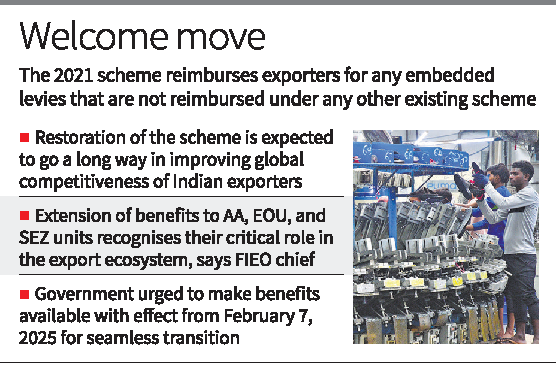
What is RoDTEP?
- Remission of Duties and Taxes on Exported Products
- Launched: 2021
- Purpose: Reimburses exporters for embedded taxes/duties/levies not covered under other schemes
- Promotes the cost competitiveness of Indian exports in global markets
Recent Decision:
- RoDTEP benefits restored for:
- Advance Authorisation (AA) holders
- Export-Oriented Units (EOUs)
- Special Economic Zones (SEZs)
- Effective From: June 1, 2025
- Previous Cut-Off: Benefits had ended on February 5, 2025
Industry Reaction:
- FIEO President S.C. Ralhan:
- Welcomed the move
- Requested retroactive extension from February 7, 2025
- Stated the decision affirms the government’s recognition of exporters’ vital role
Why It Matters:
- Exporters lobbied for restoration due to:
- Increased input costs
- Rising global competition
- The move is expected to:
- Boost India’s export competitiveness
- Ensure policy continuity for exporters in AA, EOU, and SEZ segments
AMCA Fighter Jet Project
About AMCA (Advanced Medium Combat Aircraft)
- Type: 5th-generation stealth fighter jet
- Weight Class: 25-tonne, twin-engine
- Developer: Aeronautical Development Agency (ADA)
- Induction Target: By 2034
New Execution Model
- HAL & private sector firms to compete (no default manufacturing rights)
- Bidders can form Joint Ventures or Consortia
- Must be Indian companies in compliance with national laws
- ADA will issue an Expression of Interest (EoI) soon for the development phase
Design Features
- Stealth Features:
- Internal weapons bay
- Diverterless supersonic intake (first time in India)
- Payload Capacity:
- 1,500 kg (internal)
- 5,500 kg (external)
- Internal Fuel Capacity: 6,500 kg
Engine & Development Phases
- Phase 1 (Mk1): GE F-414 engine (USA)
- Phase 2 (Mk2): Co-development of a powerful engine with France’s Safran
Strategic Importance
- Speeding up is critical due to:
- China’s deployment of 5th-gen jets
- Imminent supply of 40 J-35s from China to Pakistan
- Aims to promote Atmanirbharta (self-reliance) in the defence and aerospace sector
Bow Echo
Context: Delhi experienced a severe storm characterized by a “bow echo” pattern on weather radar, indicating intense straight-line winds that reached up to 100 kmph.
Key Highlights:
- Definition: A bow echo is a radar signature of a high wind-driven storm front, shaped like an archer’s bow, indicating intense straight-line winds.
- Impact: The recent storm in Delhi, associated with a bow echo, resulted in winds up to 100 kmph, causing significant disruptions.
- rain-cooled air (downdraft) hits the ground and spreads out.
- gust front, lifting warm air and creating new storms.
- bends into a bow, producing widespread wind damage.
- clear bow-shaped storm structure.
- early warning and disaster preparedness
- A Similar bow echo was observed over Delhi-Noida, though less intense.
- but are seen during pre-monsoon thunderstorms, especially in the northern plains.
- storm prediction and mitigation strategies.
Mendel’s Pea Plants
Context: Scientists have resolved a 160-year-old mystery concerning Gregor Mendel’s pea plant experiments, identifying the specific gene responsible for the round or wrinkled seed trait.
Key Highlights:
- Historical Background: Gregor Mendel’s 19th-century experiments with pea plants established foundational principles of genetics, observing traits like seed shape.
- The Mystery: While Mendel noted the inheritance of round and wrinkled seeds, the exact genetic mechanism behind this trait remained unidentified for over a century.
- Scientific Breakthrough: Recent research has pinpointed the gene responsible for the seed shape trait, providing a molecular explanation for Mendel’s observations.
- Methodology: The study utilized advanced genetic sequencing and analysis techniques to identify the gene and understand its function in seed development.
- Implications: This discovery not only validates Mendel’s work at a molecular level but also enhances our understanding of plant genetics, potentially informing agricultural practices.
India’s Digital Addressing System
Context: The Indian government is planning to introduce a new ‘Digital Address’ system, akin to Aadhaar, to assign unique digital IDs to every physical address in the country.
Key Highlights:
- Digital Address Code (DAC): A unique identifier for every address, including homes, offices, and commercial establishments, based on geolocation data.
- Objective: To enhance service delivery, governance, and logistical efficiencies by providing precise digital identification of locations.
- Implementation: Part of the Digital Public Infrastructure (DPI) initiative, following the successes of Aadhaar and UPI.
- India Post’s Role: India Post has proposed a 10-digit unique identification number, called DIGIPIN, for each address in India.
Cholera Outbreak in Sudan
Context: UNICEF reports that over 1 million children are at risk due to a cholera outbreak in Sudan’s Khartoum State. The ongoing conflict has severely damaged infrastructure, leading to unsafe water sources and exacerbating the spread of cholera.
Key Highlights:
- Cholera Cases and Deaths: Since January 2025, Khartoum State has reported over 7,700 cholera cases, including more than 1,000 in children under five, resulting in 185 deaths.
- Wider Impact: Nationwide, over 65,200 cholera cases and more than 1,700 deaths have been reported across 12 of Sudan’s 18 states since the outbreak was declared in August 2024.
- Vaccination Efforts: UNICEF has delivered over 13.7 million doses of oral cholera vaccines since 2023, including nearly 1.6 million doses in 2025. An additional 3 million doses are expected by the end of May 2025.
- Water and Sanitation Support: UNICEF is supporting the operation of the Al Manara Water Treatment Plant in Khartoum, providing safe water to nearly 1.9 million people. Additionally, 360,000 litres of water treatment chemicals have been delivered to water plants across several states.
- Nutrition Assistance: Over 17,000 children under five with severe acute malnutrition have been treated in Khartoum State since the beginning of 2025. UNICEF has distributed more than 30,000 cartons of ready-to-use therapeutic food and therapeutic milk.
Kami Rita Sherpa
Context: Nepali mountaineer Kami Rita Sherpa achieved a historic milestone by summiting Mount Everest for the 31st time, breaking his own world record and solidifying his status as one of the most accomplished climbers in history.
Key Highlights:
- Record-Breaking Achievement: At 55 years old, Kami Rita Sherpa reached the summit of Mount Everest for the 31st time, surpassing his previous record of 30 ascents.
- Additional Ascents: Beyond Everest, Kami Rita has summited other major Himalayan peaks, including K2, Cho Oyu, Manaslu, and Lhotse, contributing to his total of 40 ascents of peaks over 8,000 meters.
- Legacy and Recognition: Often referred to as “Everest Man,” Kami Rita’s achievements highlight the critical role of Sherpa climbers in high-altitude mountaineering and have brought international recognition to their contributions.
First successful custom gene-editing treatment
Context: Nine-month-old boy named Kyle “KJ” Muldoon Jr., suffering from a rare genetic disorder known as CPS1 deficiency, became the first person to receive a customized gene-editing treatment using base editing—a refined version of the CRISPR-Cas9 technology.
Key Highlights:
- Base Editing vs. CRISPR-Cas9: Unlike traditional CRISPR-Cas9, which cuts both DNA strands, base editing allows for precise single-base changes without double-strand breaks, reducing potential risks and improving accuracy.
- Mechanism: The base editing tool was programmed to identify and correct the mispaired base in KJ’s DNA, effectively rewriting the genetic error responsible for his condition.
- Advantages: Base editing’s precision and reduced need for foreign DNA insertion make it a promising approach for treating various genetic disorders.
- Challenges: Despite its success, the treatment’s high cost and the need for customization for each patient pose challenges for widespread adoption. Regulatory hurdles also remain significant.
Kilauea Volcano
Context: Hawaii’s Kilauea volcano erupted dramatically, with lava fountains soaring over 1,000 feet into the air from the Halemaʻumaʻu crater.
Key Highlights:
- Lava Coverage: The lava flows covered a significant portion of the Halemaʻumaʻu crater floor, though they remained confined within the Hawaii Volcanoes National Park, posing no immediate threat to nearby communities.
- Volcanic Hazards: The eruption released substantial amounts of volcanic gases, including sulfur dioxide, which can react in the atmosphere to form volcanic smog or “vog.” This vog can adversely affect air quality, posing health risks to humans, animals, and vegetation.
Electric Hansa (E-Hansa)
Context: India has embarked on developing the E-Hansa, a two-seater electric trainer aircraft, marking a significant advancement in indigenous aerospace innovation and green aviation.
Key Highlights:
- Project Overview: The E-Hansa is part of the HANSA-3 (Next Generation) program, aiming to provide a cost-effective, domestically produced option for pilot training.
- Cost Efficiency: With an estimated cost of ₹2 crore, the E-Hansa is approximately half the price of comparable imported trainer aircraft, making it an economical choice for flight training institutions.
- Environmental Impact: As an electric aircraft, the E-Hansa aligns with India’s commitment to green aviation, utilizing clean energy and reducing carbon emissions in the aviation sector.
- Indigenous Development: The project underscores India’s focus on self-reliance in aerospace technology, reducing dependence on imports, and fostering domestic research and development capabilities.
Spectral Function
Context: Researchers at the Raman Research Institute (RRI), Bengaluru, have developed a novel method to detect hidden quantum properties in exotic materials, such as topological insulators and superconductors.
Key Highlights:
- Innovative Approach: The study demonstrates that the SPSF can reveal topological invariants, such as winding numbers and Chern numbers, which are crucial for understanding the electronic properties of materials.
- Enhanced Accessibility: By leveraging the spectral function, the new method provides a more straightforward means for researchers to probe the topological aspects of materials, potentially reducing the complexity and cost associated with traditional methods.
- Implications for Technology: The ability to detect hidden topological properties could accelerate advancements in quantum computing, fault-tolerant electronics, and energy-efficient systems, where the unique behaviors of exotic materials are pivotal.
CCEA hikes MSP for 14 Kharif crops
Context: Cabinet Committee on Economic Affairs (CCEA), chaired by the Prime Minister, approved an increase in the Minimum Support Prices (MSP) for 14 Kharif crops for the 2025–26 marketing season.
Key Highlights:
- Highest MSP Increases:
- Nigerseed: ₹820 per quintal
- Ragi: ₹596 per quintal
- Cotton: ₹589 per quintal
- Sesamum: ₹579 per quintal
- Paddy MSP Adjustments:
- Common variety: ₹2,369 per quintal (increase of ₹69)
- Grade A: ₹2,389 per quintal (increase of ₹69)
- Farmer Profit Margins:
- Bajra: 63%
- Maize: 59%
- Tur: 59%
- Urad: 53%
- Other crops: 50%
Cabinet Committee on Economic Affairs (CCEA):
- Status: Extra-constitutional — not mentioned in the Constitution, but established under the Rules of Business of the Government of India.
- Authority: Operates under the Transaction of Business Rules, 1961.
Composition
- Chairperson: The Prime Minister of India
- Members: Selected Union Cabinet Ministers, especially those handling:
- Finance
- Home Affairs
- Agriculture
- Commerce and Industry
- Railways
- Road Transport and Highways
- Petroleum and Natural Gas
- Other ministries as needed
Functions and Responsibilities
- Pricing decisions for major commodities (like sugar, wheat, petroleum).
- Approval of Foreign Direct Investment (FDI) proposals beyond a certain financial threshold.
- Sanctioning major infrastructure projects (in sectors like railways, roads, power, telecom).
- Deciding on disinvestment in Public Sector Undertakings (PSUs).
- Reviewing and clearing investment proposals, especially in sectors with large public interest.
- Decisions on exports and imports, subsidies, and economic relief packages.
- Managing fiscal issues like Minimum Support Prices (MSPs) for crops.
PM Modi to inaugurate Patna Airport terminal
Context: Prime Minister Narendra Modi inaugurated the new terminal at Jay Prakash Narayan International Airport in Patna and laid the foundation for a new civil enclave at Bihta Airport.
Key Highlights:
- Patna Airport Terminal:
- Constructed at a cost of ₹1,200 crore.
- Spans 65,155 square meters.
- Can handle 4,500 passengers during peak hours.
- Increases annual passenger capacity from 2.5 million to 10 million.
- Features modern amenities including check-in counters, boarding bridges, and conveyor belts.
- Bihta Airport Civil Enclave:
- Foundation stone laid for a new terminal.
- Expected to serve 5 million passengers annually.
- Designed to accommodate 3,000 passengers during peak hours.
- Additional Infrastructure Projects:
- Foundation stone laid for the Nabinagar Super Thermal Power Project Stage-II (3×800 MW) in Aurangabad district, valued at ₹29,930 crore.
- Initiation of road projects, including the Patna–Arrah–Sasaram four-lane highway and the six-laning of the Varanasi–Ranchi–Kolkata highway.
- Construction of a new Ganga bridge between Buxar and Bharauli.
Vinayak Damodar Savarkar
Context: Prime Minister Narendra Modi paid tribute to Vinayak Damodar Savarkar on his birth anniversary.
Key Highlights:
- Tribute by PM Modi:
- Recognized Savarkar as a symbol of patriotism and sacrifice.
- Highlighted his role in India’s freedom struggle and his ideological contributions.
- Savarkar’s indomitable courage and struggle in the freedom movement continue to inspire the nation towards building a developed India.
- Savarkar’s Legacy:
- Known for formulating the ideology of Hindutva.
- Authored “The Indian War of Independence,” a seminal work on the 1857 uprising.
- Imprisoned in the Cellular Jail, Andaman, for his revolutionary activities.
- Released in 1924 after submitting clemency petitions to the British government.
- Later became a prominent leader of the Hindu Mahasabha.
Padma Awards
| Category | Details |
| Total Awardees | 139 |
| Padma Vibhushan | 7 |
| Padma Bhushan | 19 |
| Padma Shri | 113 |
| Women Awardees | 23 |
| Foreigners/NRI/PIO/OCI | 10 |
| Posthumous Awards | 13 |
Padma Vibhushan Awardees
| Name | Field | State/Country | Remarks |
| Dr. D. Nageshwar Reddy | Medicine | Telangana | Gastroenterology |
| Justice J. S. Khehar | Public Affairs | Chandigarh | Former CJI |
| Kumudini Lakhia | Art (Dance) | Gujarat | Kathak exponent |
| L. Subramaniam | Art (Music) | Karnataka | Violin maestro |
| M. T. Vasudevan Nair | Literature (Posthumous) | Kerala | Writer |
| Osamu Suzuki | Trade & Industry (Posthumous) | Japan | Suzuki Motors |
| Sharda Sinha | Art (Posthumous) | Bihar | Folk singer |
Padma Bhushan Awardees:
| Name | Field | State/Country | Remarks |
| A. Surya Prakash | Literature (Journalism) | Karnataka | Ex-Prasar Bharati Chair |
| Anant Nag | Art (Acting) | Karnataka | Actor |
| Bibek Debroy | Literature (Posthumous) | NCT Delhi | Economist |
| Jatin Goswami | Art | Assam | Sattriya dance |
| Jose C. Periappuram | Medicine | Kerala | Cardiac surgeon |
| Manohar Joshi | Public Affairs (Posthumous) | Maharashtra | Former LS Speaker |
| Nalli K. Chetti | Trade & Industry | Tamil Nadu | Textile business |
| N. Balakrishna | Art (Acting) | Andhra Pradesh | Actor/MLA |
| P. R. Sreejesh | Sports (Hockey) | Kerala | Goalkeeper (Hockey) |
| Pankaj Udhas | Art (Posthumous) | Maharashtra | Ghazal singer |
| Shekhar Kapur | Art (Film) | Maharashtra | Filmmaker |
| Shobana Chandrakumar | Art (Dance/Acting) | Tamil Nadu | Bharatanatyam dancer |
| Sushil Kumar Modi | Public Affairs (Posthumous) | Bihar | BJP leader |
| Vinod Dham | Science & Engineering | USA | “Father of Pentium” |
INVAR Anti-Tank Guided Missile
Context: The Indian government is set to place a ₹2,000–₹3,000 crore order to procure Invar anti-tank guided missiles (ATGMs) from Bharat Dynamics Ltd (BDL) to boost India’s armored capabilities.
Key Highlights
- Indigenous Defence Boost: Govt plans to procure 500 Invar ATGMs from Bharat Dynamics Ltd (BDL), Hyderabad.
- Deal Value: Estimated between ₹2,000 crore and ₹3,000 crore.
- Missile Use: Invar missiles are launched from Russian-origin T-90 tanks capable of a precision strike on enemy armor.
- Missile Features: High-speed, jam-proof, tandem warhead – effective against explosive reactive armor (ERA).
- Manufacturer: Bharat Dynamics Ltd, a key public sector unit under the Ministry of Defence.
Warrant of Arrest
Context: The Supreme Court of India has ruled that when an individual is arrested under the authority of a warrant, it is not mandatory for law enforcement officers to separately inform the arrestee of the grounds for their arrest.
Key Highlights:
- Warrant-Based Arrests: The Supreme Court clarified that in cases where an arrest is made under a warrant, the warrant itself inherently includes the reasons for the arrest. Therefore, law enforcement officers are not required to separately inform the individual of the grounds for their arrest.
- Legal Implications: This ruling delineates the procedural obligations of authorities in warrant-based arrests, distinguishing them from arrests made without a warrant, where informing the arrestee of the grounds is mandatory.
- Constitutional Context: The decision aligns with Article 22(1) of the Indian Constitution, which mandates that an arrested person must be informed of the reasons for their arrest. However, the Court’s interpretation specifies that in the case of warrant-based arrests, the warrant itself satisfies this requirement.