
Yoga Mahotsav 2025 in Puducherry
Highlights of the Event:
- Organised by Morarji Desai National Institute of Yoga (under the Ministry of Ayush)
- Featured a mass demonstration of the Common Yoga Protocol
- Emphasized Yoga as:
- A universal language of peace and harmony
- Relevant across age and gender
- A crucial part of a healthy future
Exam-Oriented Points:
| When is the International Day of Yoga observed? | 21st June (every year) |
| What was marked by the Yoga Mahotsav 2025? | 25-day countdown to 11th IDY |
| Who inaugurated Yoga Mahotsav 2025? | Prataprao Jadhav, MoS for Ayush |
| Where was the 2025 event held? | Puducherry |
| Who organised the event? | Morarji Desai National Institute of Yoga |
| Which ministry is associated with Yoga Day activities? | Ministry of Ayush |
38th Meeting of Central Apprenticeship Council
Context: The Central Apprenticeship Council (CAC), in its 38th meeting chaired by Minister Jayant Chaudhary, has proposed a 30% hike in stipends under NAPS and NATS to attract more apprentices and reduce dropout rates.
Key Highlights:
- Stipend Hike: The existing stipend range of ₹5,000–₹9,000 will be increased to ₹6,800–₹12,300 across five bands.
- CPI-Linked Revision: Stipends will be revised every 2 years based on the Consumer Price Index (CPI) to keep up with inflation.
- Scheme Details:
- Under PM-NAPS, the Govt contributes ₹1,500 or 25% (whichever is less).
- Under NATS, the government contributes 50% of the stipend.
- Sector Expansion: The industry list will shift from the 1987 code to the NIC Code 2008, adding sectors like IT, telecom, biotech, and renewable energy.
- Education-Industry Link: Promote “apprenticeship embedded education” by introducing terms like “Degree Apprenticeship” and “Contractual Staff.”
- Modern Learning Modes: Proposal to allow online, virtual, and blended training modes for basic and practical training by employers.
- Goal: Strengthen India’s apprenticeship ecosystem and bridge the gap between education, industry, and employment, especially for rural youth.
Honey Production in India
Context: In the May 2025 edition of ‘Mann Ki Baat’, PM Narendra Modi highlighted India’s significant growth in honey production, calling it a pillar of rural livelihood and self-reliance.
Key Highlights:
- India’s Sweet Growth: India has seen a 60% increase in honey production over the last decade, making it one of the world’s leading honey-producing nations.
- Sweet Revolution: PM Modi referred to the last 11 years as a period of “Sweet Revolution”, boosting beekeeping and the rural economy.
- World Bee Day: Mentioned in the context of promoting global awareness on beekeeping, celebrated annually on May 20.
- Success Story – Chhattisgarh’s Korea District:
- Local tribal farmers produce pure organic ‘Sonhani’ honey from forest flowers.
- Initiated using the District Mineral Fund under the Honey Mission.
- Farmers trained in Kurukshetra for scientific beekeeping.
- Sustainable Livelihood: Sonhani honey reflects local employment, forest-based economy, and women’s empowerment in tribal areas.
- Self-Reliant India (Aatmanirbhar Bharat): PM Modi emphasized that each drop of local honey symbolizes the hard work and hope of rural India, aligning with the self-reliance mission.
National Beekeeping & Honey Mission (NBHM)
Nodal Ministry:
- Ministry of Agriculture and Farmers Welfare, Government of India.
Launch Year:2020.
Objectives:
- Holistic development of the beekeeping sector for income generation.
- Increase the productivity of crops through pollination support.
- Promote scientific beekeeping and technology adoption.
- Enhance the quality of honey and its marketability.
- Capacity building of beekeepers and institutions.
- Encourage R&D in beekeeping and honey processing.
Funding:
- Centrally Sponsored Scheme.
- Total allocation: ₹500 crore under the Atma Nirbhar Bharat package.
Outcomes Expected:
- Doubling of farmers’ income via beekeeping.
- Increase in pollination efficiency and crop yield.
- Generation of rural employment and entrepreneurship.
Relevant Agencies Involved:
- National Bee Board (NBB) – Nodal agency for implementation.
- ICAR, KVKs, State Agri Departments, FPOs.
- APEDA – for honey export promotion and traceability.
Conclusion:
- India is among the top honey producers in the world.
- Beekeeping supports sustainable agriculture and biodiversity.
- NBHM aligns with SDGs, especially Zero Hunger and Climate Action.
India-Africa Digital Compact
Context: On the occasion of Africa Day (May 25), the article emphasizes the need for a new India-Africa digital compact, leveraging India’s experience in Digital Public Infrastructure (DPI) to support Africa’s digital transformation goals.
Key Highlights of the News:
Africa’s Digital Transformation Agenda:
- Africa is implementing its Digital Transformation Strategy (2020–2030) to accelerate socio-economic progress through digital innovation.
- Initiatives like the Smart Africa Alliance and Policy and Regulatory Initiative for Digital Africa (PRIDA) aim to build inclusive, tech-driven growth.
India’s Shift to Tech-Led Development Diplomacy:
- India is transitioning from infrastructure-focused aid to technology-driven, inclusive partnerships.
- The Pan-African e-Network (2009) was an early example of India’s digital cooperation in tele-education and tele-medicine.
Key India-Africa DPI Collaborations:
- Togo (2021): MoU with IIIT-Bangalore to implement Modular Open-Source ID platform.
- Zambia (2023): MoU with the Centre for DPI at IIIT-B to support the Smart Zambia Initiative.
- Namibia (2024): Agreement with NPCI to develop a UPI-like payment system.
- Ghana: Linking its national payment system with India’s UPI for faster transactions.
What Sets India Apart:
- India promotes DPI as a digital public good — open-source, scalable, and public-focused.
- Offers an alternative to proprietary or surveillance-driven models from other global powers like China and the US.
- India’s framing of co-development and respect for local contexts enhances appeal in Africa.
Institutional and Educational Bridges:
- IIT Madras’ Zanzibar Campus is India’s first overseas IIT, offering advanced tech education (AI, Data Science).
- Scholarships backed by Indian private firms integrate capacity building with development goals.
Challenges in Africa’s Digital Landscape:
- Largest digital divide globally due to high data/device costs, rural-urban disparities, and gender gaps in access.
- Unreliable energy supply hinders digital infrastructure expansion; sustainable energy is vital.
- However, 85% African countries now have digital ID systems; 70% use biometrics, offering a strong base for DPI.
Conclusion:
A new India-Africa digital compact grounded in mutual respect, institutional collaboration, and co-creation can become a scalable model for promoting digital inclusion and governance innovation across Africa.
Remission of Duties and Taxes on Exported Products (RoDTEP) Scheme
Context: The Government of India has restored RoDTEP benefits for Advance Authorization holders, Export-Oriented Units (EOUs), and SEZ units, effective from 1 June 2025, to enhance India’s export competitiveness.
Key Highlights of the News:
Policy Restoration & Applicability:
- RoDTEP benefits reinstated for:
- Advance Authorization (AA) holders
- Export-Oriented Units (EOUs)
- Special Economic Zones (SEZs)
- Applicable for exports made from 1 June 2025 onwards.
- Follows a 4-month suspension that had adversely impacted exporters.
About RoDTEP Scheme:
- Launched in January 2021 to replace WTO-disallowed export incentives.
- Aims to reimburse embedded taxes (e.g., electricity duties, mandi fees) not refunded through other schemes.
- WTO-compliant and digital, with direct benefit transfers to exporters.
Impact on Exporters & MSMEs:
- Particularly helpful for SMEs struggling with:
- Thin profit margins
- Volatile global demand
- Pricing pressures
- Vinod Kumar, President of India SME Forum: “Restoration is a much-needed relief for the SME export community.”
MSME Contribution to Exports:
- Account for around 45% of India’s exports.
- Key sectors: Textiles, Engineering Goods, Pharmaceuticals, Gems & Jewellery.
- As of Jan 31, 2025:
- 59 million MSMEs registered.
- 203 million people employed in the MSME sector.
- 71,178 units deregistered since July 2020 due to closures.
Conclusion:
The RoDTEP benefit restoration is a strategic correction to support exporters and reinforce India’s commitment to a stable and fair export regime, especially amid global uncertainty and tight competition.
Repatriation of undocumented Bangladeshi immigrants
Context: India is intensifying the repatriation of undocumented Bangladeshi immigrants by directly transporting them to Tripura for return across the land border, bypassing lengthy deportation procedures.
Key Highlights of the News:
- 160 undocumented Bangladeshis (including women and children) were flown via an Indian Air Force (IAF) plane from Ghaziabad (UP) to Agartala (Tripura).
- The individuals were earlier detained by Delhi Police during a crackdown in outer Delhi.
- They are to be pushed back across the Bangladesh border.
Government’s Approach:
- The move is part of a central government directive to speed up the removal of undocumented immigrants.
- The usual deportation process is considered lengthy, hence direct transportation and land-border return are being preferred.
- These actions are distinct from deportations of Bangladeshis who entered legally and overstayed their visas.
Security Context:
- Action intensified after the Pahalgam terror attack (April 22, 2025).
- Following the attack, MHA directed all States to identify and act against undocumented migrants, particularly from Bangladesh and Myanmar.
- Over the past month, more than 500 migrants have been sent back across the India-Bangladesh border.
Conclusion:
India has adopted a fast-tracked pushback strategy for undocumented Bangladeshi immigrants, emphasizing national security concerns and aiming to circumvent bureaucratic delays in traditional deportation, especially after heightened security alerts post-terror incidents.
Bharat Forecast System
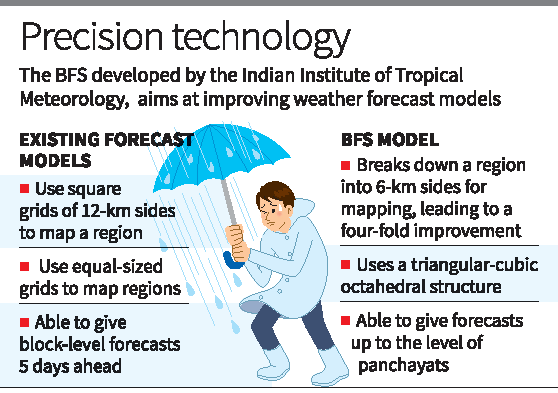
Context: The India Meteorological Department (IMD) has adopted the Bharat Forecast System (BFS) to provide more precise, short- and medium-term rainfall forecasts, down to the panchayat level.
Key Highlights of the News:
About Bharat Forecast System (BFS):
- Developed by the Indian Institute of Tropical Meteorology (IITM).
- Tested since 2002, now officially operational under IMD.
- Offers enhanced forecast accuracy with a three- to seven-day lead time.
- BFS does not significantly enhance long-range forecasts (monthly/seasonal).
Technical Advancements:
- Improved weather model resolution:
- Earlier: 12 km x 12 km grid
- Now: 6 km x 6 km grid → 4x finer detail
- India is now the only country offering operational forecasts at this fine resolution.
Localised Forecasting:
- Earlier: Forecasts at block level (5 days ahead).
- Now: Forecasts are possible at the panchayat level (a few villages grouped).
New Grid Structure:
- BFS uses a triangular-cubic octahedral grid, which:
- Generates more dense grids over tropical regions.
- Provides better resolution in weather-volatile areas like India.
Limitations and Future Plans:
- BFS won’t significantly improve sudden/severe thunderstorm prediction.
- To address that, 34 Doppler Weather Radars will be installed over the coming year.
Conclusion:
The Bharat Forecast System marks a major leap in weather prediction capabilities for India, promising sharper and hyper-local rainfall alerts, critical for agriculture, disaster preparedness, and rural planning, especially in the context of increasingly unpredictable weather patterns.Top of Form
AI-powered satellites are ushering in a new era of space autonomy
Context and Background
- Since Sputnik (1957), satellites have largely remained passive tools for communication, observation, GPS, etc.
- AI is now enabling satellites to act autonomously, marking a dramatic shift in the space landscape.
Understanding Autonomous Satellites
- Enabled by AI and edge computing, satellites now:
- Analyze their environment in real-time.
- Make independent decisions without Earth-based commands.
- Compared to self-driving cars, these satellites use onboard AI systems to function independently in orbit.
Key Applications of AI-Powered Satellites
- Autonomous Maneuvers – for docking, inspections, refueling, debris removal.
- Self-diagnosis & Repair – identifying and fixing faults independently.
- Intelligent Route Planning – to optimize fuel and avoid hazards.
- Geospatial Intelligence – detecting natural disasters, monitoring in real-time.
- Combat Support – identifying threats, possible autonomous engagement in defense.
Emerging Risks and Legal Dilemmas
- AI Hallucination Risk: Misidentifying harmless objects (e.g., a commercial satellite) as hostile, triggering unintended responses.
- Potential for diplomatic conflict due to AI misjudgments or evasive actions.
- Multinational nature of satellites (built, launched, operated by different states) complicates accountability and liability.
Legal and Policy Challenges
- Existing treaties (e.g., Outer Space Treaty, 1967; Liability Convention, 1972) assume human control:
- OST Article VI: Assigns state responsibility.
- OST Article VII: Addresses liability for damage.
- AI autonomy blurs fault attribution:
- Is the developer, operator, launching state, or the AI itself liable?
- Existing laws are ill-equipped to handle AI-generated actions.
Geopolitical and Ethical Risks
- Dual-use technology (civilian + military) increases misinterpretation risk.
- Raises fears of AI-driven space weaponization and unintended escalation.
- Ethical data governance and privacy concerns due to AI’s massive data handling.
Proposed Solutions
Legal Innovations:
- Categorize satellite autonomy levels, akin to driverless car standards.
- Introduce “meaningful human control” in space activities.
- Develop global certification/testing for satellite AI behavior (e.g., stress testing, black-box recording).
- Use models from aviation & maritime law:
- E.g., HNS Convention (1996) and Montreal Convention (1999) for pooled liability and compensation.
Institutional Framework:
- Engage bodies like:
- UN Committee on Peaceful Uses of Outer Space (COPUOS)
- International Standards Organisation (ISO)
- Group of Governmental Experts on Lethal Autonomous Weapons Systems
Conclusion: A New Era of Shared Responsibility
- By 2030, thousands of autonomous satellites may operate in low Earth orbit.
- The challenge is to build a coherent legal architecture that matches technological progress.
- Emphasis on international cooperation, regulatory foresight, and ethical responsibility to prevent instability and conflict in space.
Iran Rejects Halting Uranium Enrichment Amid U.S. Nuclear Talks
Context
- Ongoing nuclear talks between Iran and the United States are being held, mediated by Oman.
- Talks are the highest-level contact since the U.S. exited the 2015 Iran Nuclear Deal (JCPOA) under President Donald Trump.
Key Points
- Iran has ruled out suspending uranium enrichment, which is a non-negotiable red line for Tehran.
- The U.S. demands zero enrichment, even rejecting the allowance of “1% enrichment” – according to Trump’s envoy Steve Witkoff.
- Iran insists on its right to a civilian nuclear program, which it says is guaranteed under the Nuclear Non-Proliferation Treaty (NPT).
About Uranium Enrichment
- Enriched uranium is required for civilian nuclear energy, but high-level enrichment can also be used for nuclear weapons.
- Iran says its enrichment is for peaceful energy needs.
- Western nations and Israel accuse Iran of secretly developing nuclear weapons — a charge Iran denies.
Summary Table:
| Aspect | Iran Position | U.S. Position |
| Uranium Enrichment | Non-negotiable, peaceful purposes | Zero enrichment even at minimal levels |
| Nuclear Weapon Accusation | Strongly denies weapon development | Suspects Iran of weapon intent |
| Legal Stand | Cites rights under NPT | Wants stricter controls beyond NPT |
| Mediation | Supported via Oman | Participating via envoy Steve Witkoff |
| Progress in Talks | “Complicated and unresolved” | “Very, very good” (Trump’s statement) |
Anaemia as a preconception issue, not just during pregnancy
Key Facts and Figures
| Indicator | Data / Statement |
| Anaemia prevalence among Indian women | Over 57% of reproductive-age women are anaemic |
| Vitamin B12 deficiency | Affects ~49% of women of reproductive age |
| Maternal Mortality Ratio (MMR) | 93 per 1,00,000 live births in India |
| The main cause of anaemia | Iron Deficiency Anaemia (IDA) – but B12 deficiency and thyroid disorders are also key |
| Common IFA side effects | Nausea, constipation, diarrhoea, poor absorption |
| Alternative treatment | IV Ferric Carboxymaltose (IV FCM) – fast-acting and not affected by Hepcidin |
Debate:
- Anaemia is a preconception issue
- Many women conceive while already anaemic, weakening pregnancy outcomes.
- Symptoms (fatigue, dizziness) are often dismissed or ignored.
- Leads to risks like preterm birth, low birth weight, pre-eclampsia, and post-partum hemorrhage.
- Oral IFA alone is insufficient
- Limited efficacy due to low adherence and absorption.
- Better suited for mild cases; ineffective for restoring iron in severely anaemic women during a short pregnancy span.
- Shift to preconception care
- Screening before pregnancy for:
- Anaemia (including B12-related)
- Thyroid disorders
- Gestational diabetes risks
- Use of IV FCM + injectable B12 + folate for faster recovery.
- Screening before pregnancy for:
- Community and health worker role
- ASHAs and Anganwadi workers must promote preconception check-ups.
- Integrate preconception awareness into existing maternal-child health programs.
- Policy and societal commitment required
- Making preconception care as routine as antenatal care is essential.
- It’s not just a medical but a societal responsibility to ensure women enter pregnancy healthy.
Actionable Interventions Suggested
| Area of Focus | Recommendations |
| Iron supplementation | Use IV Ferric Carboxymaltose (FCM) over oral IFA in moderate-severe cases |
| Vitamin & micronutrient care | Combine injectable B12 and folate with iron therapy |
| Screening tools | Check thyroid function, B12 levels, and glucose levels pre-pregnancy |
| Community involvement | Train ASHA & Anganwadi workers for preconception counselling |
| Policy direction | Include preconception screening in national maternal health strategies |
Systemic preparedness and interdisciplinary response to extreme heat
Key Points & Facts
| Category | Key Information |
| Climate-health conference | India 2047: Building a Climate-Resilient Future |
| Health threats from heat | Dehydration, heatstroke, worsening of chronic diseases |
| Systemic problem | The health system is reactive, not preventive |
| Primary care role | Frontline workers (ASHA, PHC staff) can be trained as heat-safety champions |
| Proven city model | Ahmedabad’s heat action plan has shown life-saving results |
| At-risk groups | Elderly, chronic patients, outdoor workers, and low-income communities |
| Heat-related illness issues | Often undetected or misdiagnosed in clinical settings |
Main Themes & Solutions Proposed
1. Proactive & Preventive Health System
- Move from crisis response (IV fluids, emergency care) to early intervention.
- Train ASHAs and PHC staff to detect heat stress, issue alerts, and conduct door-to-door outreach.
- Integrate meteorological early warnings with public health response.
2. Clinical Readiness
- Create standard clinical protocols for the diagnosis and treatment of heat illnesses.
- Conduct summer readiness drills in hospitals.
- Set up “heat corners” and pre-stock cooling supplies.
- Provide follow-up care for heat-affected patients.
3. Multisectoral Collaboration
- Urban planning: Cool roofs, heat-shielded public spaces, and shelter design.
- Labour reforms: Regulate outdoor work, hydration breaks, and shaded rest areas.
- Water supply: Reliable availability during peak heat months.
- Use climate data to drive public health planning.
4. Equity-Centred Approach
- Heat is a “social injustice multiplier” — it hits the most vulnerable hardest:
- Pavement vendors, informal workers, children in poor schools, elderly in slums.
- Mapping vulnerability (social + geographic) is key.
- Deploy mobile hydration stations, early morning health checks, and cool shelters.
- Protect rights and health of informal sector workers and homeless populations.
Actionable Interventions Suggested
| Sector | Intervention |
| Public Health | Heat illness training, early alerts, mobile hydration, summer drills |
| Urban Development | Cool roofing, ventilation, shaded spaces, misting zones in slums |
| Meteorology | Integrated heat alerts tied to health networks and local governance |
| Labour Policy | Heat-safe work hours, hydration breaks, and workers’ shelters |
| Community Outreach | Use WhatsApp, ASHAs, Anganwadi workers for last-mile awareness |
‘Sugar Boards’ Necessary in Schools?
Key Facts and Highlights
| Aspect | Details |
| Initiative | CBSE directed 24,000+ affiliated schools to set up ‘sugar boards’ to educate children on sugar intake risks. |
| Purpose | Visual awareness of sugar content in packaged drinks/foods, recommended sugar intake, and health risks. |
| Concept Originator | Food influencer Revant Himatsingka started the campaign via social media outreach. |
| Example from the activity | A 300 ml aerated drink = 8 teaspoons of sugar (~32g); 125 ml mango drink = 5 teaspoons (~20g). |
| Reporting Deadline | Schools can submit activity reports and photographs to CBSE till July 15. |
Why Necessary?
| Concern | Details |
| Type-2 Diabetes in Children | Increasing incidence — 397 cases per lakh (India), 2nd only to China (734/lakh). |
| WHO Limit for Sugar Intake | ≤25 grams/day (≈6 teaspoons); Indian children aged 11–18 consume ~15% of daily calories from sugar. |
| NCPCR’s Role | Urged sugar boards for all schools (not just CBSE); called excess sugar a “child rights issue”. |
| Genetic Risk | Indians are more prone to heart disease due to genetic predisposition, which calls for stricter dietary cut-offs. |
FSSAI and Regulatory Gaps
| Regulation Area | Current Status |
| HFSS Definition (High Fat, Salt, Sugar) | Not finalised. FSSAI held meetings in April-May 2024; still under discussion. |
| Labelling Standards | No final health-star rating system for front-of-pack labels yet. Existing rules apply only to food claims. |
| Current Reliance | India follows WHO guidelines due to a lack of indigenous epidemiological data. |
| Example Regulation | A food item can be labelled “low sugar” only if ≤5g of sugar per 100g. |
Maldives Reaffirms Support to India on Counterterrorism
Key Points
| Topic | Details |
| Occasion | High-Level Core Group (HLCG) Meeting between India and the Maldives |
| Maldivian Leader Present | Foreign Minister Dr. Abdulla Khaleel |
| Terror Incident Referred | Pahalgam terror attack (April 2025) – 26 killed, many injured |
| Message of Support | The Maldives extended “firm support” to India’s fight against terrorism in all its forms |
| Indian Representative | External Affairs Minister S. Jaishankar |
| Other Key Topic | The Maldives appreciated India’s emergency financial assistance grant |
One-Liner Takeaways
- The Maldives condemned the Pahalgam terror attack and pledged support to India against terrorism.
- The reaffirmation came during the India-Maldives HLCG meeting in New Delhi.
- Bilateral cooperation also included appreciation for India’s financial aid to the Maldives.
India-U.S. Diplomatic Outreach Amid Strained Ties
Key Points
| Topic | Details |
| Indian Officials Visiting U.S. | Foreign Secretary Vikram Misri and Deputy NSA Pavan Kapoor |
| Context of Strain | U.S. President Donald Trump’s controversial remark on mediating the India-Pakistan ceasefire |
| India’s Stand | EAM S. Jaishankar rejected mediation claim; said ceasefire was achieved through direct India-Pakistan talks |
| Purpose of Visit | Reaffirm India’s stand on terrorism from Pakistan, address issues from Operation Sindoor, and push bilateral ties forward |
| US Diplomatic Vacancies | Key posts in the State Department, Defence, and the Ambassadorship to India remain unfilled since January |
| India’s Concern | Lack of U.S. point persons seen as causing communication gaps in Indo-U.S. ties |
| Follow-up Agenda | Visit is a follow-up to PM Modi’s U.S. visit in Feb 2025 and launch of India-U.S. COMPACT (Catalysing Opportunities for Military Partnership, Accelerated Commerce & Technology) |
| Upcoming Delegation Visit | A 9-member parliamentary delegation to visit Washington from June 3–6 |