
Rig Vedic Period (c. 1500 – 1000 BCE) forms the foundation of Vedic Civilization in ancient India. Primarily reconstructed from the hymns of the Rigveda, this era chronicles the lives of the Indo-Aryan tribes as they settled in the Sapta-Sindhu region. Learn about their kinship-based tribal polity, which was governed by assemblies like the Sabha…
Rig Vedic Period (c. 1500 – 1000 BCE)
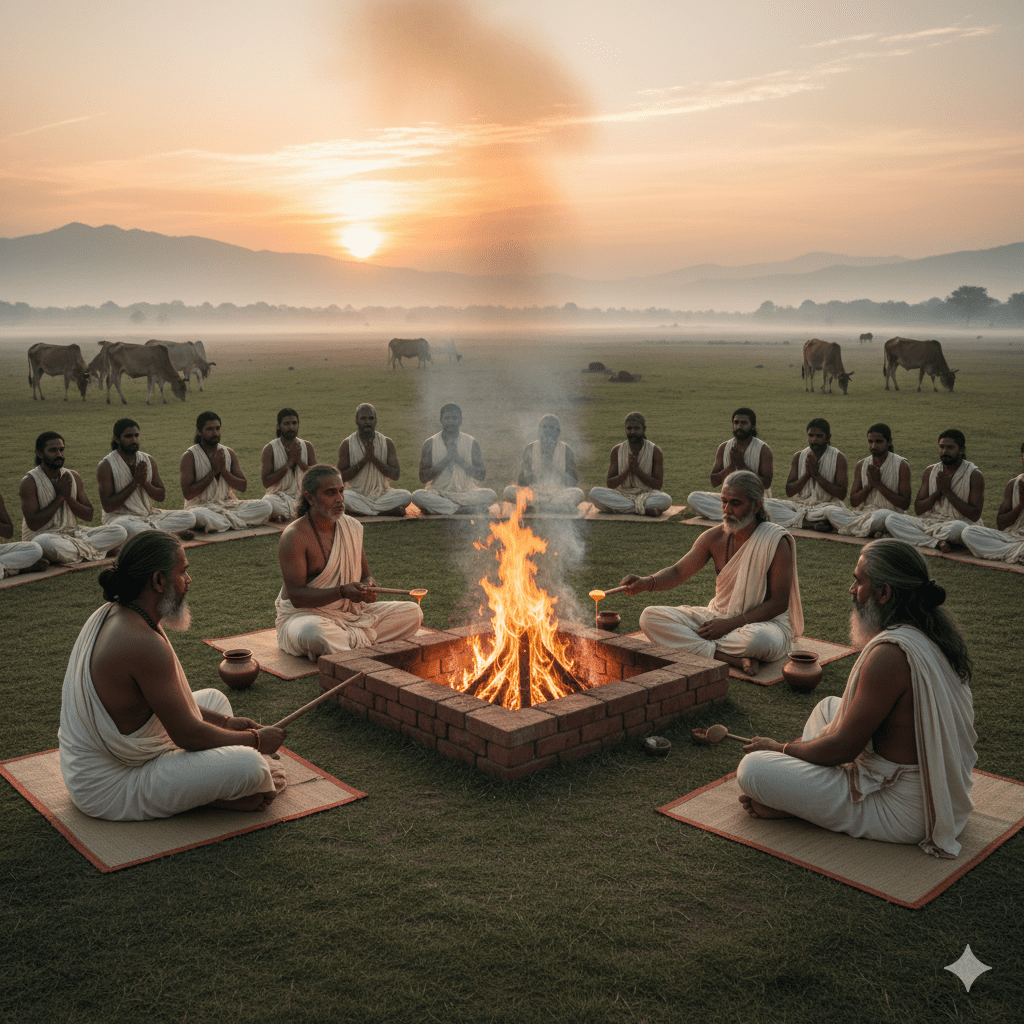
The Rig Vedic Period, constituting the foundational phase of the Vedic Civilization, represents a crucial epoch in ancient Indian history. Spanning approximately 1500 BCE to 1000 BCE, this era is characterized by the migration and settlement of the Indo-Aryan tribes, known as the Vedic people, into the fertile plains of the Sapta-Sindhu region (comprising modern Punjab and its surrounding areas). The entire understanding of this civilization rests heavily on the Rigveda, the world’s oldest surviving sacred text, which paints a vivid picture of a pastoral, decentralized, and nature-worshipping society.
Also Read: Pre Historic Times
Sources for Reconstructing Vedic Society and Culture
Reconstructing the life, polity, and belief system of the Early Vedic people relies on a careful synthesis of literary and archaeological evidence.
1. Literary Sources: The Rigveda Samhita
The Rigveda (literally, “Veda of Praise/Verse”) is the paramount source. It is the earliest layer of the four Vedas and offers unparalleled insights into the society.
- Structure: It is a collection of 1,028 hymns (suktas) divided into ten books (mandalas). Mandalas II through VII are considered the oldest and collectively known as the “Family Books,” detailing tribal history and core rituals. Mandala I and X are later additions, with Mandala X containing the famous Purusha Sukta, which first explicitly mentions the four-fold varna division.
- Content: The hymns are primarily invocations to deities (devas) like Indra, Agni, and Varuna. They provide rich details about their daily life, political struggles (including the Battle of Ten Kings), social norms, and economic practices centered on the cattle (SEO Keyword: Rigveda, Vedic Literature, Indo-Aryan).
- Language: The language used is an archaic form of Sanskrit known as Vedic Sanskrit, which is highly inflectional and complex.
2. Archaeological Evidence
While the Rig Vedic people did not leave behind monumental structures like the Harappans, archaeology provides important context:
- Geographical Correlation: The geography described in the Rigveda corresponds roughly to the area of the late Harappan Civilization and the subsequent Painted Grey Ware (PGW) culture. However, direct cultural links are debated.
- Iron Age Transition: The transition into the later period is marked by the presence of iron (Krishna-Ayas or black metal), which became prominent only in the subsequent Later Vedic period (c. 1000 BCE onwards). The Rigvedic people primarily used copper/bronze (Ayas).
- Cemetery H Culture: Located in the Punjab region, some aspects of this post-Harappan culture are sometimes associated with the periphery of the early Indo-Aryan migration routes.
Also Read: Indus Valley Civilization
Geography of the Rig Vedic Period – Area of Settlement
The core territory of the Rig Vedic tribes was the Sapta-Sindhu region, stretching from eastern Afghanistan to the upper Ganga-Yamuna Doab.
| Rig Vedic Name | Modern Identity | Geographical Significance |
| Sindhu | Indus River | The most frequently mentioned river, the economic lifeline of the region. |
| Sarasvati | Ghaggar-Hakra system/A mythical river | Highly revered and considered the holiest river (Naditama – the best of mothers). |
| Parushni | Ravi River | Site of the decisive Battle of Ten Kings (Dasarajna war). |
| Shutudri | Sutlej River | Marked the eastern boundaries of early settlements. |
| Kubha | Kabul River (Afghanistan) | Indicates the western geographical extent of the early Indo-Aryan movements. |
The settlements were largely in the nature of fortified villages (gramas), reflecting the semi-nomadic, pastoral nature of the tribes, who moved seasonally in search of fresh pastures for their cattle.
Political Organisation and Evolution of Monarchy
The political organization was fundamentally tribal (kinship-based) and decentralized. Power resided in the tribe (Jana) rather than a fixed territory (Janapada), which developed later.
1. The Tribal Chief (Rajan) and Administration
- Rajan (Chief): The Rajan (king or chief) was primarily the Gopa Janasya (protector of the tribe). His role was almost exclusively military—leading the tribe in cattle raids (Gavishti) and defending against rival tribes or the indigenous Dasyus.
- No Standing Army: The Rajan did not maintain a professional, standing army. The tribal militia (Sena) was composed of the entire male population ready for battle.
- Absence of Taxes: Revenue collection in the form of regular taxes was unknown. The chief received voluntary offerings (Bali) from his people, which he was expected to redistribute.
2. Checks on the Rajan’s Power (Assemblies)
The Rajan’s power was effectively limited by popular assemblies:
- Sabha: A smaller council of elders or nobles, acting as an advisory and judicial body.
- Samiti: A larger assembly of the entire tribe (Jana), which exercised supreme political authority. It was essential for the election or re-election of the Rajan and discussions on important matters of war and peace.
- Vidatha: The oldest and most important tribal assembly, dealing with ritual, religious, and economic matters.
The absence of permanent bureaucracy and hereditary kingship highlights the non-monarchical, democratic character of early Vedic polity.
Social Organization
Rig Vedic society was relatively egalitarian and kinship-based, marked by mobility and less rigidity than the subsequent periods.
1. Family and Kinship
- Kula (Family): The basic social unit was the extended, patriarchal joint family, headed by the Kulapa (father).
- Gotra: The term Gotra (meaning cow-pen in its early sense) came to denote the system of lineage and exogamy (marrying outside one’s Gotra).
- Diet: The diet included barley, milk products (ghee, curds), and sometimes the meat of animals sacrificed, especially the goat or sheep. The cow was generally deemed Aghanya (not to be killed).
2. Varna System and Social Stratification
Social division existed but was occupational and flexible:
- Varna: The initial division was mainly between the fair-skinned Aryans and the darker-skinned, non-sacrificing Dasyus or Dasas.
- Fluidity: The four varna (Brahmana, Kshatriya, Vaishya, Shudra) were mentioned only late in the Rigveda (Mandala X, Purusha Sukta), indicating that the system was in its nascent stage and still based on merit and occupation, not rigid heredity. A famous hymn states, “I am a poet, my father is a physician, and my mother is a grinder of corn. With different objects in view, we engage in our respective occupations.”
3. Position of Women
Women enjoyed substantial respect and freedom:
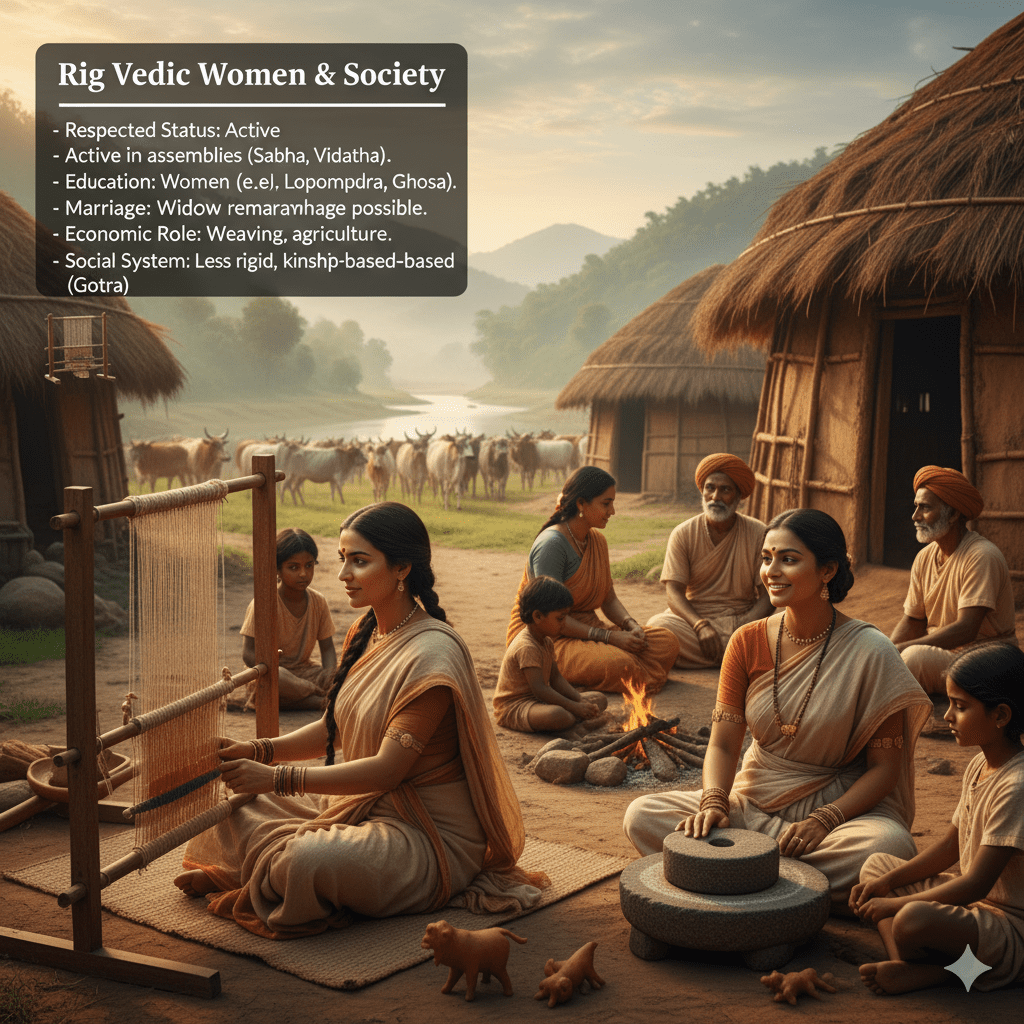
- Public Life: They actively participated in assemblies (Vidatha) and tribal gatherings.
- Education and Marriage: They were educated, and there were several examples of female seers (e.g., Apala, Ghosa, Visvavara). Monogamy was common, though polygyny was known among the chiefs. Marriage was usually post-puberty, and widow remarriage (Niyoga) was permitted.
Economy
The Rig Vedic economy was fundamentally pastoral and semi-nomadic, dictated by the needs of their primary asset: the cattle.
- Pastoralism (The Driving Force): The cow (Gau) was the basic measure of wealth, often referred to as a medium of exchange. Tribal conflicts (Gavishti) were often fought over cattle, not land. Horse-rearing was also essential for mobility and warfare.
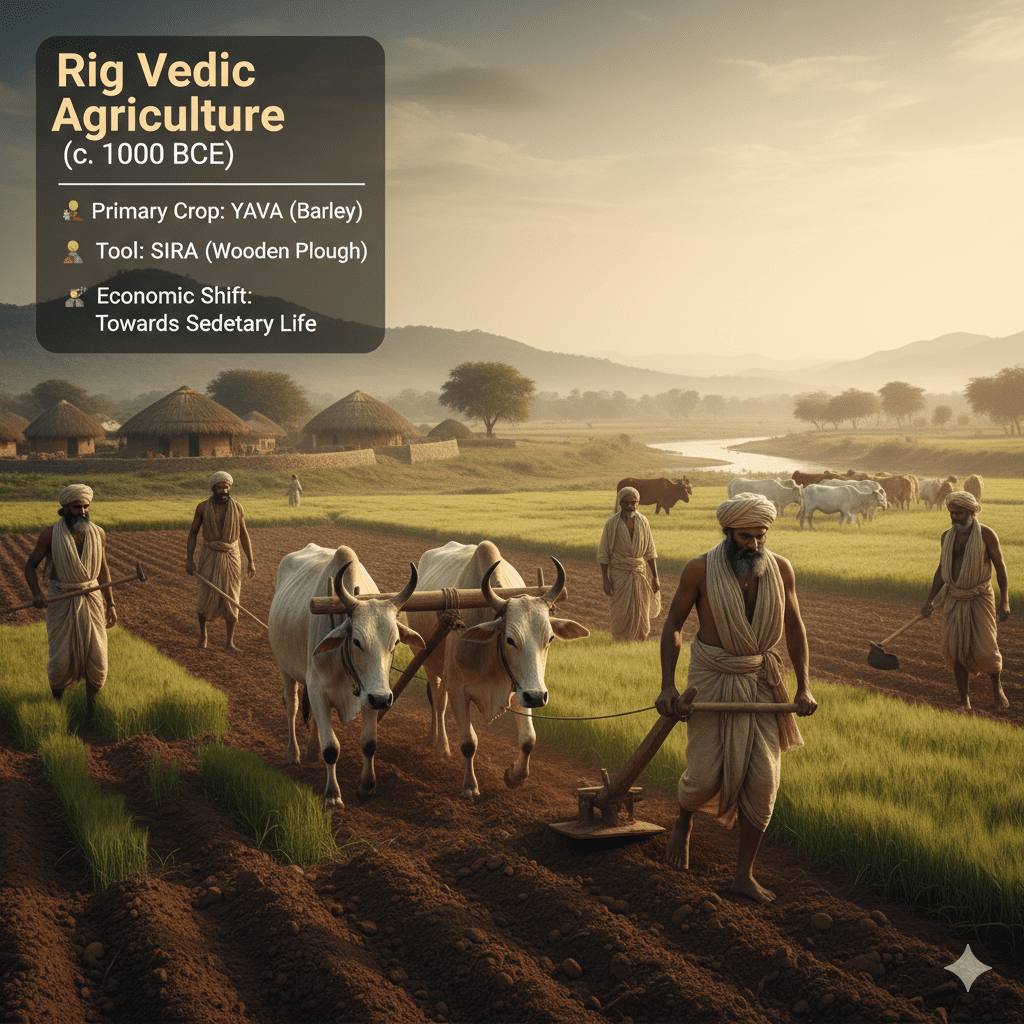
- Agriculture (Secondary): Agriculture was known but secondary. The main crop was Yava (barley). Ploughing was done using the plough (Sira) and oxen. The focus was on sustenance rather than surplus production.
- Trade and Currency: Trade was limited and mostly conducted through the barter system. Gold ornaments, particularly the Nishka (often worn as a necklace), might have served as a rudimentary unit of value, though it was not yet a coined currency.
- Crafts: The main crafts included carpentry (making chariots and implements), metalworking (coppersmiths/bronzesmiths), weaving (by women), and pottery (simple red-ware).
| Vedic Term | Meaning | Economic Significance |
| Gau | Cow | Primary measure of wealth and value. |
| Gavishti | Search for cows | Term for conflict/warfare. |
| Yava | Barley | The principal agricultural produce. |
| Nishka | Gold Ornament | Used as a unit of exchange/wealth. |
| Ayas | Copper/Bronze | The metal primarily used by the Rig Vedic people. |
Religious Practices and Culture
The religion was an uncomplicated form of Polytheistic Nature Worship, involving propitiation and praise through hymns.
1. The Pantheon and Cosmic Order (Rita)
The gods were categorized into three realms—Celestial, Atmospheric, and Terrestrial—with no supreme being reigning over all:
- Indra: The most popular god (Purandara – breaker of forts), ruling the atmosphere and associated with rain and war. About 250 hymns are dedicated to him.
- Agni (Fire): The second most important god, acting as the intermediary between gods and humans. About 200 hymns are dedicated to him.
- Varuna: The celestial god, the upholder of Rita (the cosmic and moral order).
- Soma: A plant/intoxicating drink and the god associated with it.
Note: The concept of Rita was fundamental, representing the eternal law that governs the universe and morality, differentiating their worldview from later, complex ritualistic phases.
2. Mode of Worship
- Sacrifice (Yajna): The core of the religious practice involved the Yajna (fire sacrifice), which was simple and domestic. Offerings were primarily milk, ghee, grain, and Soma.
- Priests: The Brahmanas (priests) were beginning to emerge, overseeing the proper conduct of the sacrifices, but the rituals were not overly complicated or restrictive.
- Lack of Idolatry: The religion did not feature temples or image worship. The offerings were made directly into the sacrificial fire (Agni). The focus was on securing practical benefits (Dharma)—such as good health, victory, and progeny—rather than philosophical liberation (Moksha).